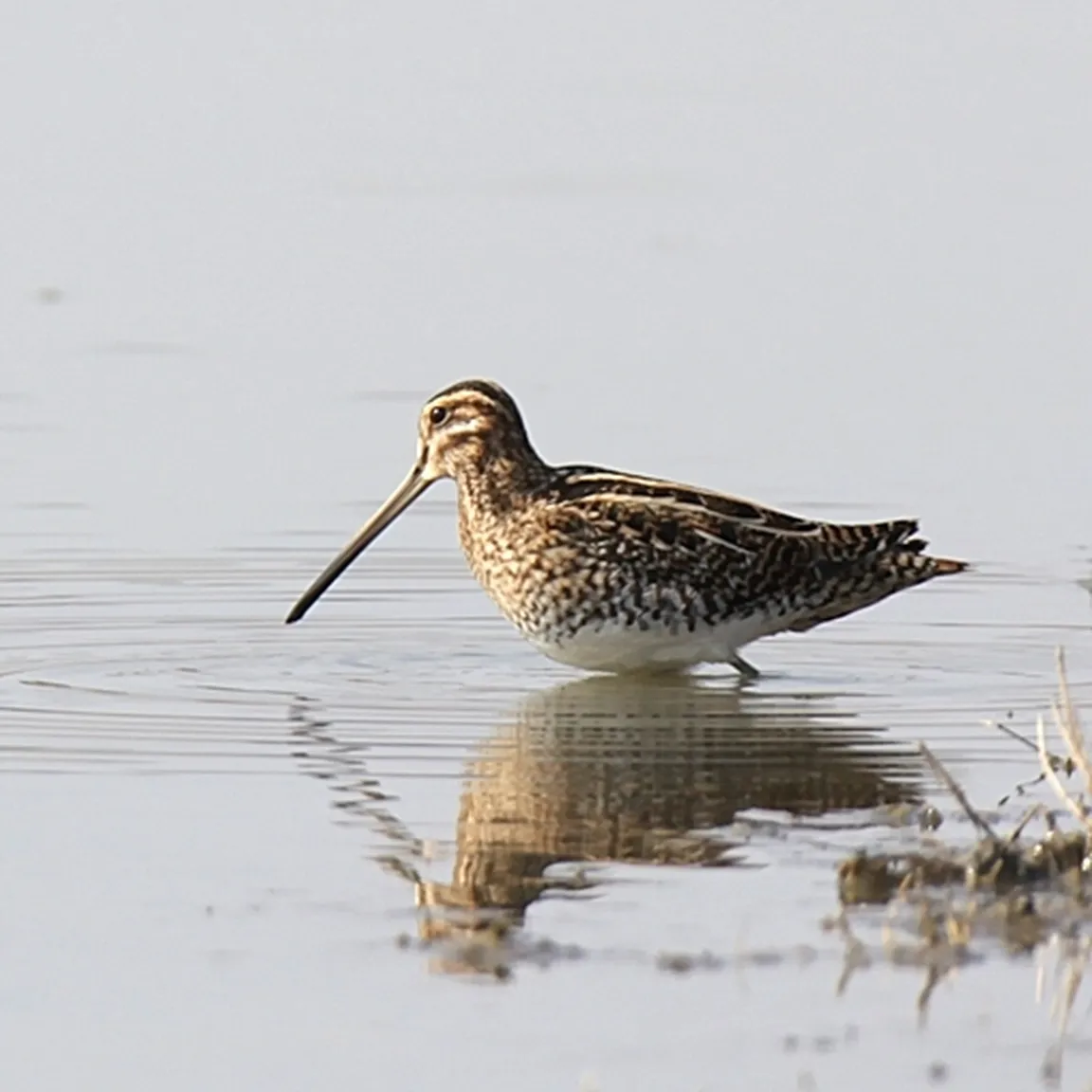
The snipe (Gallinago gallinago) belongs to the smaller shorebirds, as together with its bill, which is about 7 cm long, it measures 23 to 28 cm. Its wingspan is between 39 and 45 cm. The snipe prefers to hide among tussocks of sedges or grasses, rather than exposing itself, but when we, while foraging on the muddy bank or during spring singing at a reed bed or a similar singing site, do reveal it, we will easily recognize it. It is betrayed by a disproportionately long straight bill, a hunched posture of a stocky body, relatively short legs, and its characteristic striped body and head. Along its brown-streaked back run decorative markings, along the head it has bands of light and dark brown. Its sides, chest and throat are brown-speckled, and the belly is white. Of course its protective coloration makes it easier for it to hide among clumps of vegetation. It relies on it so much that we must approach it to 10 to 15 m before it escapes in a zigzag flight, often taking off literally from under our feet. In doing so it can alarm us with a loud cry, "ka-ač!", which sounds as if someone is sneezing. The snipe is active at dusk, at dawn and after sunset. It is known for its nuptial display within its breeding grounds. In spring evenings and nights it flies in large circles, and in between with a tail fanned out it plunges toward the ground. At that time the outer tail feathers emit a vibrating sound, reminiscent of a goat bleating.
The snipe is a migratory bird that nests on wetlands, bogs and damp meadows from April to August. It builds its nest on a raised place to prevent it from being reached by water, and it hides it well among tussocks of sedges or grasses. In autumn it flies south, where it overwinters. Even in winter it is tied to similar habitats. Often you can observe it by lakes, rivers and water ditches as it searches for food by poking its long bill into the muddy bank. The snipe usually feeds in small groups; larger flocks form only during migration and in winter. It mainly feeds on insects, but also on earthworms, small crustaceans and slugs and spiders, occasionally also plant-based foods. Here and there it swallows a tiny pebble, which helps it grind food in its stomach.
The snipe, which in Slovenia is treated as a critically endangered breeder, is most affected by changes to its habitat. Its habitat is shrinking due to the drying of wetlands and floodplains, regulation of waterways, changes in meadows with excessive fertilization, and the encroachment of meadows by woody species, a consequence of abandoning mowing.