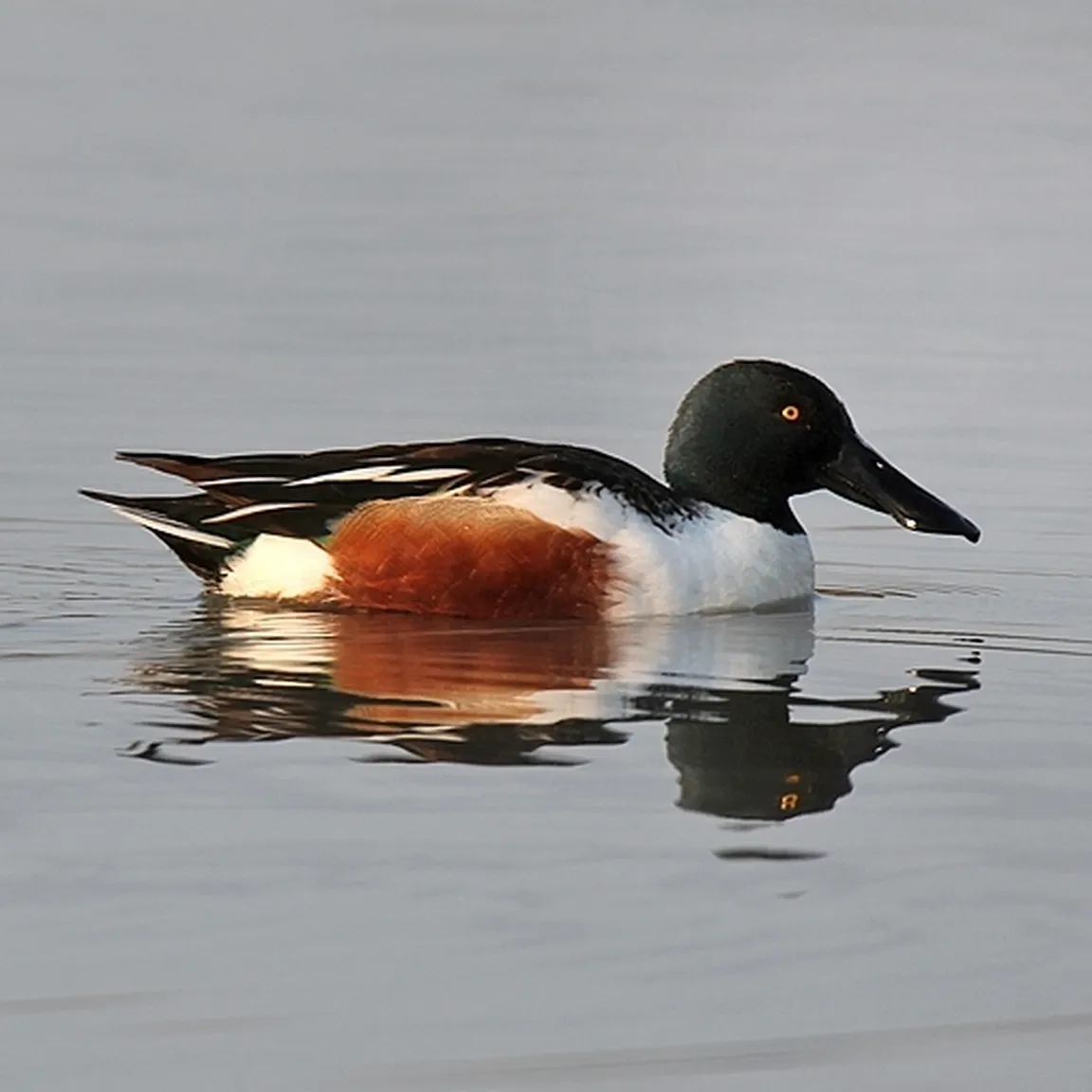
The shovelers (Anas clypeata), with a length of 44 to 52 cm and a wingspan of 73 to 82 cm, are medium-sized ducks. It has a short neck and an unusually long and broad bill, which gave rise to its name and gives this species such a distinctive appearance. The male shoveler has a dark green head that shines metallic in the sun and from a distance looks black. It has a black tail and a black-and-white back, its completely white chest sharply transitions to a brown belly. Because of its distinctive coloration, it cannot be mistaken for any other duck. The female, with her protective coloration that she mainly uses during the breeding season to hide from predators, is the complete opposite of the colorful male. Among females of other duck species she is easily distinguished by her large bill. Shovelers are active by day and usually stay in pairs or small groups; only during foraging and stops on the migratory route do they join larger flocks. It feeds mainly on aquatic invertebrates, for example larvae and adults of insects, with planktonic crustaceans, copepods, and mollusks. It also preys on small vertebrates, such as tadpoles, and its diet is supplemented with plant shoots and seeds.
The shoveler is a migrant that returns to breeding areas in spring. Individual pairs or small, slightly numerous groups nest from April to June on shallow inland (freshwater) lakes and wetlands surrounded by dense reedbeds or similar plant communities. It very much enjoys waters with lush aquatic vegetation, which host rich assemblages of invertebrates. It nests on the ground, preferably near water, where it is well hidden among clumps of grasses or reeds. In Slovenia it is a rare breeder, listed as a highly endangered species on the Slovenian Red List of Breeding Birds. In autumn it flies to Africa, where it winters. In winter it tends to stay near river mouths in coastal areas.
The shoveler has a very large distribution range (areal) and a large population, but in some areas it is already threatened by habitat change and loss. In addition, it is also a popular game species hunted in North America, Italy and Denmark, especially in Iran.