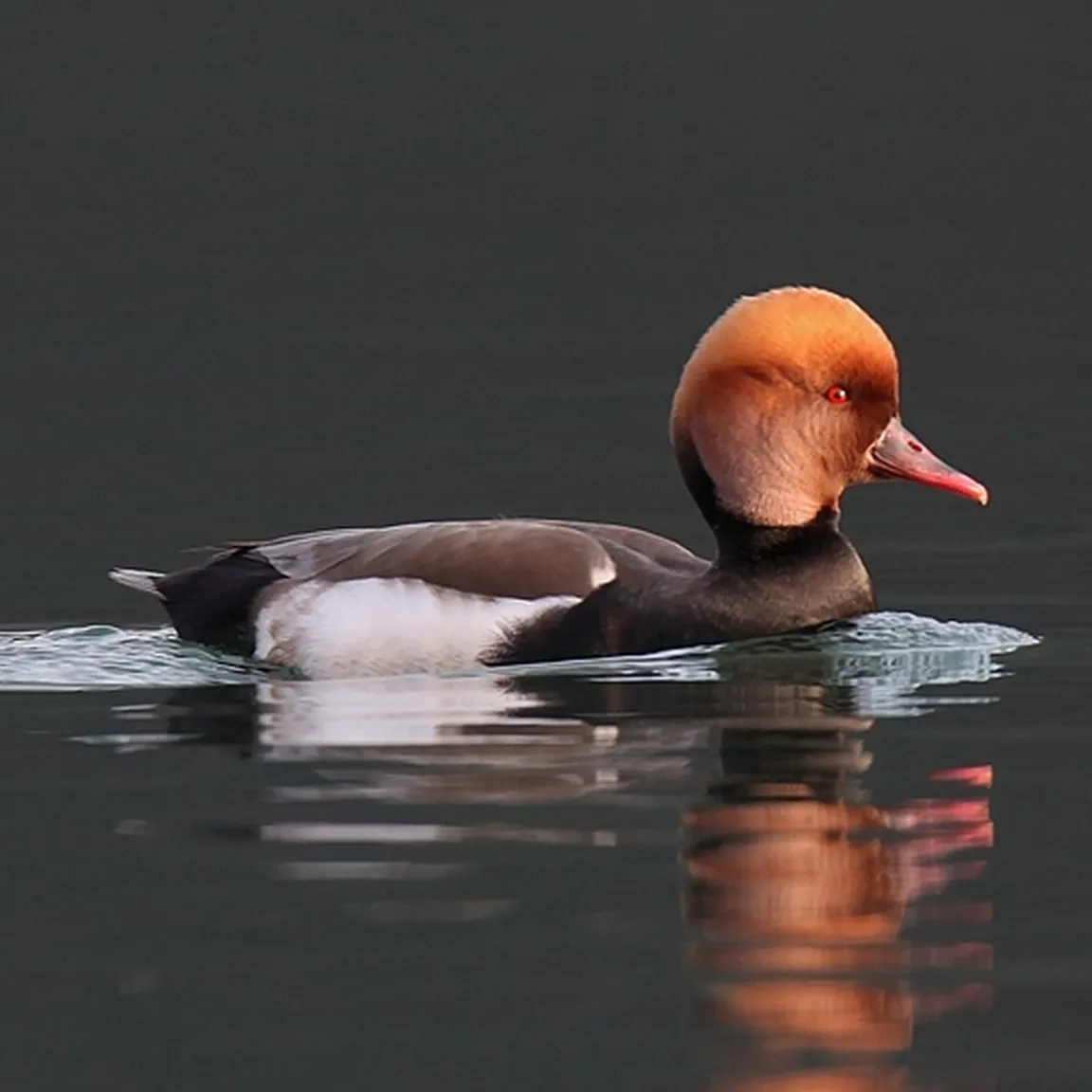
The red-crested pochard (Netta rufina) is a duck the size of a teal. It measures 53 to 57 cm in length, and its wingspan is 84 to 88 cm. The male is of striking colors; his round head is orange, the cheeks cinnamon-brown, and the eye and the bill are blood-red. It has a raven-black neck, chest, belly and tail section, gray-brown wings and dirty white flanks. The female is a true contrast to the strongly colored male. Its body is dark brown with a pattern of lighter cross bands, the face and throat are gray, and the head is black-brown. In front of the tip of the black bill there is a pink ring.
The red-crested pochard is more or less a herbivorous bird. Its diet consists of roots, shoots and seeds of aquatic plants, occasionally supplemented by some aquatic invertebrate or tadpoles. It is active during the day, most lively at sunrise and sunset.
This is a social bird that spends most of the year in small groups, but in winter it joins larger flocks that can number several hundred birds. It nests in May and June. It builds a nest from twigs, roots and leaves and hides it in dense reed vegetation or places it on floating vegetation among thick reeds. It nests on large lowland rivers and lakes overgrown with reeds. In winter it can stay in the nesting area, but it can also move to milder climate regions. During migration and wintering, it can also be found in calm bays along the sea coast and in river deltas.
In our country it is a regular winter visitor, and nesting has not yet been confirmed despite its occasional appearances during the summer months.