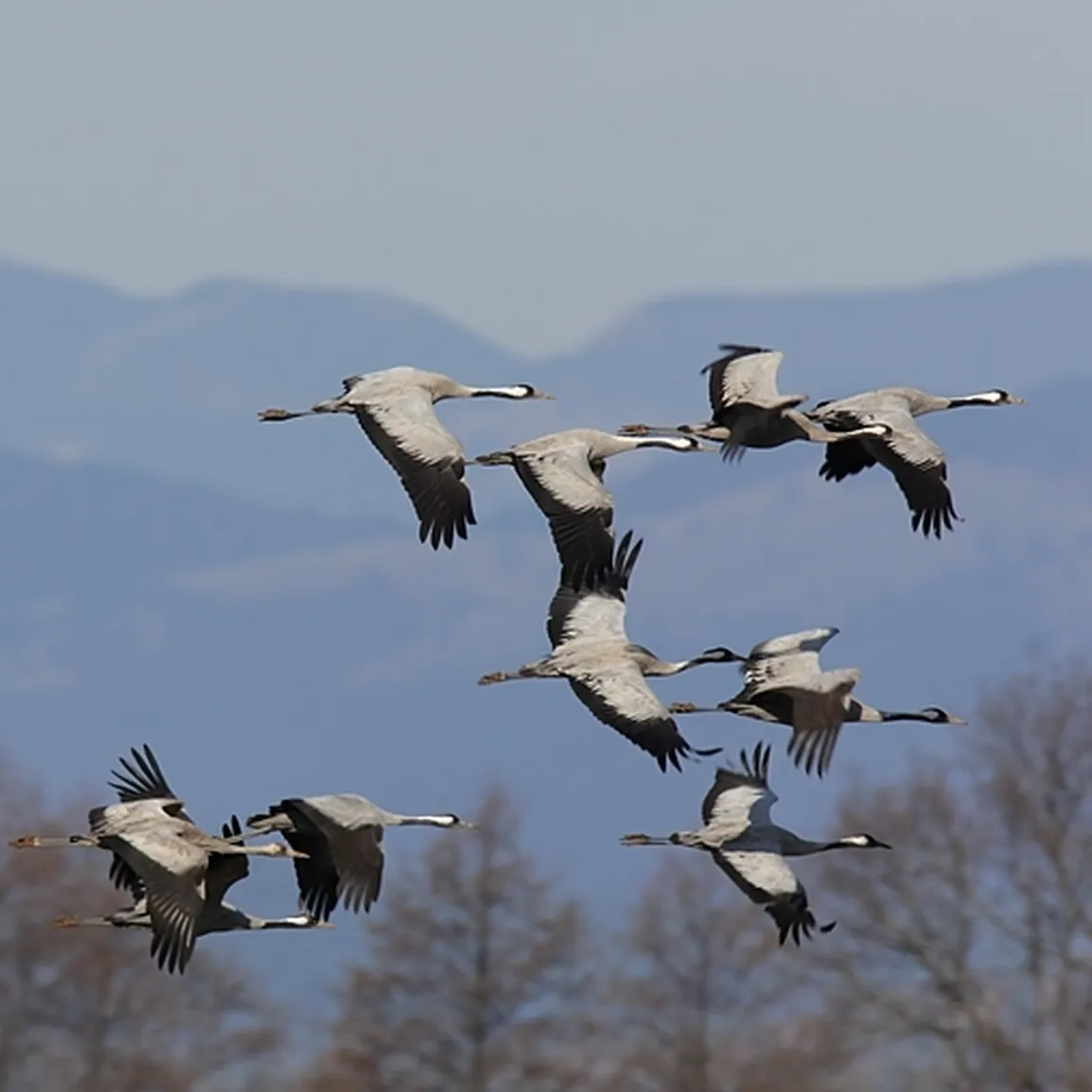
Crane (Grus grus) is a magnificent bird, measuring 96 to 119 cm from the tip of its tail to the tip of its medium-length beak, with a wingspan of 180 to 222 cm. It is, therefore, a large bird with very long legs and a long, slender neck. Its plumage is bluish-gray, and nesting individuals acquire a reddish-brown tinge due to pigments in marsh waters with which they color themselves during incubation. The conical beak is ornamentally colored; the throat and the front part of the neck are black, while the back of the neck is white. On the top of the head the crane has bare red skin. When on the ground, the long black flight feathers give the impression of a fluffy tail, but the tail is actually quite short. The crane flies with an extended neck and legs.
The crane uses daylight daily to search for food. It is an omnivore that feeds on roots, tubers, young shoots, leaves and fruits of plants; among animal foods, its menu includes basically everything it finds—from adult insects and their larvae, earthworms, spiders, and centipedes to amphibians, reptiles, fish, small mammals, eggs and bird chicks. At night, cranes roost in communal sleeping sites, to which they return each night.
In our country you can observe the crane during migration, mainly in spring. It is a pronounced migrant, which migrates across Europe along two established routes and uses the same areas for rest. In warm regions, cranes usually depart in larger groups at the beginning of September. During migration they form flocks in the shape of the letter V, thereby reducing air resistance and energy expenditure on the long journey. To breeding areas they return from wintering grounds in Africa or on the Iberian Peninsula in March, and begin to nest in April or May. A single pair nests on different wetlands and bogs, but for successful nesting it requires large and inaccessible areas. Therefore it most often nests on impenetrable high bogs and marshes surrounded by forest, and along sparsely populated rivers in northern Europe. It builds its nest from marsh vegetation in or right by the water and can use it year after year. Although the crane is a wary bird that is easily startled, it is quite loud. At dawn or on bright nights, the parents at the nest trumpet loudly in duet, thus celebrating the arrival of new life.
Crane populations, both in breeding areas and wintering areas, are most threatened by habitat loss, fragmentation and degradation. Regulations, urbanization and the spread of intensive agricultural areas lead to the concentration of more cranes in smaller areas, which means poorer chances of survival. In some countries along its migratory route it is still hunted; in breeding areas where tourism is developed, disturbances to the adults more often leave the chicks unprotected, making them more vulnerable to predators.