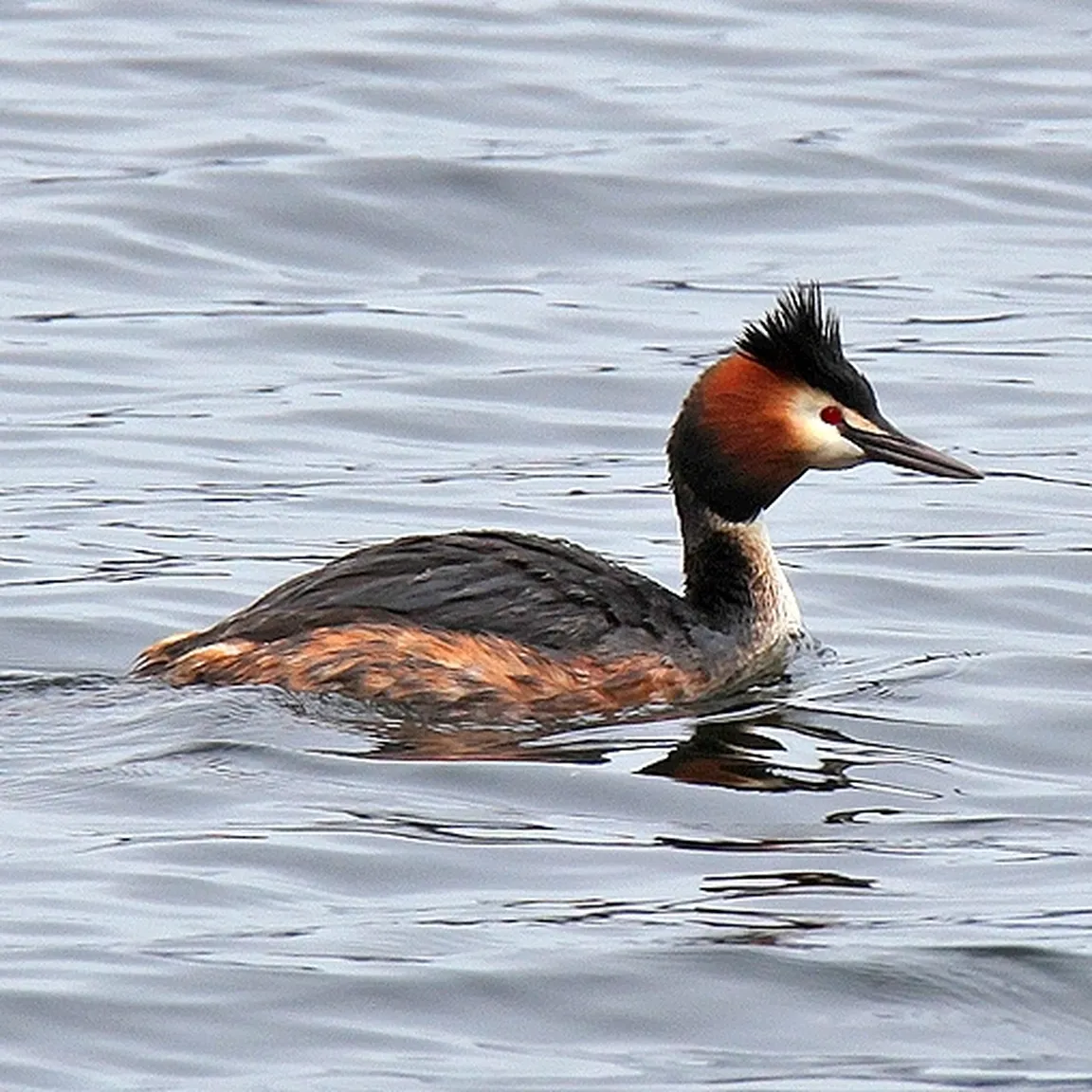
The great crested grebe (Podiceps cristatus) is the largest among grebes that live here. From the tip of the pointed bill to the end of the very short tail it measures 46 to 51 cm, and its wingspan is between 59 and 73 cm. The great crested grebe is a very slender bird with a long, narrow neck. It holds its head upright, only at rest does it fold it back and rest its head on its back. In summer plumage it is unmistakable. On the top of its head it has two black crests that it sweeps back when agitated or frightened. During courtship this crest raises, spreads them, and shakes them vigorously. Under the white cheeks it has large chestnut-brown ear-tufts with a black edge. The front of the neck and belly are snow-white, along the sides it is gray-brown, and its wings are darker, almost black. In winter it is less colorful; the crests and ear-tufts disappear. In winter it resembles the brown-necked grebe, which is more stocky and has a darker neck than the crested one.
The great crested grebe is a migratory bird, but in our country it can be observed year-round. Individuals that nest in Slovenia typically overwinter elsewhere, but in winter crested grebes that nested in northern regions fly to our area. From April to August it nests on shallow bodies of water with lush bank vegetation, mainly reeds. The nest, which may be floating or anchored to the shore, is built from plant material. It is not a shy bird and can often be seen swimming on open water. It overwinters on continental lakes, which generally do not freeze. If that happens anyway, it moves to the sea coast or near it, or to lakes that have not frozen. In winter the great crested grebes keep to themselves, especially when feeding. It feeds on adult fish, crayfish, mollusks and insects, occasionally also on amphibians. During the nesting period the majority of its diet consists of adult insects and their larvae. When the parents go hunting, they carefully cover the nest with vegetation and thereby further hide the eggs from predators.
In Slovenia the great crested grebe is listed on the Red List of threatened breeding birds. It is classified as a vulnerable species, but there is concern that, due to changes in its habitat, it will become more endangered. Also in other countries, environmental changes pose the greatest threat to the survival of this bird.