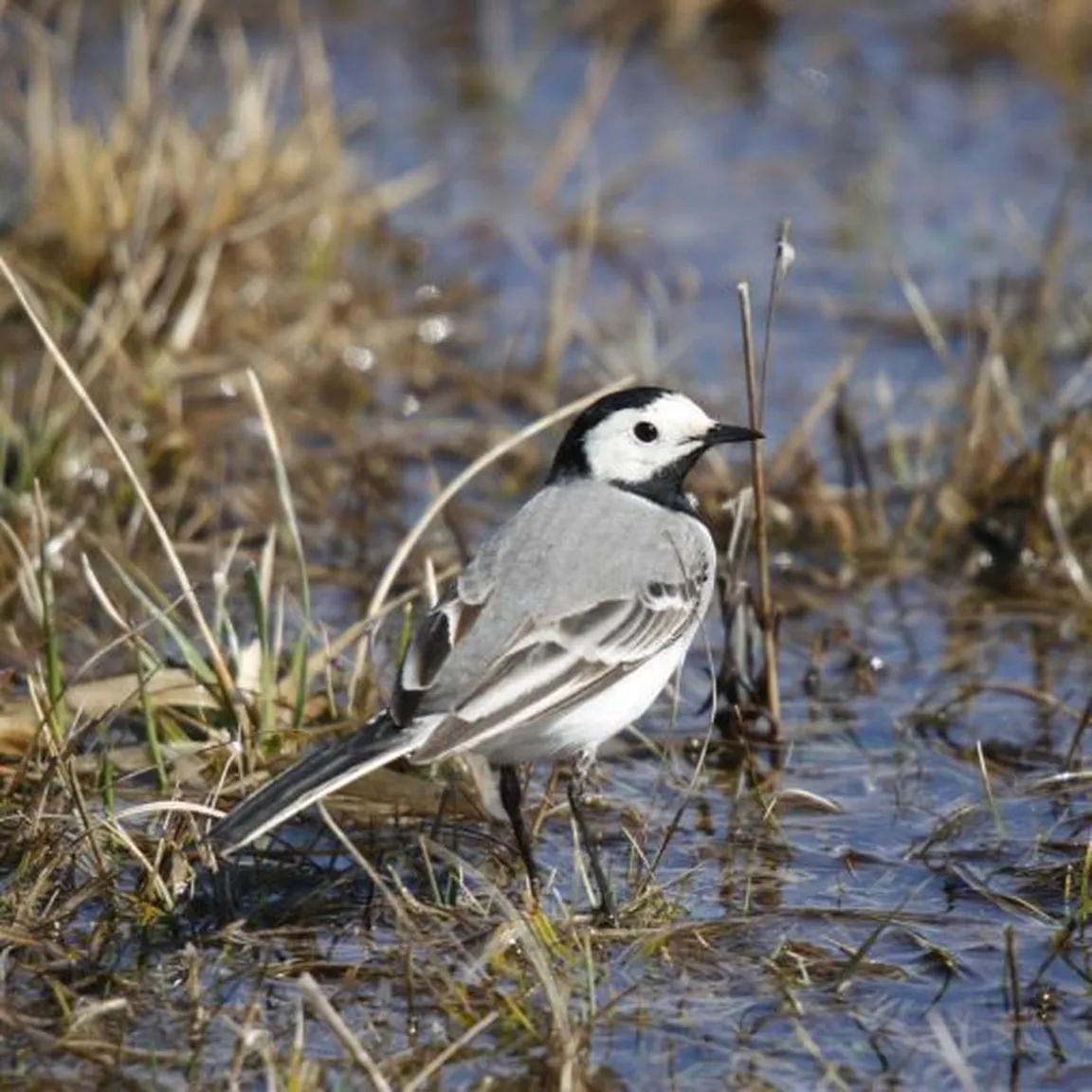
The white wagtail (Motacilla alba) is a slender songbird that we all know. On the ground it constantly rhythmically raises and lowers its long, black-and-white tail and, while walking, it characteristicly tilts its head. Then it darts after an insect and stops even faster, beginning to agitatedly flick its tail. In flight it has a white forehead, shading on the cheeks, and a white belly and the underside of the tail. The crown, nape, slender pointed bill, throat, chest, eye and legs are black, and the back is sooty gray. The feathers on the wings are also black and white. The female is somewhat less contrasted in color, especially the transition between the black crown and her dirty gray back is not as sharp as in the male. In winter both sexes are paler – the black on the head and wings becomes gray, the throat becomes white; only the black bib remains. When stretched, it measures from 16 to 19 cm and is thus only slightly longer than the house sparrow, which is much chunkier and has a shorter tail.
This lively bird is active during the day, foraging for insects on clearings—for example on pastures or mown meadows, fields, roofs, or even asphalt roads or parking lots. It mostly catches them on the ground, though sometimes it will rise after them into the air.
The white wagtail nests here and winters as well, so it can be observed in all seasons. It builds a cup-shaped nest from twigs and grasses and hides it, for example, in a hole in a wall, under roof tiles, in ivy cover, or on the riverbank. It lives in open cultivated landscapes, usually near human settlements, but it also likes proximity to water. Our populations, as already stated, do not migrate, while northern populations of the white wagtail winter in the Near East and in northeastern Africa.