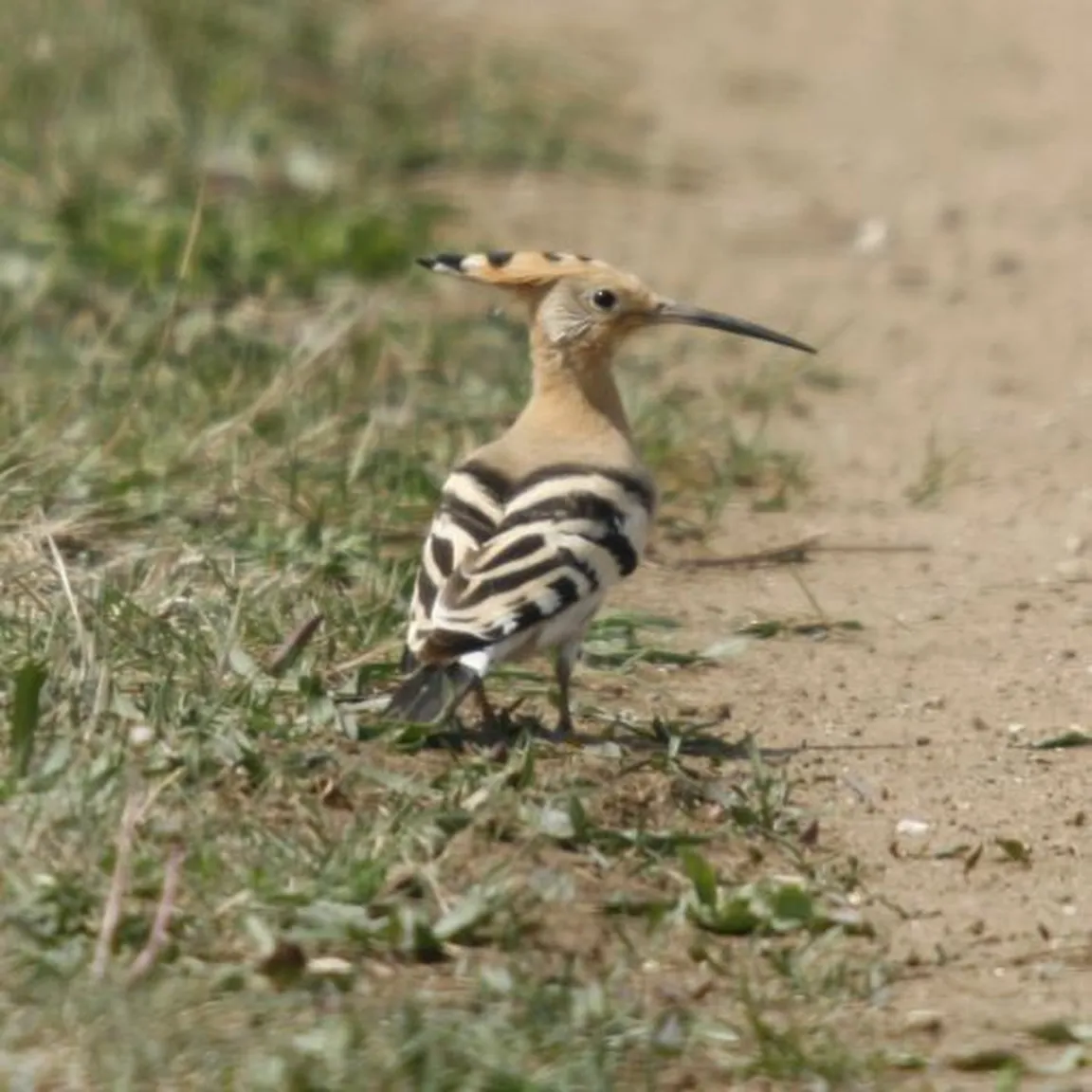
Hoopoe (Upupa epops) is certainly one of the most recognizable birds that occur here. This is a bird the size of a jackdaw, but with a much longer, downward-curved, slender bill. When fully extended it measures from 25 to 29 cm, of which 4 to 5 cm are the bill. Wingspan ranges from 44 to 48 cm. Its chest, throat, neck, head, nape and ’shoulders’ are pink ochre in color, the lower part of the body behind the legs is white. The broad and rounded black wings are adorned with white stripes, and the broad white cross stripe is also characteristic of the black tail. On top of the head it has a crest with black-tipped feathers. With its erected crest the hoopoe resembles a Native American chief, but it usually spreads it only for a short time – when agitated or after landing. Because of its distinctive call »up-up-up«, which can be heard surprisingly far away, in some places it is also called hupkač. The name hoopoe also suits it, since the young drive away intruders who try to steal from the nest with a smelly secretion. People have always found the hoopoe interesting, in addition to this they have attributed prophetic and miraculous properties, which is why it has acquired other names, for example vodeb, odap, bud, butej, mutec, and also smrdat or smrdela.
Vodeb is a diurnal bird that usually searches for food on the ground, rarely chasing after insects in the air. As for foraging for food, it is most suited to areas with low vegetation and small patches of bare ground, which it finds in pastures or on tracks. It loves large insects, which it uses its long bill to pick deftly from the surface of the ground or searches for them in livestock droppings or in the soil. It delights in grasshoppers, crickets, beetles, sawflies and the larvae of these insects, as well as earthworms and larger prey, for example lizards and even small mammals.
The hoopoe is a migratory bird that in September flies to wintering grounds on the African continent. It returns to us in spring, most often in April, and soon after begins to nest. It nests best in a tree hollow in an old fruit tree, though a gap in a wall or in rocks also seems suitable. It lives in a cultivated landscape, where pastures, fields and orchards or vineyards intertwine with numerous hedgerows, living fences and shrubs, and it prefers tall, high-stemmed orchard meadows with old and hardy varieties of fruit trees and pastures nearby. It does not like cold and foggy mornings, therefore it favors warm, sunny, sheltered sites.
In Slovenia we still count the hoopoe among fairly common nesters, but it is threatened especially by the loss of suitable habitat and intensification of farming. The hoopoe is listed as a critically endangered species on the Slovenian Red List of endangered nesting birds, as it faces extinction here if the threat factors continue.