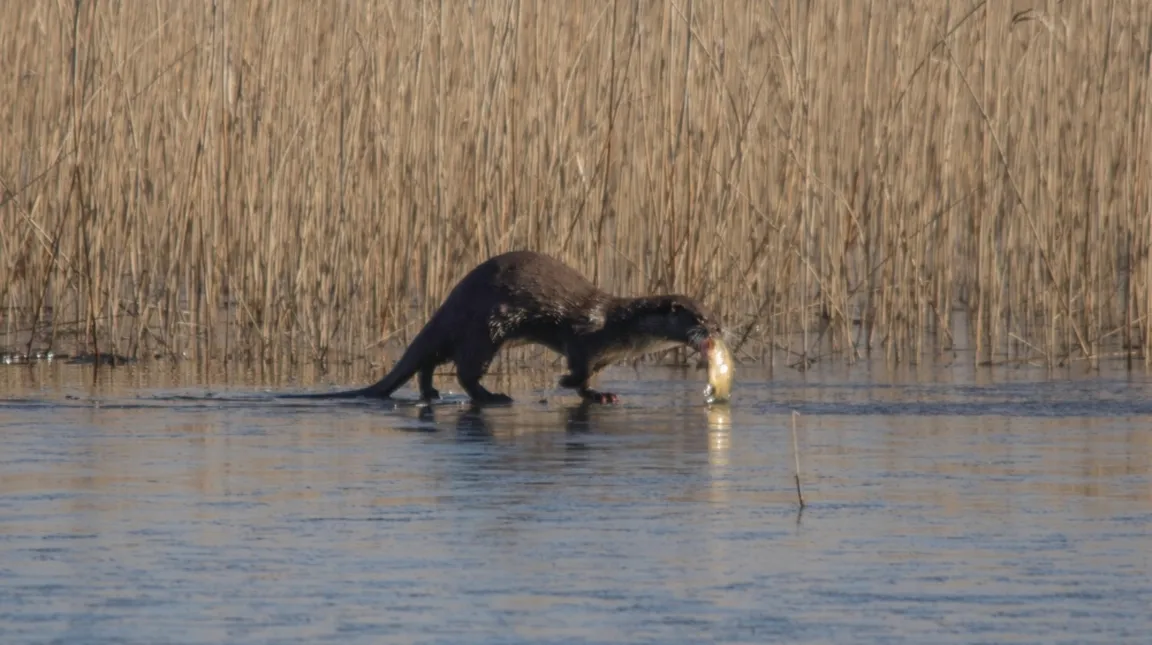
There are 13 species of otters on Earth, the Eurasian otter (Lutra lutra) or simply otter, and it is the only species in Europe. It belongs to the family Mustelidae and is, among our mustelids, the best adapted to life in water. Its long body together with a strong, conical tail measures over one meter. Adult males weigh about 9 kg and are somewhat larger than females, which usually weigh about 6 kg. The body is covered by an extremely dense, dark brown fur. Up to 50,000 hairs per square centimeter of otter fur allows it to stay dry in water. Short, stout legs have webbing between the toes. The head with large eyes and nostrils and small ears is flat. The otter sees well, but when hunting it mainly uses smell and sensory hairs—vibrissae—placed around the snout.
The otter is bound to water. On land, in search of a new territory, it can move over large distances (more than 10 km), but its movement—hopping—is fairly awkward. It lives in streams, rivers and lakes, and in some parts of Europe also in the sea. It can stay underwater for up to four minutes. It swims with a belly-to-back undulation of its spindle-shaped body and reaches speeds of up to 15 km per hour. Underwater, with quick and skillful swimming, the otter hunts fish, which account for about two-thirds of its diet. It especially enjoys crayfish, but it does not shun amphibians either, especially in the warm part of the year when they linger by and in the water. When it comes to food, it is therefore not particularly picky and it takes on whatever it encounters. Thus, in its droppings, which mark its living territory (territory), one can also find bird feathers, reptile scales and remains of insect exoskeletons.
Because of its feeding habits, the otter sits at the very top of the food pyramid or food web, and is thus a good indicator of the quality of the aquatic habitat. All hazardous substances that enter the aquatic environment mainly due to human activities accumulate in organisms and thus indirectly or directly threaten the life of the otter and other animals. The otter here has no natural predator, but the past has brought it much hardship. Humans represented competition in catching fish and crayfish, so it was once mercilessly persecuted. Later, with the development of industry and the growth of the human population, the main cause of the decline of otter populations became pollution of the aquatic environment and its alteration. Today it lives only in natural aquatic environments, for example in rivers with a varied course and abundant riparian vegetation, where it finds enough food for itself and its offspring and a suitable place to live. Thus, in our country as in the rest of Europe, it is protected and, together with other endangered species, is listed on the Red List.