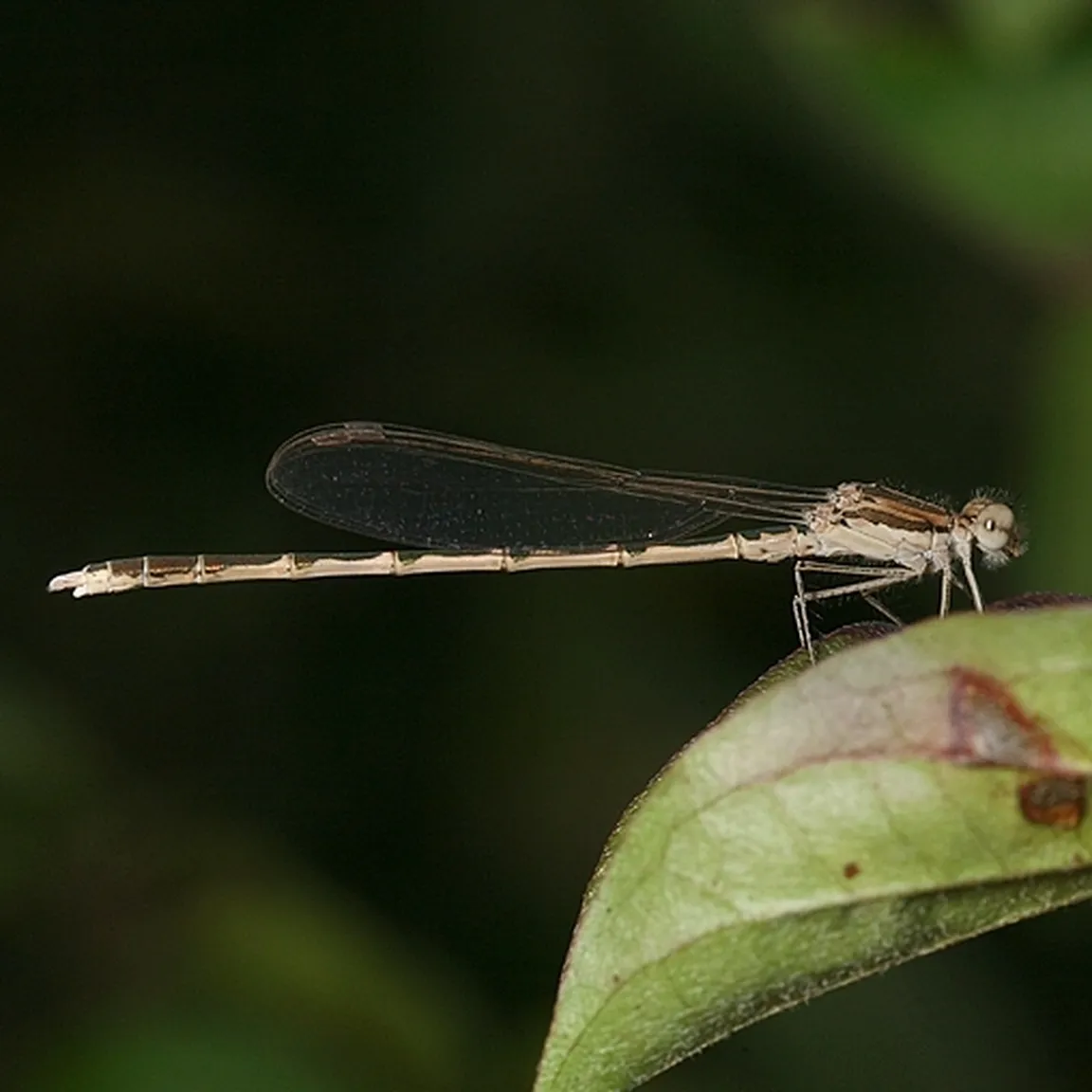
The winter damselfly (Sympecma fusca) is usually 34 to 39 mm long, and its wingspan is about 4 cm. When the winter damselfly rests, it often clutches close to a reed stem and thus hides even more. At that moment one can observe one of the characteristic features of this genus, namely that its long brown pterostigmas (the typically pigmented cell at the tip of each wing) hardly overlap. The pterostigma on the forewing is situated noticeably closer to the wing tip than the pterostigma on the hindwing.
The male and female of the winter damselfly are equally colored. They are unobtrusive dragonflies with a color scheme of dirty white, drab, brown, and almost black. For this species, which is also the only representative of its genus in Slovenia, a broad brown stripe across the upper part of the thorax is characteristic. This brown stripe, which has a completely straight upper edge, is flanked by two black stripes.
The winter damselfly inhabits all types of standing water as well as slowly flowing water bodies with lush aquatic vegetation.
This is one of the two species of European dragonflies that overwinter as adults, so adult winter damselflies can be observed throughout the year. The individuals that have overwintered are reproductively most active in April and May; the new generation of adults begins to fly and seek partners late in the summer, especially in August and September.