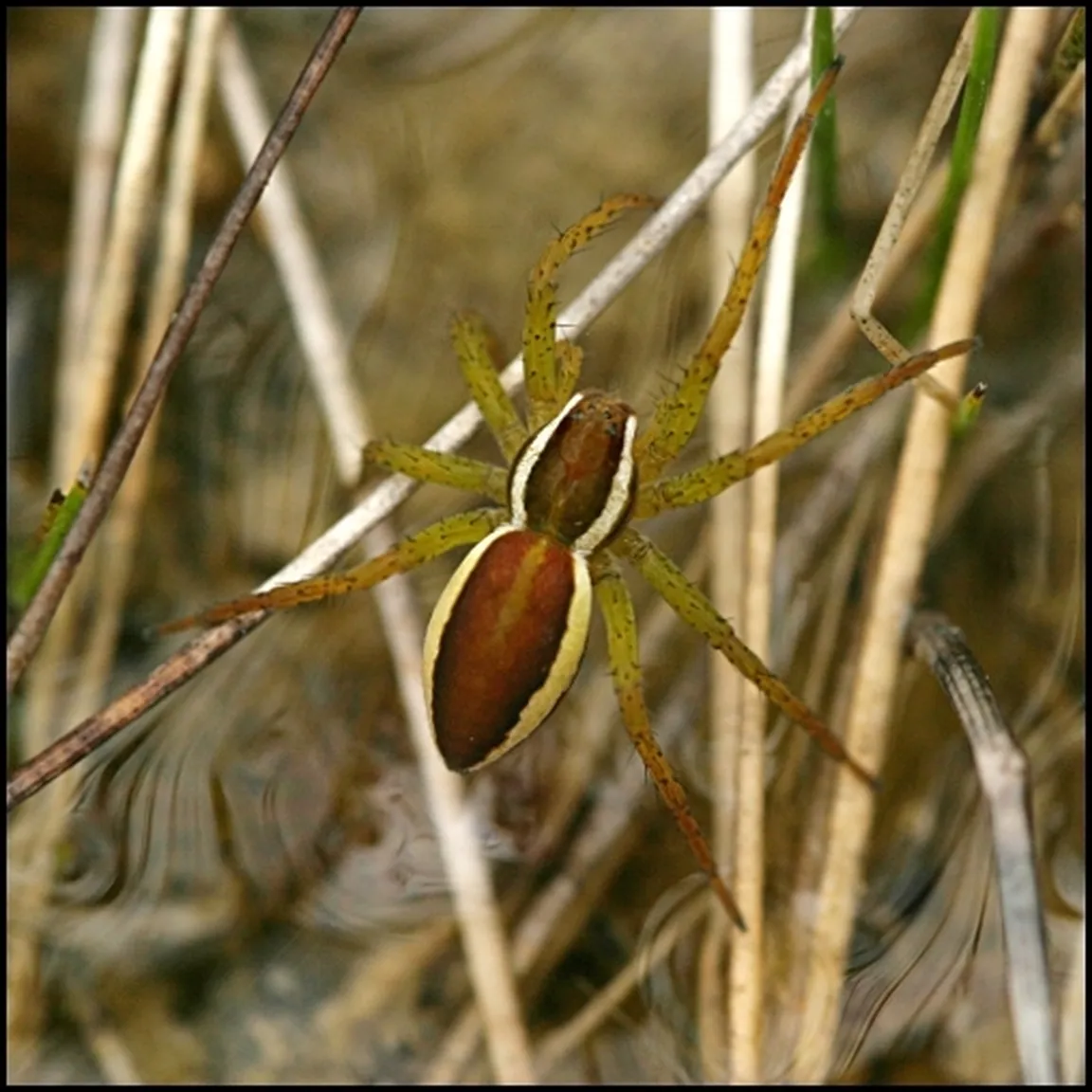
The fishing spider (Dolomedes fimbriatus) lives near water. It prefers swampy areas with permanent pools of water; for example, it likes spring-fed bogs, and it can also be found near ponds or slowly flowing streams.
This is a good hunter that searches for its prey on patches of moss, at the water's edge, or even on its surface. It often waits for prey, perched on aquatic vegetation and with its front legs on the water surface. In this way it detects movements of insects, tadpoles, and even fish fry that drift nearby. When its prey comes close enough, it grabs it with its strong legs and pulls it onto dry land, where it eats it. It is not uncommon for it to run along the water's surface in pursuit of prey... When threatened, it climbs along the stem of an aquatic plant into the water, where it can remain submerged for up to an hour.
Full size and sexual maturity are reached in late spring and summer. When the male meets the female, a lengthy courtship begins, during which the male slowly approaches the mate and tirelessly waves with its front legs until the female becomes receptive. This is a large spider; the body of an adult female is 13 to 20 mm long, the body of the male measures 9 to 16 mm. Both sexes are similar in color and pattern, only the male's abdomen is somewhat smaller than that of the female.