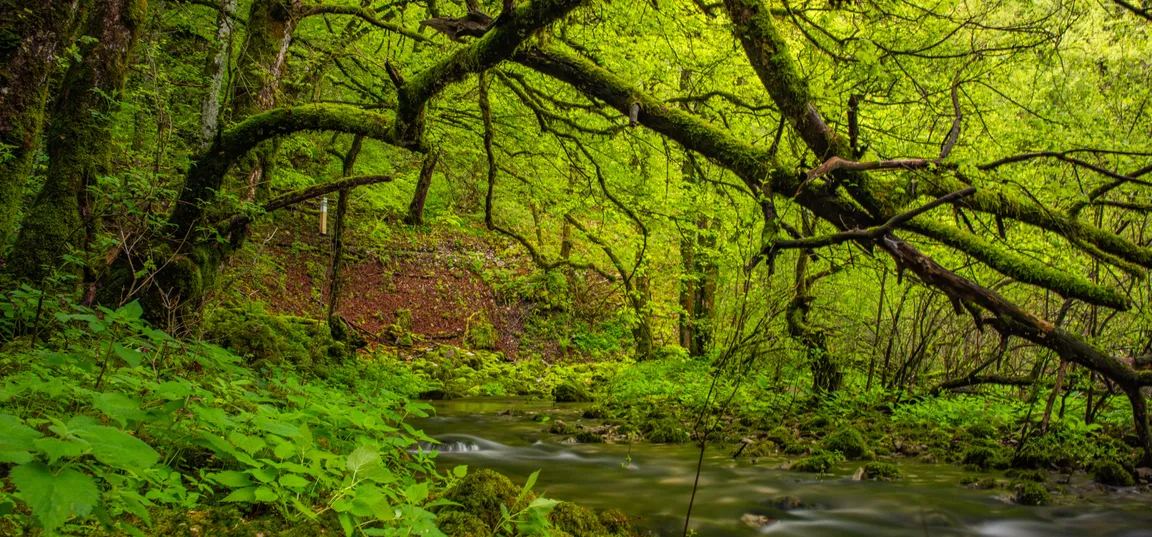
Forests are plant communities in which trees predominate. Depending on environmental factors, in a given area of the forest usually one tree species prevails; to this other species join and thus we speak of different types of beech, oak and spruce forests. Environmental factors that determine the species composition of forests include, for example, the rocky substrate, water availability or saturation and the wetness or dryness of the soil, soil depth and their aeration, the surrounding temperature, which in our region depends especially on altitude, orientation (south-facing, shady-facing) and the slope of the terrain...
The dense canopies of trees drop down to the forest floor, where undergrowth thrives with little light. Therefore, undergrowth species are mainly adapted to growth at low light intensities, some begin their development very early in spring and bloom before the trees above them leaf out.
A forest as natural vegetation generally prevails in areas with sufficient rainfall and accessible water and sufficiently high temperature. This is also the case in Slovenia, where suitable conditions for forest growth mostly prevail. Therefore it is no wonder that forests cover almost 60 % of the surface of our homeland, which places us in third place among the most forested countries in Europe.
Humans are also connected with the forest, as forests have long provided us with building material and firewood, which eased our ancestors’ survival through long and harsh winters. Our forests also provide habitat and plenty of food for numerous forest animals. In the shelter of forests all forms of living beings that we know on Earth find their space in the sun; from the smallest bacteria, colorful fungi, tiny ants and curious cyanobacteria, to the largest predators such as the lynx, wolf and bear…
In addition, natural and extensively managed forests also have a whole range of positive effects on the surroundings and thus on the living beings that live there. Such forests, among other things, act as a sponge, absorbing large amounts of water when it is abundant and then releasing it slowly when, in the dry part of the year, it is lacking — thus they positively affect the quantity and quality of drinking water supplies. Extensive forests positively influence the climate in their surroundings, soften large temperature fluctuations and thus the occurrence of extreme weather events. They prevent soil erosion by water and wind. Forests in the hinterland of wetlands enable the uninterrupted functioning of these sensitive and indispensable ecosystems and much more...
Finally, forests invite us to a break from daily life, which tires us with an unforgiving pace… but let us not forget that we are only guests in the forest, and with proper behavior we prove that we deserve the invitation!
Beech forests
These are forests in which the common beech (Fagus sylvatica) predominates, to which, depending on environmental factors, other tree species join. Thus, in higher-lying areas beech is often joined by the silver fir (Abies alba) or the European spruce (Picea abies), in some places by the Norway maple (Acer platanoides). In lower-lying beech forests beech is frequently accompanied by the field maple (Acer campestre) and the wild cherry (Prunus avium).
Similarly, depending on the type of rocky substrate, soil pH (acidity or basicity), altitude and temperature of the area, particular undergrowth species are characteristic for different types of beech forests.
In the area of the Notranjska Park, the so-called Illyrian beech forests are the most widespread, belonging among the most species-rich forest ecosystems in Europe.
For the undergrowth of Illyrian beech forests up to 600 m above sea level are characteristic herbaceous plants, e.g. Hacquetia epipactis, Aposeris foetida, Cardamine enneaphyllos (nine-leaved toothwort), Primula vulgaris (primrose) and Vicia oroboides, among tree species here the conditions are suitable for wild cherry and the field maple.
For this area even more characteristic are Illyrian montane beech forests and pine beech forests, which grow up to about 900 m above sea level. Typical undergrowth species are, for example, the forest sedge (Carex sylvatica), coral root (Cardamine bulbifera), nine-leaved toothwort (Cardamine enneaphyllos) and trefoil cress (Cardamine trifolia), the Solomon’s seal (Polygonatum multiflorum), bastard-agrimony (Aremonia agrimonoides), blue-eyed-Mary (Omphalodes verna) and the large-flowered calamint (Calamintha grandiflora).
In cooler or even higher areas, the species composition of the undergrowth changes somewhat; beech is more often accompanied by the sycamore maple (Acer pseudoplatanus). Here we will more often encounter spurge-laurel (Daphne laureola) and wood ragwort (Senecio ovatus) and the shrub Rhamnus fallax.
In Slovenia, self-sown spruce forests are limited to higher elevations and frost pockets and areas of depressions or large sinkholes in the Dinaric belt, where cold air collects. In the lowlands, the spruce (Picea abies) is present and widely used for afforestation.
In the lowland spruce forests, of course, the common spruce predominates. Here it reproduces and spreads, only here and there is joined by one of the other tree species; somewhat more wild plant species are present in the undergrowth. Because fallen needles form a dense layer and acidify the soil, evergreen spruces allow little light to reach the forest floor, and the plant species diversity in the undergrowth is modest.
The undergrowth of lowland spruce forests is nonetheless enriched by a few plant species. For example, the bird’s-nest orchid (Neottia nidus-avis) and the white helleborine (Cephalanthera damasonium), the acid-loving round-leaved bedstraw (Galium rotundifolium), the parasitic Monotropa sp., the fragrant purple cyclamen (Cyclamen purpurascens), the hard-fern (Blechnum spicant), the common wood sorrel (Oxalis acetosella), the climbing common ivy (Hedera helix) and a few more.