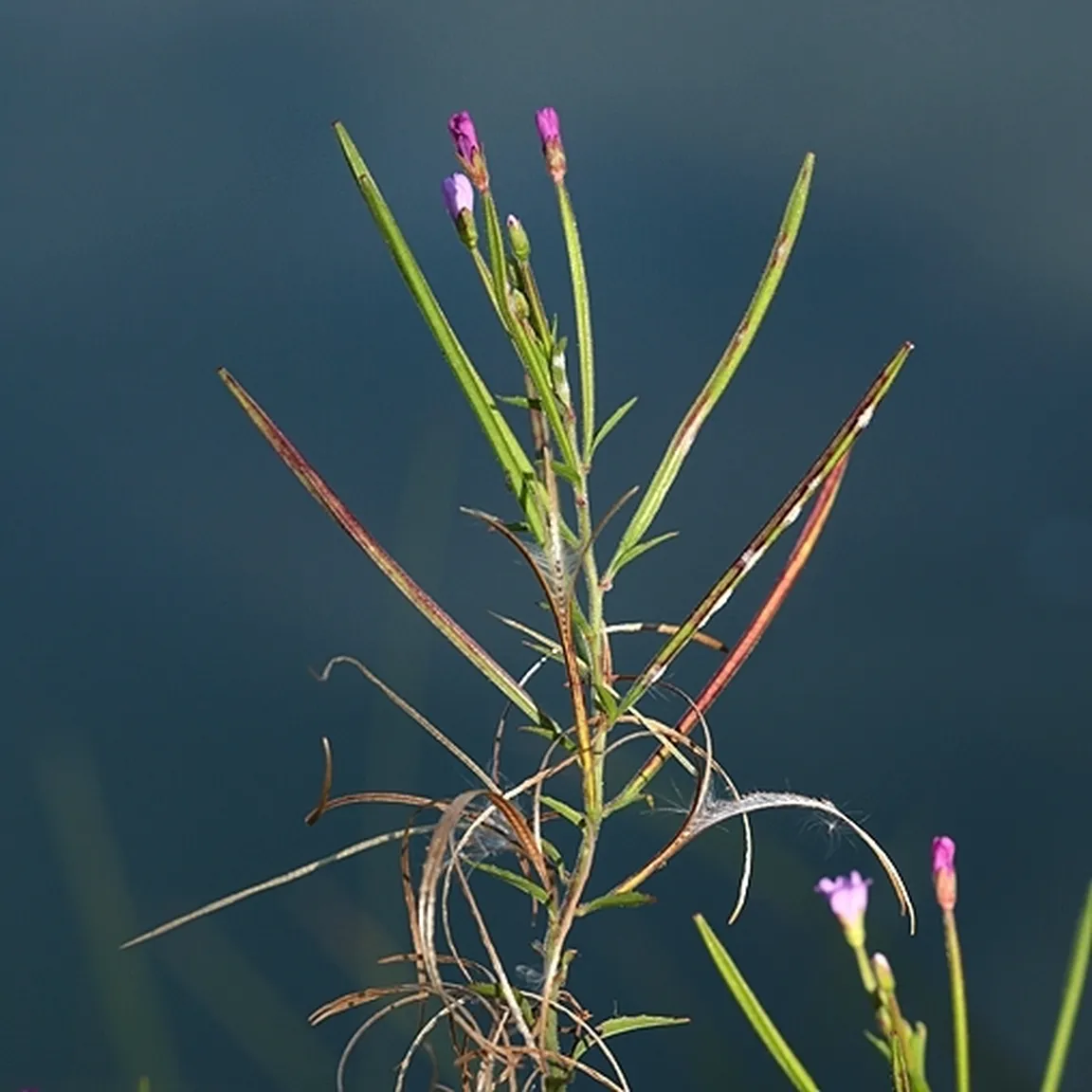
Family: evening primroses (Onagraceae)
Flowering time: June–September
Size: 15–50 cm
Habitat: banks of water, ditches, marsh meadows, forests and ruderal sites on moist soils
Smallflower willowherb (Epilobium parviflorum) is a perennial with an elongated rhizome, from which only after flowering do young shoots emerge, which during the flowering period survived in the form of a rosette. The upright round stem is densely pubescent, the longest non-glandular hairs on the stem are longer than 0.5 mm. Sessile or short-petiolate lanceolate stem leaves are indistinctly serrated and on both sides densely soft-haired. In the lower part of the stem they are arranged oppositely, in the upper part alternately (spiral) or they are arranged in threes in a whorl (verticillate). Pink flowers are in diameter less than 10 mm. The yellow band is four-lobed, and its lobes are not prominently spread. For smallflower willowherb it is characteristic that the inflorescence, calyx and ovary (and later the fruit, which may eventually become glabrous) are clothed only with glandular hairs.
Smallflower willowherb grows on more or less permanently moist soils, relatively rich in nitrogen. It thrives in light places from the lowlands to the montane belt. It is distributed throughout Slovenia.
Smallflower willowherb is also used as a home remedy for alleviating problems with the prostate, kidneys and bladder. Since tea prepared from dried willowherb has a strong effect, it should be consumed in moderation and according to recommendations, as it can cause stomach and intestinal problems.