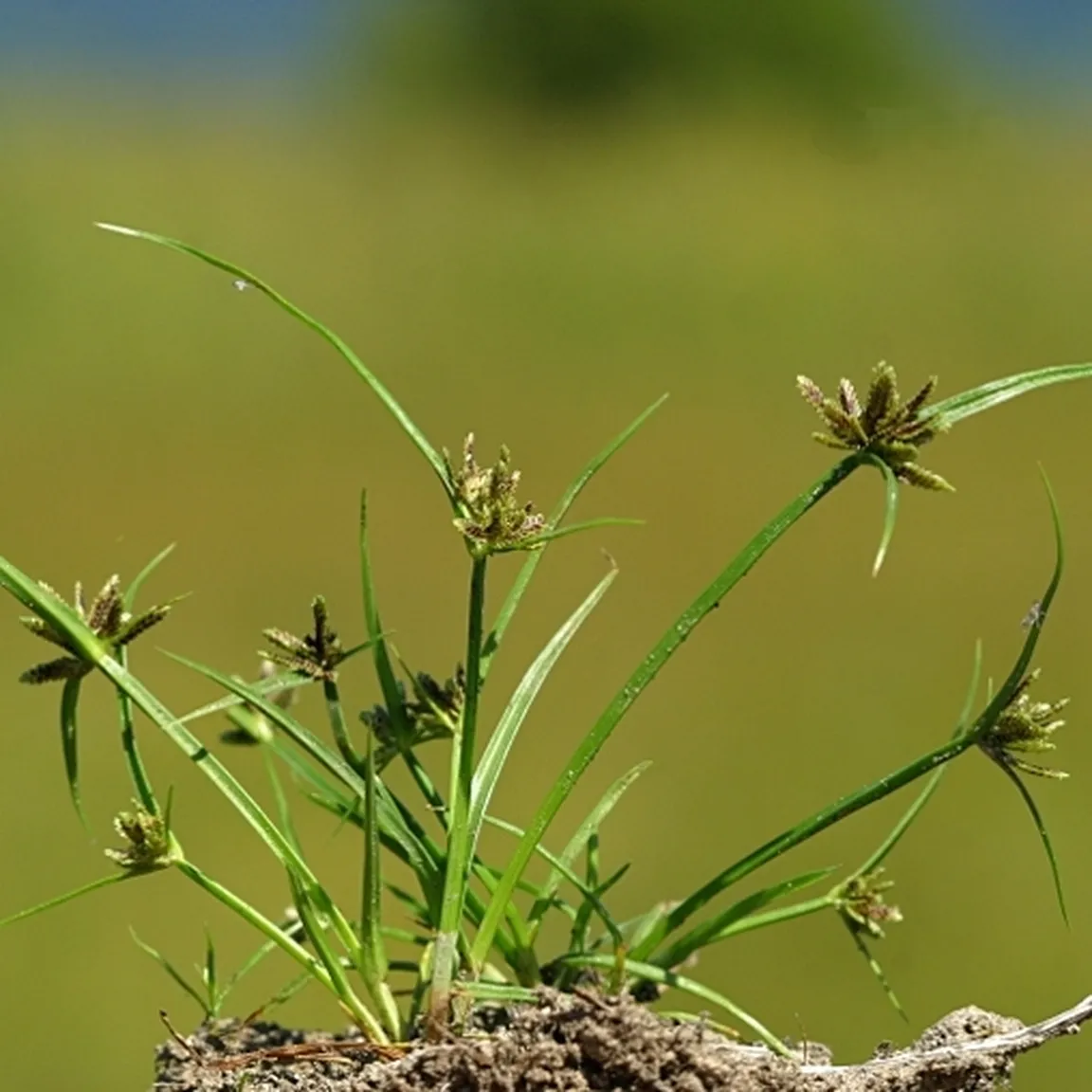
Family: sedges (Cyperaceae)
Flowering time: July–October
Size: 3–25 cm
Habitat: marshy and wet sandy, silty or clay soils, and banks of water
Black-red sedge (Cyperus fuscus) is a small, tufted annual. Its bare stems are triangular in cross-section. Two to three basal leaves are usually up to 4 mm wide and about as long as the stem. At the top of the stem develops a composed, densely head-like inflorescence, consisting of 3 to 10 mm long dark-brown spikelets with a greenish edge. The spikelets project in all directions; when viewed through a magnifying glass, we observe that in each flower three grooves have developed, and each outer glume has three veins. Below the inflorescence there are a few supporting leaves of varying lengths, at least some of which markedly exceed the inflorescence.
Black-red sedge grows on more or less regularly flooded, nutrient-rich, always moist bare soils. With the exception of mountainous areas, it is distributed scattered throughout Slovenia, especially in river valleys, but apart from Pomurje it is not common anywhere. As a vulnerable species it is listed on the Red List of endangered plants of Slovenia.