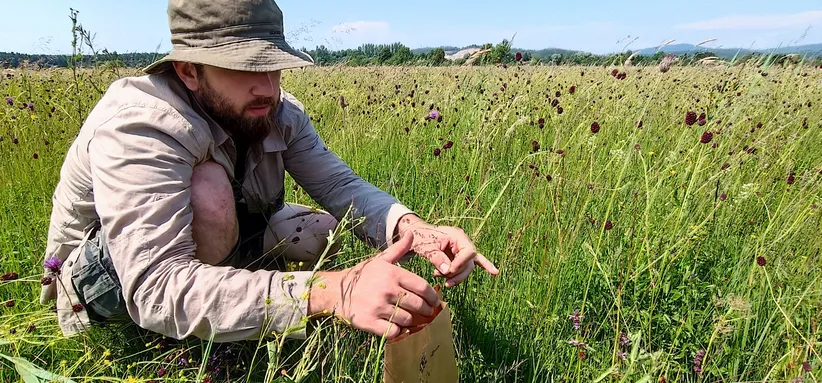
In the area of Lake Cerknica and Brejnice (Menišija), we carried out systematic vegetation surveys as part of the LIFE for SEEDS project, using a modified Braun-Blanquet method. The inventories were carried out in July, when the vegetation is most recognizable and in full development, which allows for accurate identification of plant species and their structural characteristics. We focused on meadows from which woody vegetation had been removed and/or seed mixtures had been sown during the project. In the past two years, inventories have already been carried out at the same locations by the Scientific Research Center of the Slovenian Academy of Sciences and Arts and the Agricultural Institute of Slovenia.

On the survey plots, we carried out two types of surveys: a 5 × 5 m quadrat survey using a modified 9-point Braun-Blanquet method, and a survey of the entire sample plot using the standard 7-point Braun-Blanquet method. The quadrats were precisely located with GPS devices and physically marked with stakes. A cord was stretched between the stakes to form a square, which enabled accurate analysis of the vegetation within the defined area.
In each quadrat, we assessed various structural characteristics of the vegetation. We measured the cover of individual layers (e.g., herbaceous and woody) as well as their height. Height was measured at three levels – minimum, average, and maximum – providing a detailed insight into the vertical structure of the vegetation. We also assessed the cover of litter (dead plant material), mosses, algae, and bare soil, which allows us to track changes in these parameters over the years.
For each recorded species, we determined its cover at both the quadrat and the sample plot level.

The aim of our surveys is the long-term monitoring of changes in vegetation and structural characteristics of meadow ecosystems. By repeating the surveys over several years, we will be able to analyze the dynamics of changes in species composition, vegetation cover, and height, providing a precise insight into the success of restoration projects. The final results will show how effectively the meadows have been restored and what impact these measures have on biodiversity and ecosystem stability.

The method we use enables a precise assessment of the current state of vegetation and changes over time, which is crucial for long-term monitoring of the effects of restoration measures. In this way we will be able to contribute to a better understanding of ecological processes taking place in restored meadow ecosystems, and ensure that these processes are directed toward preserving and strengthening biodiversity in these important natural areas.

Photos: Primož Žižek