Monitoring with a drone
This year we will once again monitor the nesting process from the air – a drone will be used to observe six selected locations in the Lake Cerknica area.
To ensure minimal disturbance to nesting birds, we use an unmanned aerial vehicle equipped with a thermal camera and an optical zoom camera. Observing from a distance reduces disturbance during monitoring, as we fly high enough not to disturb the birds.
Aerial monitoring provides valuable insight into birds’ nesting behaviour – the timing of nesting, breeding success, and the selection of nesting habitats. Such data are often difficult to obtain using conventional monitoring methods. The thermal camera allows us to detect nests even in remote and densely vegetated stands of healthy reed beds. Nests and birds can be detected through thermal contrast, while optical zoom allows for more precise species identification and assessment of nest condition – all without entering sensitive reedbed areas where many waterbird species nest.
Direct human presence during the nesting period can lead to nest abandonment or even the desertion of chicks, which is why this type of monitoring is significantly less disturbing for the birds.
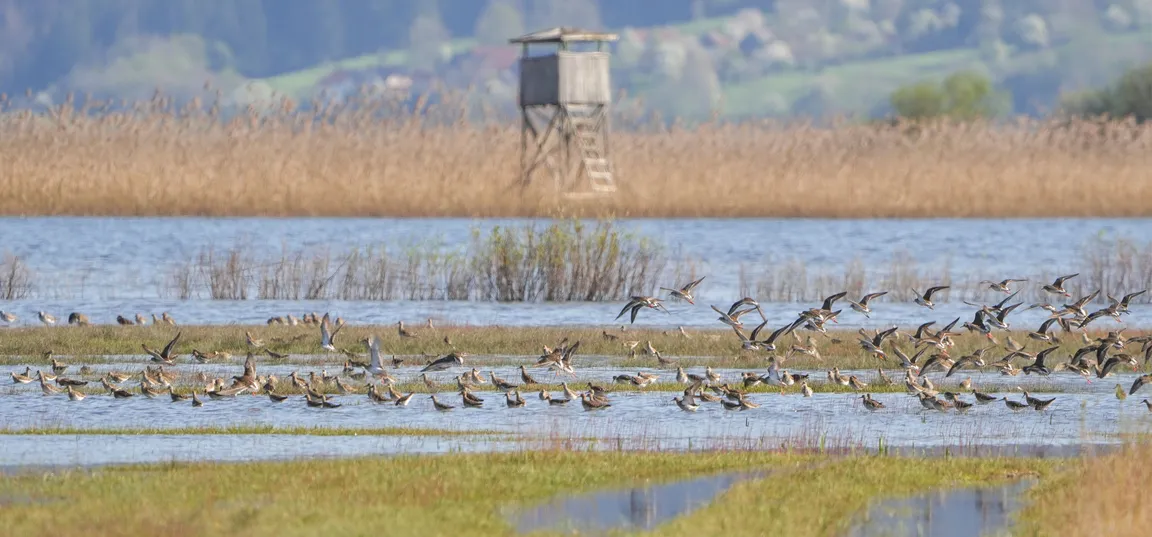
Lake Cerknica is not only the largest intermittent lake in Europe but also an important bird area included in the Natura 2000 network. Regular monitoring of waterbird populations helps us better understand the impact of human activities, land-use changes, and climate change on local bird species – and allows us to plan appropriate conservation measures in time.
A few moments captured by the drone can be viewed in the photo gallery below.