The purpose of the invitation was to undertake monitoring of birds on Lake Cerknica, which I welcomed with open arms.
The cmonitoring of birds on Lake Cerknica is carried out from January 1 to March 31, with the period divided into decades, which means we must complete the monitoring once every ten days. Our target groups of birds are water birds (all species of ducks, swans, geese, shorebirds, etc.) and all species of raptors and crows. The purpose of the monitoring is to count all species and individuals of the aforementioned groups, enter them into a database, and mark on a map where they were observed. This gives us a complete picture of where birds stay most and how they move across the Cerknica plain.
For the census itself we already have predetermined monitoring points (there are 22), from which it is easiest and most accurate to count the birds. They are arranged to allow a circular route around the lake.
Photo: Rudi Kraševec
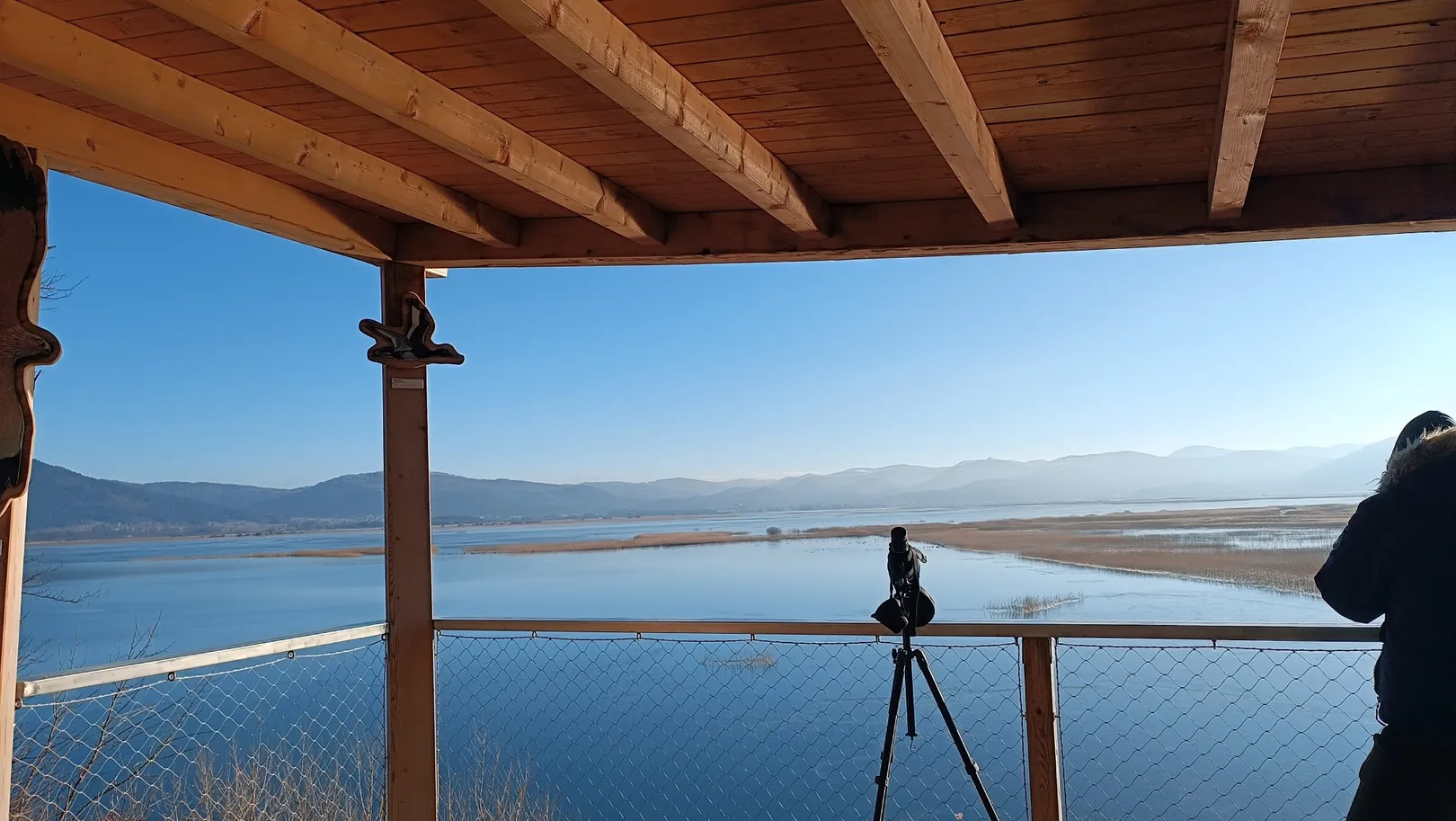
Lake Cerknica is an excellent hotspot for bird watching in Slovenia. A view of Lake Cerknica from the Orlek observation platform.
The monitoring is best started in the morning hours, as the birds are most active then and easier to observe. It lasts about 6 to 7 hours, depending on the number of birds. Later in the day the birds often hide in the reed beds, which makes identifying and counting them more difficult. When that happens, you can only be glad if the white-tailed eagle (Haliaeetus albicilla) has not fed yet that day and happens to go hunting at that moment, which drives away all the birds hidden from our eyes. Therefore, ornithologists are mostly proponents of early rising.
Photo: Rudi KraševecPhoto: Rudi Kraševec
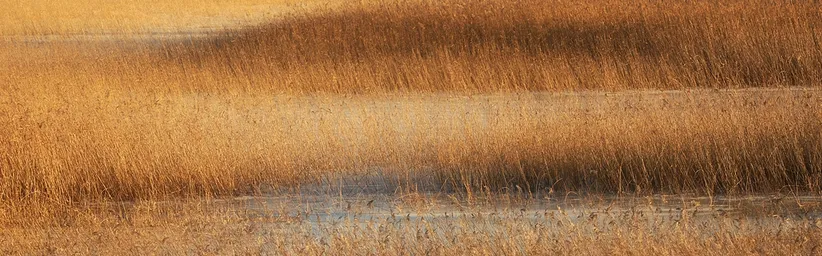
Birds tend to hide in the reed beds during the day, which makes identifying and counting them more difficult.
Considering that our lake, at full water level, is the largest in the country, without binoculars and a telescope you can practically do nothing – these are essential equipment for the entire monitoring. The worst nightmare of an ornithologist is when you spot a huge flock of mixed duck or wader species somewhere in the middle of the lake, and you only have a binocular with you. Probably the average person cannot imagine the frustration and stress that bird lovers experience in such moments.
Photo: NRP archive
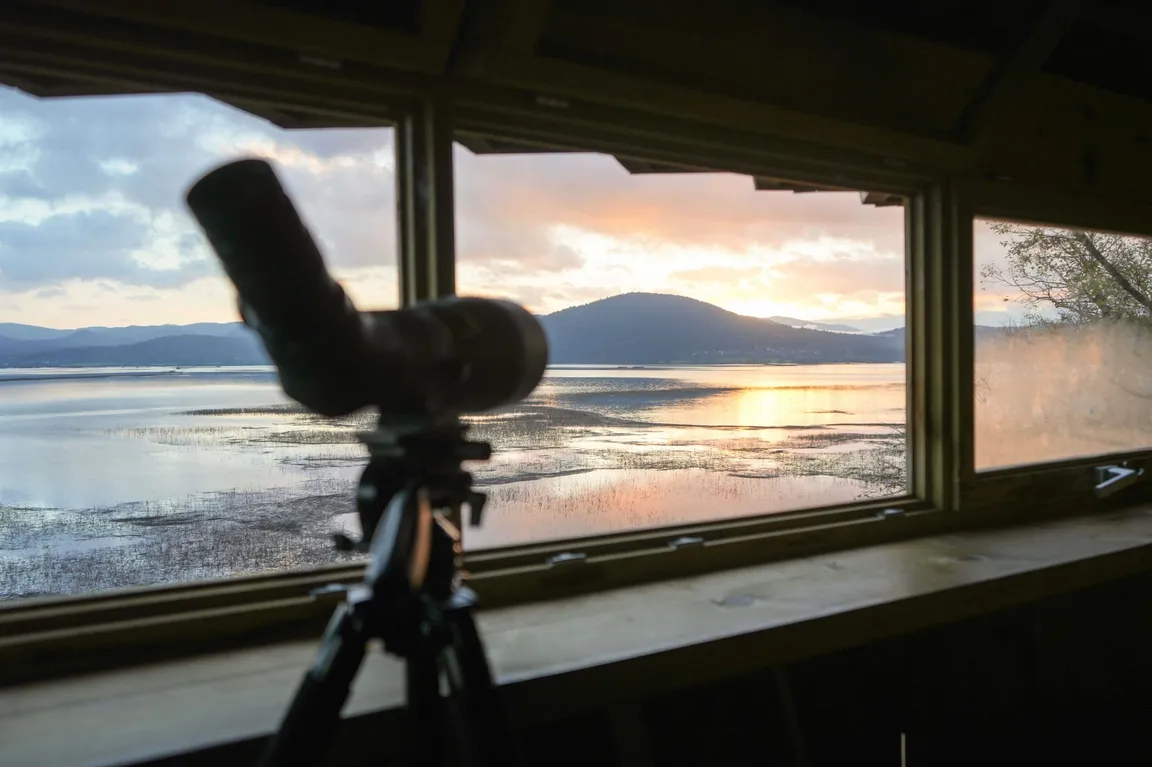
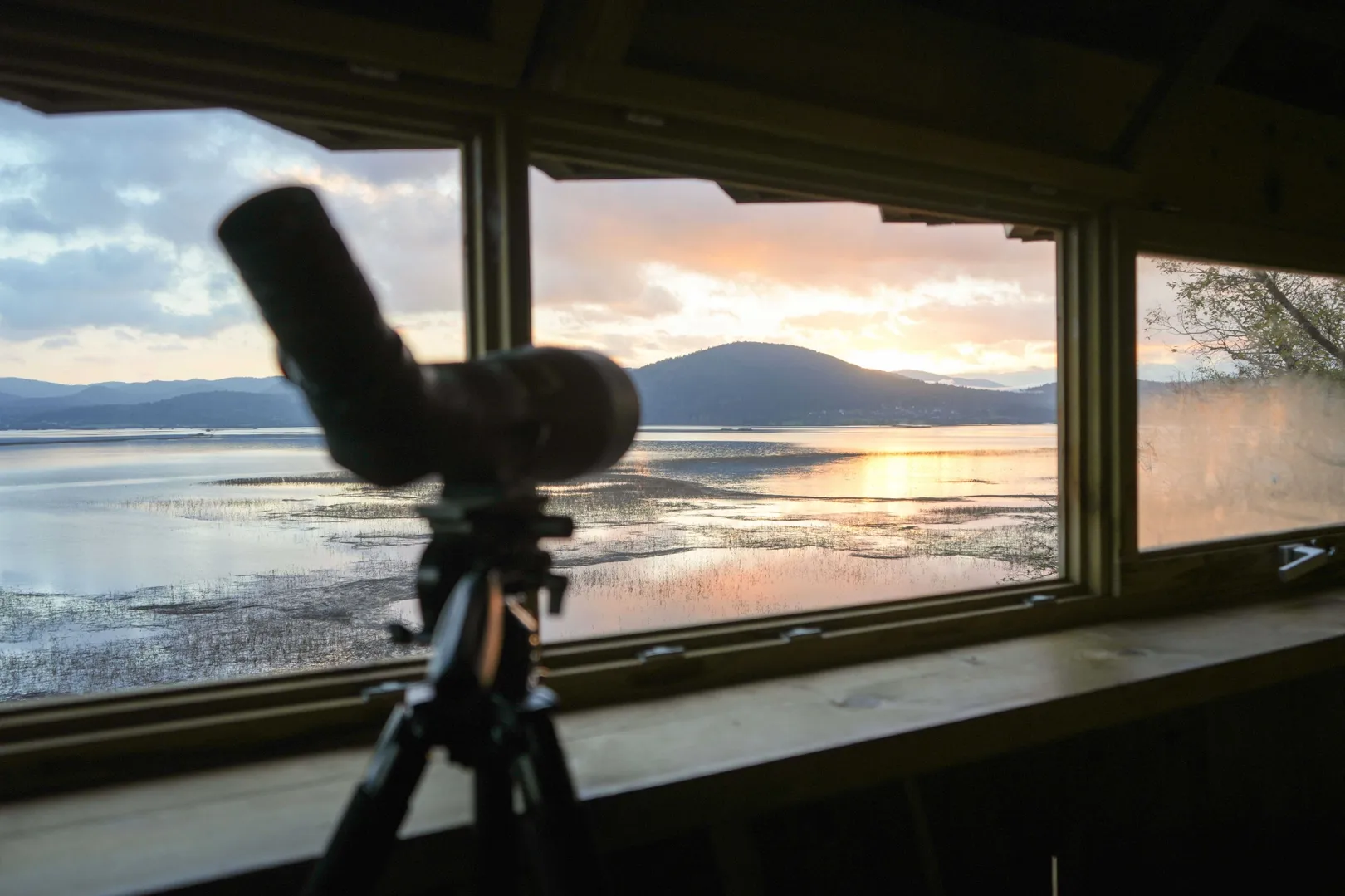
For bird watching, the morning is most suitable, and we must necessarily bring a binocular or a spotting scope.
Speaking of large flocks – this season is quite good for various species of ducks. Thus, in the winter count of waterfowl we counted as many as 1300 mallards (Anas platyrhynchos) (the most common duck species in Europe). Now other, less common species are already returning from their wintering grounds, and in large numbers. Thus, in early February in a single flock I observed about 900 teals (Anas crecca), 700 northern pintails (Anas acuta) and more than 150 gadwalls (Anas strepera). Migration is just beginning! If the water level holds until March, we can expect even higher numbers.
In this winter period I can mention two very surprising species that have decided to winter in our area – the redhead duck (Aythya nyroca) (target species of the LIFE Tršca project) and its even rarer relative, the greater scaup (Aythya marila). The latter has even appeared in a record number (11 individuals). Perhaps it doesn't sound like much, but for such a rare duck species it's a very nice number.
Snapshots from the bird monitoring (Photo: NRP archive)
But to not speak only about birds, I find it sensible to also mention other, less feathered and more furry representatives of biodiversity. Because we live in Notranjska, by a lake surrounded by forests, numerous other animals also roam here. Thus in the monitoring I observe at least once a year a brown bear (Ursus arctos), an otter (Lutra lutra) is a winter staple, and with quite a bit of luck I have even observed a wolf (Canis lupus) a few times.
For nature lovers, Lake Cerknica is an excellent destination. With a well-laid educational trail, exploration is even easier and more informative. Bird lovers will find something special here in every season. My favourite is spring, when there is plenty of bird life, but you can discover interesting things with a little effort throughout the year.
The contribution was prepared by Anže Škoberne, a member of DOPPS, the project partner on LIFE Tršca.
LIFE TRŠCA
With LIFE TRŠCA we will improve the conservation status of the intermittent Lake Cerknica.
The implementation of extensive nature conservation projects exceeds the financial capacity of the local community, therefore Notranjska Park regularly applies for projects with the possibility of co-financing by the European Union.
The implementation of large-scale conservation projects exceeds the financial capabilities of the local community, therefore Notranjska Park regularly applies for projects with the possibility of co-financing from the European Union.