Do you know how important common reed (Phragmites australis) is for the European tree frog (Hyla arborea), the common frog (Rana temporaria), the great crested newt (Triturus carnifex), and other amphibians?
Photo: Jošt Stergaršek
Common reed – key plant species
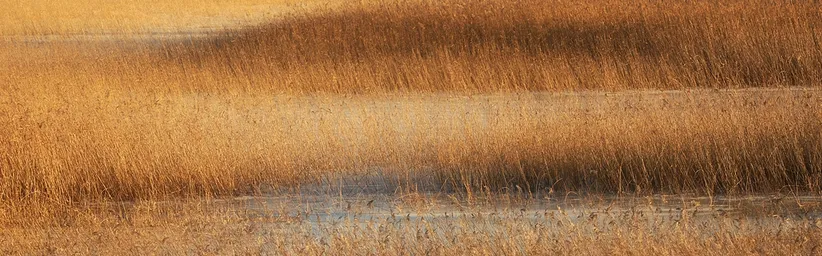
Common reed is an aquatic plant widespread throughout Europe. It thrives in wetlands, in standing or slow-flowing waters, where it plays a key role in the functioning of marsh ecosystems. Its dense root system stabilizes the soil, reduces erosion, and promotes nutrient cycling. Reed beds purify water by filtering out heavy metals and excess nutrients, improving water quality.
Their stems create a structural habitat that shades the water, mitigating temperature fluctuations and providing shelter from predators. Because of these characteristics, reeds provide breeding grounds for many amphibians.
However, reeds in marshes with high groundwater levels can have a negative impact on species diversity, as their density crowds out other plants.
Green frog –rReed dwellers
The green tree frog is a small frog, bright green in color, with distinctive sticky pads on its toes that enable it to climb well. Its presence indicates the good condition of wetland habitats. Green tree frogs often climb trees and reed stems in the immediate vicinity of swamps, where they find shelter and food sources.
During the mating season, male tree frogs call loudly from reed stems to attract females. Their reproductive cycle is closely linked to the aquatic microhabitats created by reeds, as they lay walnut-sized eggs on submerged vegetation. Since tadpoles are often preyed upon by predators, especially fish, the vegetation must be dense enough to make it difficult for them to access.
The common spadefoot toad – cave hibernator
The common spadefoot toad is another important amphibian of European wetlands. Unlike the green tree frog, it prefers not to climb on plants. It stays near the water only for a short time to lay its eggs, and then spends the winter in the forest. Near Lake Cerknica, they often hibernate in caves in the Javorniki hills, which is a unique feature in the world. It reproduces in shallow waters, such as ponds and swamps, where it lays its eggs in large groups that form floating mats. It is very important that these water bodies are free of fish, as they are the main predators of tadpoles. As there are quite a few of them in Lake Cerknica, it is important that the pools near the forest are surrounded by dense reeds, which makes it difficult for predators to access them.
The common spadefoot toad can be a very abundant amphibian, controlling insect populations and serving as prey for various predators. In this way, it represents an important link in the food chain.
Photo: Rudi Kraševec
Great crested newt – rare and endangered amphibian
The great crested newt is our largest species of newt. Females are most easily recognized in spring by the yellow stripe on their backs, while males can be identified by their silver-colored tails. Similar to brown frogs, it only stays in the water during egg-laying, then returns to the nearby forest. Unlike frogs, it lays individual eggs, which the female wraps in submerged vegetation. It is a very long-lived species, with individuals living to 15 years of age and older. This species prefers calm or slow-flowing waters and often shares its habitat with other amphibian species. The larvae feed on small invertebrates but are very sensitive to the presence of other predators, so the shelter provided by dense stands of aquatic plants, such as reeds, is important.
A complex web of interactions
Common reed, green reed, sedge, and great reed form a complex network of interactions. Dense reed beds provide shelter and breeding habitats for all three amphibian species. These, in turn, influence invertebrate populations. Favorable hydrological conditions and habitat status are important for their conservation. One of the most important areas for all three species is the reed beds in Zadnji kraj, Levišča, and other areas below Javorniki hills. Through the LIFE Tršca project, we will introduce management practices that will preserve or restore favorable conditions for the reproduction of these species. Good biodiversity is crucial for maintaining ecological balance and ensuring key ecosystem services in wetlands.
Photo: Rudi Kraševec
You can also help
On other parts of Lake Cerknica, a major threat to population conservation are road kills, and in some areas populations are approaching extinction. You can also help. Join the volunteer amphibian rescue at Lake Cerknica, one of the largest amphibian rescues in Slovenia, and together with us help preserve our very special corner of the world for future generations. You can read more about amphibian rescue on the website Cuprnških dvoživk.
Have you spotted a great crested newt? Submit your observation to iNaturalist.
Photo: Rudi Kraševec
LIFE TRŠCA
With LIFE TRŠCA we will improve the conservation status of the intermittent Lake Cerknica.
The implementation of extensive nature conservation projects exceeds the financial capacity of the local community, therefore Notranjska Park regularly applies for projects with the possibility of co-financing by the European Union.
The implementation of large-scale conservation projects exceeds the financial capabilities of the local community, therefore Notranjska Park regularly applies for projects with the possibility of co-financing from the European Union.