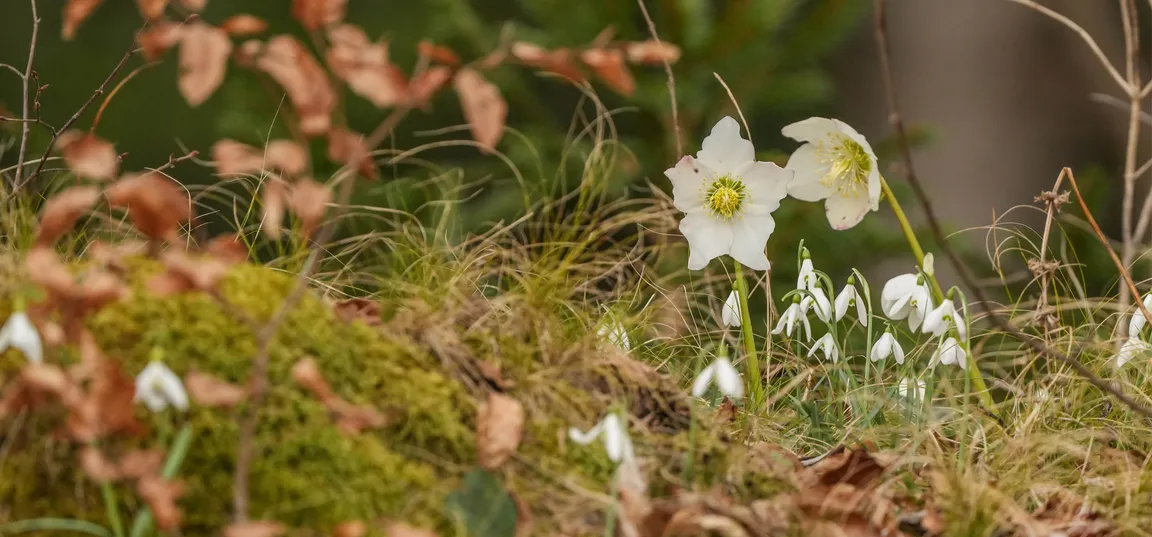
Spring brings the first flowers to our forests and meadows, heralding the awakening of nature. Among them are the snowdrop (Galanthus nivalis), black hellebore (Helleborus niger), and primrose (Primula vulgaris). These early-growing plants are not only aesthetically appealing, but also play an important role in the ecosystem by providing the first food source for early pollinators.
The snowdrop (Galanthus nivalis) is one of the most recognizable early-flowering plants in Slovenia. Its small white bell-shaped flowers appear as early as late January or February, usually before the leaves on the trees have fully opened. It grows mainly in deciduous forests, along paths, in parks, and in meadow orchards. The snowdrop is a protected species in Slovenia, as it has been protected due to intensive picking and loss of habitat. An exception is made for snowdrops and black hellebores, whose flowers can be picked for bouquets that can be held between the thumb and forefinger of one hand. Due to its early flowering, it is considered a symbol of spring and is also popular in gardens as an ornamental plant.
The black hellebore (Helleborus niger) is a somewhat lesser known but very interesting early flowering plant. Its large white flowers appear in winter or early spring. Black hellebore grows mainly in forests, on humus-rich and well-drained soils, often under spruce or beech trees. Black hellebore is also a protected species in Slovenia. In addition to its aesthetic value, it also plays an ecological role, as its early flowers provide food for the first pollinators at a time when food is still scarce.
The primrose (Primula vulgaris) is an early-flowering meadow plant, recognizable by its bright yellow or pale yellow flowers. The primrose is a common species in Slovenia, enriching meadows, forest edges, and light forests, and providing food for the first pollinators in early spring.
All three plants— the snowdrop, black hellebore, and primrose —are a beautiful example of how nature brings life and color to forests and meadows in early spring. Preserving their natural habitats, prohibiting the picking of plants, and treating nature with respect and responsibility are key to ensuring that future generations will also be able to enjoy these beautiful early-blooming plants in our very special piece of the world.