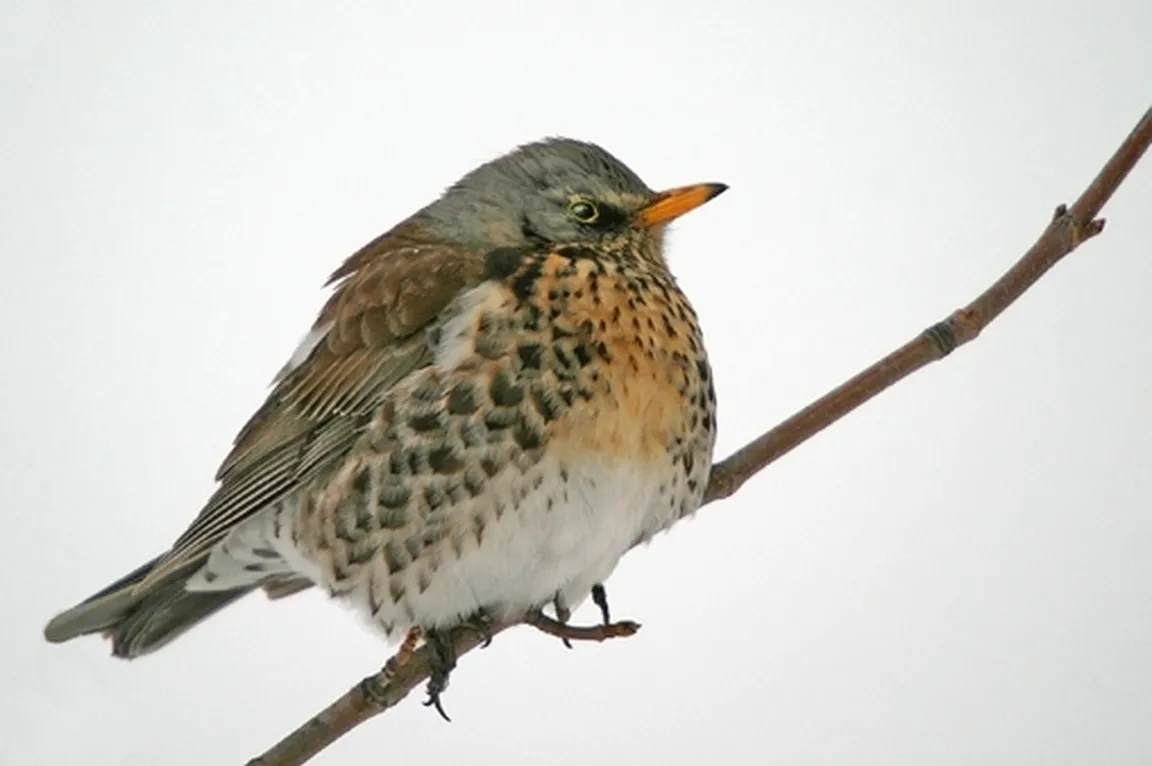
The fieldfare (Turdus pilaris) is a colorful bird from the thrush family. Its chunky body is 22 to 27 cm long, roughly as large as the blackbird, which is by far the most common among our thrushes. We will recognize it by its gray head, back and rump, while its shoulders and the upper surfaces of the wings are reddish-brown. It has a dirty white belly, which transitions into an ornate chest, speckled with black spots, its hips are adorned with black feathers with a light brown edge. The beak is dark in color with a black tip. In the breeding season the fieldfare reveals the black-and-white undersides of its wings and a long tail. It is a diurnal, social bird that feels best in groups. In the warmer part of the year it feeds mainly on larvae and adult insects, earthworms and other invertebrates, in autumn and winter it shifts to plant foods. It enjoys juniper berries and sloes, and other fruits and berries.
They migrate only from the coldest regions, so in winter we can observe large flocks of fieldfares here, which nest in northern Europe. At that time they are most often seen in grassy areas and fields bordered by hedgerows. Fieldfares nest colonially, as they feel safer that way. Nests, which they build from twigs close to the trunk high in the tree canopy, are defended by fieldfares together and fearlessly against intruders, especially crows. Here, in our country, fieldfares tend to nest in river valleys, where groups of fieldfares choose deciduous groves and orchards for nesting in a more open landscape.
It is estimated that in Europe more than 50 million adult fieldfares live, and thus it is not directly endangered, but in Slovenia it is not so common. In fact, here they are regarded as a rare nesting bird, which appears here in larger numbers only as a winter visitor.