Meadows are under the impact of changes in agriculture all over Europe. Extensive meadows that support rich biodiversity are being rapidly lost everywhere due to intensification, ploughing and in some places overgrowth. As a result, populations of meadow bird species are declining everywhere. The Eurasian curlew (Numenius arquata) has the misfortune of being a particular grassland specialist. It is not enough for it that meadows are extensive, they also have to be quite moist, flat and very open. Smaller meadows, surrounded by hedgerows and woodlands, are not interesting to it. We probably never had many such meadows in Slovenia, but now they have become a real rarity.
In Slovenia, the Eurasian curlew is mainly associated with the Ljubljana Marshes, which were an optimal habitat for it during my childhood. Today, the area is mainly characterized by cornfields, and very few wet meadows suitable for snipes remain. Unfortunately, the snipe has not nested in the Marshes since 2023. The last successful nesting was recorded in 2022. In 2023, only one pair nested, but both nests, the first and the replacement, were destroyed. In 2024, only three individuals were observed during the nesting season, showing no signs of nesting, and this year (2025) only one pair was observed, but nesting was not confirmed. Unfortunately, the corncrake in the Ljubljana Marshes remains only in the coat of arms of the municipality of Škofljica. Lake Cerknica has thus become the last refuge for Slovenian nesting Eurasian curlew.

The Eurasian curlew on Lake Cerknica
The Eurasian curlew have been nesting on Lake Cerknica since time immemorial, but the available data on this is scarce. In the 1970s, Gregori studied the birds here and estimated that 2-3 pairs of Eurasian curlew were nesting in the Benetek, Dujce, and Lipsenjščica areas at the time. Bordjan estimates the nesting population in 2007 to be 2-5 pairs. The first systematic censuses at Lake Cerknica were only organized between 2023 and 2025, when the population was estimated at 1-2 pairs. So far, only 3 Eurasian curlew nests have been found at Lake Cerknica: in 1996 and 2024 at Žerunska blata, and in 2016 at Dolenjska blata. We do not yet have any reports of observed Eurasian curlew chicks. However, the modest data on the Eurasian curlew are probably not a reflection of the population status, but rather of the poor state of research.
The area of the Lake Cerknica dry-up zone measures approximately 25 km2, which at first glance seems like a lot of space for Eurasian curlew. Unfortunately, this is not the case. Two factors significantly limit the availability of space for them: the type of habitat and the size of the lake during the nesting period. The habitat types at the lake are well documented. Based on the structure of the vegetation, we have classified them into four groups: reed beds, "kravina," "blata," and meadows. The reed beds, shown in orange on the map, are not the habitat of the Eurasian curlew. Neither is "kravina," shown in brown, as it consists of tall sedges that are more or less impassable for Eurasian curlew in early May. Reed beds and "kravina" cover nearly 60% of Lake Cerknica.
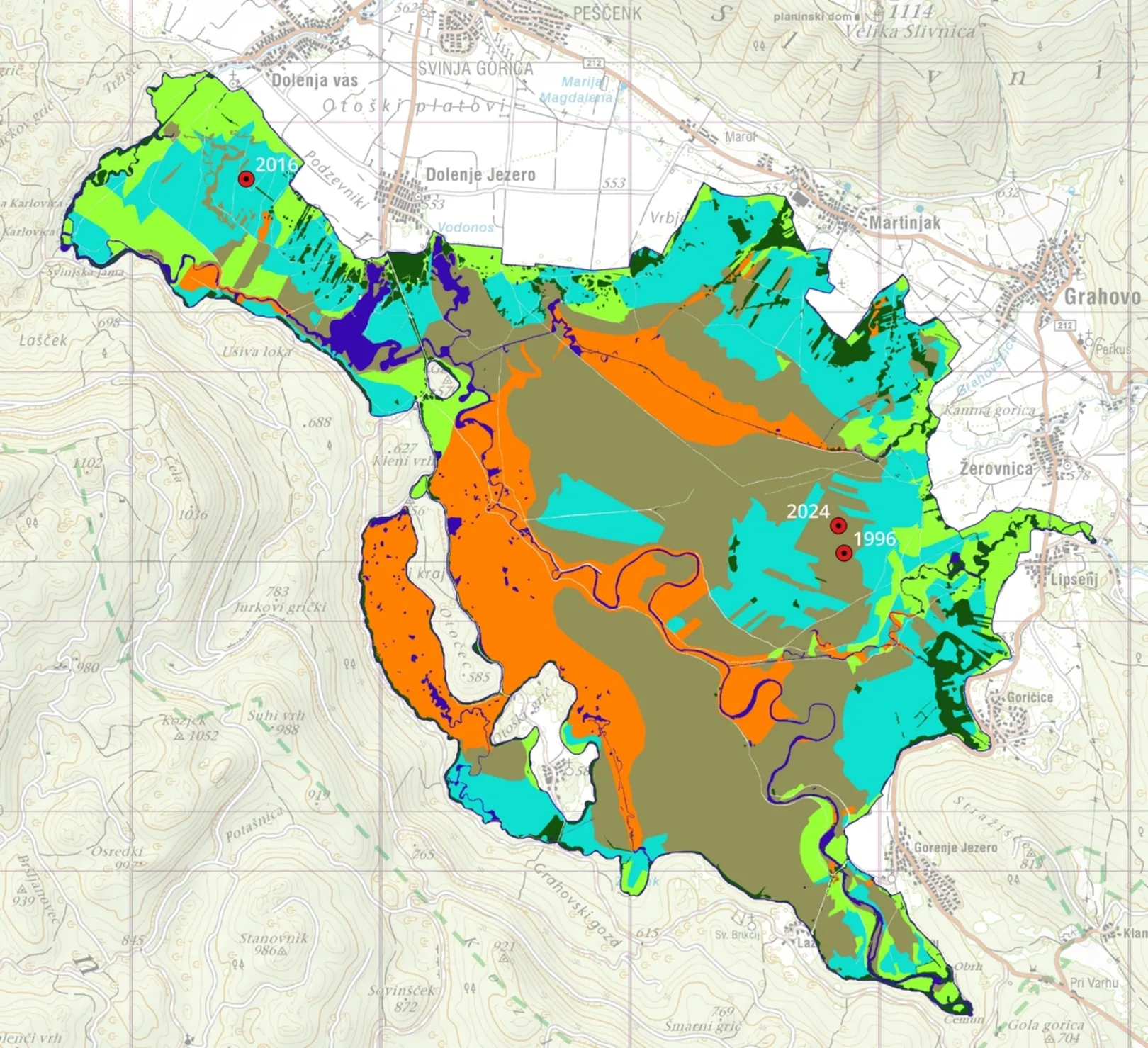
"Blata" are crucial for the Eurasian curlew
It appears that the "blata" shown in light blue on the map, covering around 25% of the lake, are crucial for Eurasian curlew at Lake Cerknica. This is the term used by locals to refer to the areas on the outer part of Lake Cerknica that are rarely reached by lake water and are covered with various communities of alkaline low marshes, low sedges, and purple moor-grass. These areas are very wet and unsuitable for agricultural machinery even in the middle of summer, when the lake is completely dry. This appears to be an ideal habitat for the Eurasian curlew. Or rather, it was until the marshes were still mowed by hand, until around World War II. At that time, the marshes covered approximately 700 ha, and mosaic mowing, which was not carried out everywhere every year, created a huge area without shrubs and trees. Here, patches of low vegetation on plots mowed the previous year alternated with slightly taller vegetation on plots that had not been mowed for several years.
It is a pity that we have no data on the size of the population from those times, but Gregorij's findings from the 1970s confirm the importance of the marshes for the Eurasian curlew.
After World War II, mowing marshes gradually began to be abandoned. This was primarily because the soil, due to many years of waterlogging, did not allow for mechanical mowing. As a result of this abandonment, the marshes began to become overgrown with reeds and other shrubs in some places. A large part of the marshes around Dolenje Jezero, Martinjak, Grahovo, and Lipsenj are therefore no longer suitable for Eurasian curlew to nest, as there are no longer any large open areas there. The bushes also provide hiding places for foxes and jackals, which causes an additional problem of nest predation. The areas of Dujce and Benetek have become overgrown with tall vegetation, which are so high that they prevent lapwings from moving around.
Larger areas of unovergrown marshes remain mainly near Dolenja vas in the west and near Žerovnica in the east of Lake Cerknica. The Dolenjska and Žerunska blata are also the only areas where we have so far managed to find Eurasian curlew nests. Only here do we observe Eurasian curlew mating every year, but even here the conditions are not ideal. Part of the Žerunska blata, where two nests were discovered, is flooded for a short time almost every year during the nesting season, which is fatal for nests with eggs. Another problem is that a large part of the Žerunska and Dolenjska blata are mowed regularly every year. As a result, the vegetation here is so low that it does not provide safe cover for Eurasian curlew to nest – the birds would be too exposed to predators. In the Dolenjska blata, another problem is walkers who often let their dogs run free in the meadows, which of course makes nesting even more difficult for such a sensitive and rare bird as the Eurasian curlew.
Literature:
- Bordjan, D. (2012): Vodne ptice in ujede Cerkniškega polja (južna Slovenija) v letih 2007 in 2008, s pregledom najzanimivejših opazovanj do konca leta 2010. - Acrocephalus 33 - 152/153: 25-104.
- Gregori, J. (1978): Prispevek k poznavanju ptičev Cerknicškega jezra in bližnje okolice - Acta carsologica 8/7: 305-329
- Jančar, T., Stergaršek, J. & Kraševec, R. (2023): Popis kosca Crex crex na Cerkniškem jezeru v letu 2023 in analiza njegovega habitata. - Notranjski regijski park, Cerknica.
- Tome, D. & Vrezec, A. (2023): Poročilo o daljinskem sledenju velikemu škurhu (Numenius arquata) z Ljubljanskega barja (končno poročilo: v 2.0). Naročnik: Javni zavod Krajinski park Ljubljansko barje. Ljubljana (Nacionalni inštitut za biologijo).
- Tome, D. & Vrezec, A. (2024): Veliki škurh (Numenius arquata) na Ljubljanskem barju v letu 2024 (v 1.0). Naročnik: Javni zavod Krajinski park Ljubljansko barje. Ljubljana (Nacionalni inštitut za biologijo).
The article was prepared by Tomaž Jančar for the magazine Svet ptic (2025/4).
Report on the breeding population of the Eurasian curlew on Lake Cerknica