LIFE FOR SEEDS: Discovery of a new species for Slovenian flora at Lake Cerknica

Published: 23. 02. 2026 Author: NRP Categories: Nature, Projects

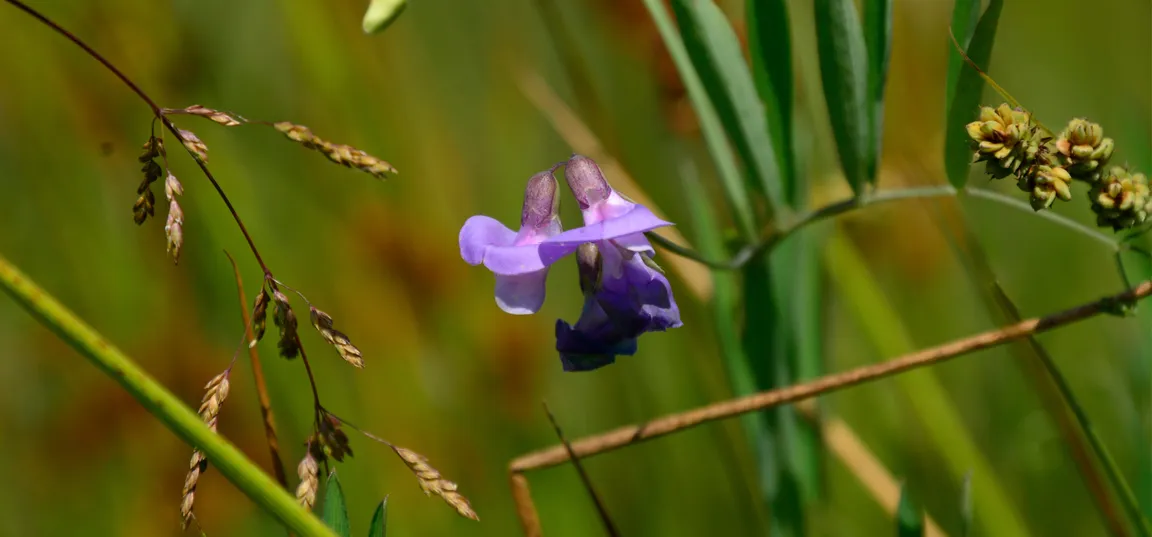
A small purple flower grows in the foreground among green grass stalks, slightly blurred due to movement or focus. Around it are grass blades and dry brown seed heads.
Photo: Primož Žižek

Although our knowledge of the living world around us is becoming more complete every day, nature still has the power to surprise us. Even in Europe, one of the most thoroughly researched parts of the world, something completely new is occasionally discovered. This is exactly what happened at the intermittent Lake Cerknica, where researchers from the Jovan Hadži Biological Institute, part of the Scientific Research Centre of the Slovenian Academy of Sciences and Arts (ZRC SAZU), and the Slovenian Birdwatching Society (DOPPS), as part of the LIFE FOR SEEDS project, discovered a plant species that was previously unknown in Slovenia.

The species in question is Lathyrus palustris or in english marsh pea, which was first documented and confirmed as part of the Slovenian flora in the area of Lake Cerknica. As it did not yet have an official name in Slovenia, the researchers named it močvirski grahor – grahor after the Slovenian name of the genus Lathyrus, and močvirski after the Latin adjective palustris, which means "marsh".

A wetland plant with intercontinental distribution

The marsh pea is a typical marsh plant, associated with moist and occasionally flooded habitats. It is relatively widespread globally, thriving in the temperate zones of Europe, Asia, and North America, which is why it is classified as a species with a Holarctic distribution. It has been recorded in all countries bordering Slovenia, but has not been mentioned in any of the identification keys for Slovenian flora to date.

This gap has now been filled with the new discovery. The discovery is also important from a scientific point of view, as it connects the areas of distribution of the species between Central and Southeastern Europe, where the marsh pea is rare and often considered an endangered species.

How can we recognize marsh pea?

Although at first glance it resembles some other species of pea with pink flowers, it can be reliably identified by several characteristic features. It has a narrow winged stem, leaves with tendrils, and usually two to three pairs of very narrow, almost linear leaflets. The flowers are pink and grouped in inflorescences, which usually contain two to six flowers. It is this combination of characteristics that distinguishes it from related species.

Home on our very special piece of the world

In the area of the Lake Cerknica, the marsh pea thrives in several different marsh plant communities. Researchers have found it in tall sedge, on wet meadows with Molinia caerulea, and in basic low marshes dominated by Schoenus ferrugineus. Such habitats are characteristic of areas that are flooded for part of the year and then gradually dry out – it is precisely this dynamic that creates an exceptional diversity of habitats.

Between 2022 and 2024, researchers found the species at eight locations, which can be grouped into three larger areas within the Cerknica polje. Given the size of the intermittent Lake Cerknica, it is highly likely that the marsh pea thrives in additional, as yet undiscovered locations.

A rare but valuable find

Although the marsh pea is classified as not endangered on a global scale, it is rare in many European countries. For this reason, it is protected by law in some places, such as Croatia, Hungary, and parts of Austria. In Slovenia, it does not yet have special protection status, as its presence had not previously been confirmed. However, given its dependence on rare habitats that are sensitive to human intervention, it undoubtedly deserves to be included on the list of endangered plants in Slovenia.

This is why further monitoring of this remarkable plant is very important. The new discovery not only enriches the list of Slovenian plant species, but also further confirms how exceptionally valuable in terms of nature conservation and interesting for research our special corner of the world is.

LIFE FOR SEEDS

LIFE FOR SEEDS focuses on establishing a seed bank of 300 representative species of three priority habitat types at the European Union level.

Nalaganje...
Projects in the Notranjska Park
Logotip notranjskega parka z rastlino in metuljem.

Projects in the Notranjska Park

The implementation of extensive nature conservation projects exceeds the financial capacity of the local community, therefore Notranjska Park regularly applies for projects with the possibility of co-financing by the European Union.

The implementation of large-scale conservation projects exceeds the financial capabilities of the local community, therefore Notranjska Park regularly applies for projects with the possibility of co-financing from the European Union.

Read more
Read more