
LIFE TRŠCA: An exceptional start to 2026 with more than 18,000 recorded birds

Published: 23. 04. 2026 Author: NRP Categories: Projects

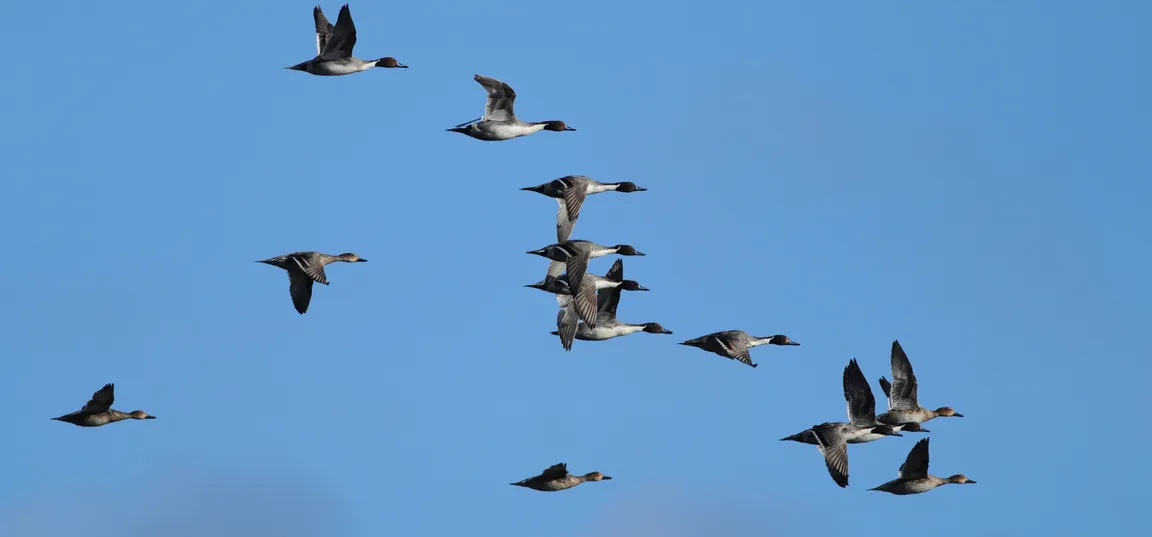
A flock of birds flies through the air in a loose V-formation; against a uniform, cloudless blue sky, dozens of birds with outstretched wings hover in the air.
Among the ducks, we noticed an unusually large number of long-tailed ducks. (Photo: Dejan Bordjan)

The first three months of 2026 are already behind us, and we are now well into spring. During three months of bird monitoring, we recorded as many as 55 species of waterbirds, birds of prey, and corvids, totaling more than 18,000 individuals. The most numerous were Eurasian teal (Anas crecca), Eurasian wigeon (Anas penelope), Northern pintail (Anas acuta), and Eurasian coot (Fulica atra). All of these species overwintered on the lake, each exceeding 2,000 individuals during this period. More than 1,000 Mallards (Anas platyrhynchos) were also counted. One indicator of good and natural habitat conservation is the ratio between mallards and other duck species. Areas where the mallard is not the most abundant duck are generally more natural and provide better conditions for birds. This is also confirmed by the diversity of ducks, as we recorded a total of thirteen species at the lake during the first three months.

Well-preserved natural wetlands, such as Lake Cerknica, also attract many rarer species. This year, we have already recorded both target species of the LIFE Tršca project: the Red-necked grebe (Podiceps grisegena) and the Ferruginous duck (Aythya nyroca). The former was observed only once, but there is still hope for a successful breeding season. More observations were gathered for the ferruginous duck, which also overwintered in the area. Although increasingly common in recent years, this remains a relatively rare occurrence in Slovenia. While no pronounced migration of ferruginous ducks was recorded this year, their numbers increased noticeably after winter. They have already formed pairs and are showing early breeding behavior. Although the lake currently holds very little water for this time of year, their breeding season is still some time away, and these observations give us reason for optimism.


In February and March, Common cranes (Grus grus) delighted observers. Unlike in the rest of Slovenia, they were frequently observed roosting here, further increasing the conservation value of the lake. In March, cranes gradually gave way to Waders (Charadriiformes), which also benefit from the extensive shallow areas of the lake. Among the more notable species recorded were the Black-tailed godwit (Limosa limosa), Common redshank (Tringa totanus), Eurasian spoonbill (Platalea leucorodia), and Lesser black-backed gull (Larus fuscus). The arrival of the first Swallows (Hirundinidae) also marked the transition into spring.

The contribution was prepared by the Slovenian Society for the Observation and Study of Birds (DOPPS).

LIFE TRŠCA

With LIFE TRŠCA we will improve the conservation status of the intermittent Lake Cerknica.

Nalaganje...
Projects in the Notranjska Park
Logotip notranjskega parka z rastlino in metuljem.

Projects in the Notranjska Park

The implementation of extensive nature conservation projects exceeds the financial capacity of the local community, therefore Notranjska Park regularly applies for projects with the possibility of co-financing by the European Union.

The implementation of large-scale conservation projects exceeds the financial capabilities of the local community, therefore Notranjska Park regularly applies for projects with the possibility of co-financing from the European Union.


Read more
Read more