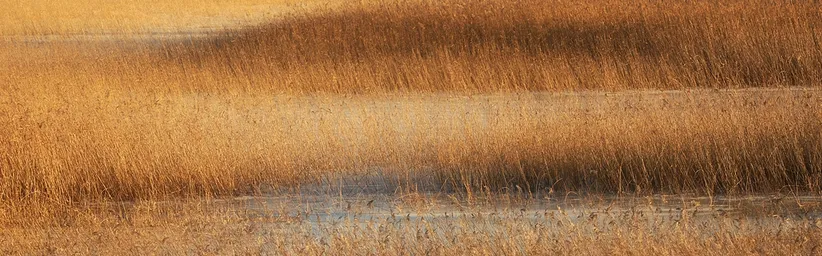
Birds and dragonflies often perch on them. It is perhaps less well known that this is a herbaceous perennial, which is taxonomically classified as a grass. As is typical for perennials, the above-ground parts die off each year, while energy is stored in the root system – in the case of common reed, in the rhizomes. It spreads with the help of seeds that ripen in dense, tufted inflorescences, but vegetative propagation from parts of the roots and stems is also very important. Over the years, the underground rhizome system strengthens and many stems grow from the same rhizome, which can form dense stands of reeds.
Common reed is widespread and common, with no major threats to its survival. In North America, it is even classified as a highly invasive species. It often gets in our way, and we would prefer to eradicate it by mowing and burning. So why is it actually receiving conservation attention at Lake Cerknica?

Figure 1: View of the inflorescences of common reed (Phragmites australis).
Ecological importance of reeds through the seasons
Have you ever stepped into an old reed bed? It is not exactly the epicenter of plant diversity. Perhaps here and there you will see a weed struggling to reach the light on the shaded ground. The ground is covered with years of dead stems and leaves, creating an impenetrable maze where few animals are found. The thickets are so dense that after just a few steps, you lose your sense of direction. Nevertheless, the reed bed is one of the most important habitat types at Lake Cerknica, as it serves as a refuge, spawning ground, nesting site, and feeding ground for numerous species. The role of the reed bed depends heavily on the size and structure of the stand, the season, and the water level.
In winter, when the water level is high and the water is cold, the northern pike (Esox lucius) and tench (Tinca tinca) lay their eggs deep in the reed bed below the water surface. Although common reeds are dormant, old woody stems provide cover from other predators, and the vegetation also protects them from the water flow, which is otherwise gentle but persistent. In the slightly deeper water of the Stržena stream, pike stop at the edge of the reeds and patiently wait for their prey. Later, at the beginning of spring, brown frogs set off from the forest. The best places for common frogs (Rana temporaria) to lay their eggs are shallow open water areas surrounded by dense reeds, which allow the tadpoles to quickly escape to safety. Such waters could be called lake windows.

Figure 2: Mallards (Anas platyrynchos) overwinter safely in the shelter among the reeds.
In springtime, birds also begin to nest. For their nesting site the redhead (Aythia nyroca) and the brown-necked grebe (Podiceps grisegena) prefer lake windows, where the shallow water heats quickly and there is enough food. Similarly, the moorhen (Fulica atra), the crested grebe (Podiceps cristatus) or the gray goose (Anser anser) and other species do so, though they are somewhat less picky. The reed also provides enough nesting material, which they weave into a nest among the dried culms, and the succulent young shoots of the plants are already available for food. In addition to birds, the early reed dragonfly (Brachytron pratense) also begins to fly around the reeds, as do many larval stages (Trichoptera sp.). In the evening the chorus of the green tree frog (Hyla arborea) is joined by the drumming of the bittern (Botaurus stellaris), calls are also heard from the little crake (Porzana parva) and the water rail (Rallus aquaticus), and surely some other species as well. During the day the air is filled with the chirping of the reed warbler (Locustella luscinioides) and numerous reed warblers (Acrocephalus sp.).
In summer the water slowly withdraws and increasingly exposes aquatic life to predators from the air. On a large pile of drift from dead reeds, the white-tailed eagle (Haliaeetus albicilla) perches and calmly consumes fresh prey, and the calm in the reeds and abundance of fish nearby is exploited by the otter (Lutra lutra). The doe deer (Cervus elaphus) also safely raises fawns. When the water finally recedes and the summer heat begins, moist ground in the shade of the reeds is used by numerous green frogs (Pelophylax sp.), whose skin would otherwise dry out. In dried lake windows, the brown bear (Ursus arctos) scavenges the remains of dead fish. In August a short mowing period also begins and landowners hurry with removing biomass from the lake. The first heavy rains will soak the soils and tractor access will no longer be possible.

Figure 4: A red deer fawn patiently waits for its mother.
In early autumn at night over the wide plains of Lake Cerknica, the piercing croak of the stag's call sounds. From the night call, weary deer herd choose for their daily resting places what remains of the large reed stands after mowing. The abundance of prey in reeds is also exploited by the wolf (Canis lupus), flocks of starlings (Sturnus vulgaris) and barn swallows (Hirundo rustica) on migration. But when the water again floods the karst field, terrestrial animals retreat, and after a short period when few animals are visible, with the onset of winter many ducks return to rest in the shelter of the reeds, feed on seeds or rest on piles of driftage.
How to ensure proper management?
Listing species that are connected with reed beds in some way is only illustrative of the role reeds play in the good state of Lake Cerknica. Of course there are many other species connected with reed beds that are not mentioned here. One of the key questions is therefore how to ensure such a management approach that we maximize the biodiversity potential of the area? What are the key ecosystem functions of reed beds – is it peace and shelter, or is it a source of food?
Therefore it is important to have a good knowledge of the distribution of species and their ecology in relation to management approaches. It is also important to have good knowledge of how reed beds respond to mowing, which is specific due to the demanding habitat conditions at Lake Cerknica. From the knowledge gained, it is important to develop a comprehensive management plan, in which some areas are planned as no-mow zones to permanently preserve old reed stands. Elsewhere areas with occasional mowing (e.g., every 3-5 years), and areas with moderate mowing intensity (every 2 years), and areas with regular mowing are planned. In addition, it is important to implement low-intensity measures for maintaining lake windows and ensuring connectivity – with shoreline vegetation, unmown islands and strips.
Because it is almost impossible on the first attempt to prepare a perfect management plan, it is important to monitor population status and the implementation of management continuously, and respond accordingly and supplement it with new knowledge. In addition to mowing, the annual cycle of water level fluctuations is an important factor and managing it is particularly important in light of past interventions and climate change.

Figure 5: View of Levišča, where the largest consolidated stand of reeds on Lake Cerknica is. In the lower right corner you can also see a lake window.
Experience from abroad
Similar challenges are faced in other areas as well; in many places this issue has been dealt with for many decades and they have accumulated a lot of experience and developed support systems for good planning and monitoring of management. Therefore, within the LIFE Tršca project, which focuses on the reed beds of Lake Cerknica, we visited the Ham Wall Nature Reserve in England and Prespa National Park in Greece. The experiences gained, complemented by knowledge from the literature, will be transferred and included in the preparation of the management plan for Lake Cerknica. This is a challenging process, which we will carry out together with a wide range of stakeholders over the course of a multi-year project.
Author: Rudi Kraševec, conservation biologist on the LIFE TRŠCA project