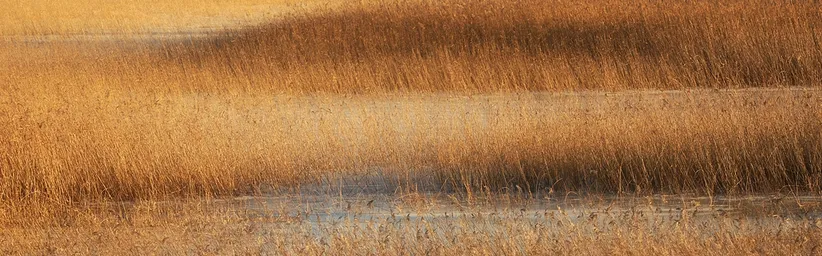
The water levels in the intermittent Lake Cerknica fluctuates, which has recently, due to the consequences of climate change, become more unpredictable. Therefore only plants adapted to such conditions can thrive in these habitats. They are called amphibious plants and can thrive underwater and also when the water recedes. One of the adaptations that allows them to thrive in such diverse environments is heterophylly. This means that on the same plant leaves of different shapes have developed: submerged, floating or aerial.
At Lake Cerknicae Variable water levels guide the development of leaves in certain plants, influence the distribution of plants and plant communities in different habitats, move mowed vegetation, and thus change conditions over a larger area., water is the driving force that determines the growth of plants and the survival of other organisms. With every change in the water regime, the conditions at Lake Cerknica also change, enabling or hindering the development and life of animals and plants. As part of the LIFE TRŠCA project, we study how lake management affects plants, including amphibious plants. Every intervention in the lake and its tributaries can have severe consequences for the plants in this area.

Extreme heterophylly in the species Sium latifolium (broad-leaved water-parsnip), where on the same plant you can see leaf forms that are characteristic of submerged plants, as well as leaves that are found in typical terrestrial species. Because of such pronounced heterophylly, it is hard to believe that such very different leaves belong to the same plant.


If you look at the different leaves of the common arrowhead (Sagittaria sagittifolia), you would never guess that they belong to the same plant. Submerged leaves are very thin and strap-like, similar to the leaves of typical aquatic plants. The aerial leaves have a leaf blade in the shape of a spear, with a waxy coating called a cuticle that protects the leaves from excessive water loss.

Not only plants, but the water also constantly changes the entire landscape of the Cerknica Plain. Meandering streams, such as the Stržen, on one side erode their banks, on the other deposit sediments and reshape the bed of Lake Cerknica. At high flows, the river's transport capacity can move large amounts of organic matter and clayey sediments.

After a period of heavy rainfall in mid-September, the water level suddenly rose and flooded numerous surfaces that had been mowed just before the rise. The water raised the mowed reeds, sedges and other plants and, with the help of wind, moved huge piles of this material, which later became stuck on vital stands of reeds. Some meadows were buried under dead plant material, which caused anger among the owners of these lands.
The contribution was prepared by the Faculty of Biotechnology, University of Ljubljana.