The aim of the project is to take a comprehensive approach to the conservation of reed beds, adapt their use, and ensure favorable living conditions for the species that inhabit them. One of the key activities for ensuring the long-term nature of appropriate measures is the reform of existing agricultural interventions and the design of new ones in the new programming period of the common agricultural policy after 2027, which will ensure appropriate use and be attractive to farmers, and this is also the most important role of the ministry as a partner in this project.
The requirements that contribute to the preservation of marsh vegetation at Lake Cerknica are included in the strategic plan for the common agricultural policy 2023–2027, and are based on cross-compliance rules and specific intervention schemes under the Climate and Environment Scheme (SOPO) and specific intervention operations under the Agri-Environmental-Climate Payments – Biodiversity and Landscape (hereinafter: KOPOP_BK).
Cross-compliance rules are mandatory requirements (hereinafter: PZR) based on European Union legal acts and standards for good agricultural and environmental conditions (hereinafter: DKOP), as specified in the Strategic Plan for the Common Agricultural Policy 2023–2027. This is a set of mandatory rules or standards that we knew in previous programming periods as cross-compliance. In terms of content, conditionality is more demanding than cross-compliance, as most standards have become stricter, and some, partially modified, practices of the green component of direct payments from the 2015–2022 period have been added to the list of standards. Beneficiaries of subsidies are required to comply with them, but do not receive additional payments for doing so. Compliance with the cross-compliance rules is a prerequisite for farmers to receive payments for interventions that are claimed under the single application. The cross-compliance rules include nine GAEC standards and 11 SMR standards. The following cross-compliance standards apply to the conservation of wetlands at Lake Cerknica:
GAEC 2: Protection of wetlands and peatlands;
PZR 3: Conservation of wild birds;
PZR 4: Conservation of natural habitats and wild animal and plant species;
DKOP 8: Minimum proportion of arable land allocated to non-productive areas and features (to be implemented by 2025, after which non-productive areas will be provided under the voluntary SOPO scheme), and on all agricultural areas, preservation of landscape features and prohibition of cutting hedges and felling trees during the breeding and rearing season for birds;
DKOP 9: Prohibition of conversion or plowing of permanent grassland in Natura 2000 areas.
Intervention The Climate and Environment Scheme (SOPO) contributes to establishing a balance between the need for food production and climate and environmental protection. The schemes are voluntary for farmers and annual, giving farmers greater flexibility than multi-annual commitments. Each year, farmers decide whether to participate in the SOPO schemes and which SOPO schemes to participate in. For Lake Cerknica, the INP 8.01 Extensive Grassland (EKST) scheme is applicable.
Intervention IRP 18.03 Agri-environment-climate payments – biodiversity and landscape (KOPOP_BK) contributes to the preservation and improvement of biodiversity and landscape diversity with 15 operations. Farmers decide to implement these operations on a voluntary basis, and the implementation obligation lasts for five years. Four operations can be implemented in the Notranjska Park area, three of which are under the management scheme and one under the management-results scheme.
The management schemes are:
BK.1 Special grassland habitats (HAB);
BK.5 Conservation of wetlands and marshes (MOBA);
BK.11 Control of invasive alien plant species (ITRV).
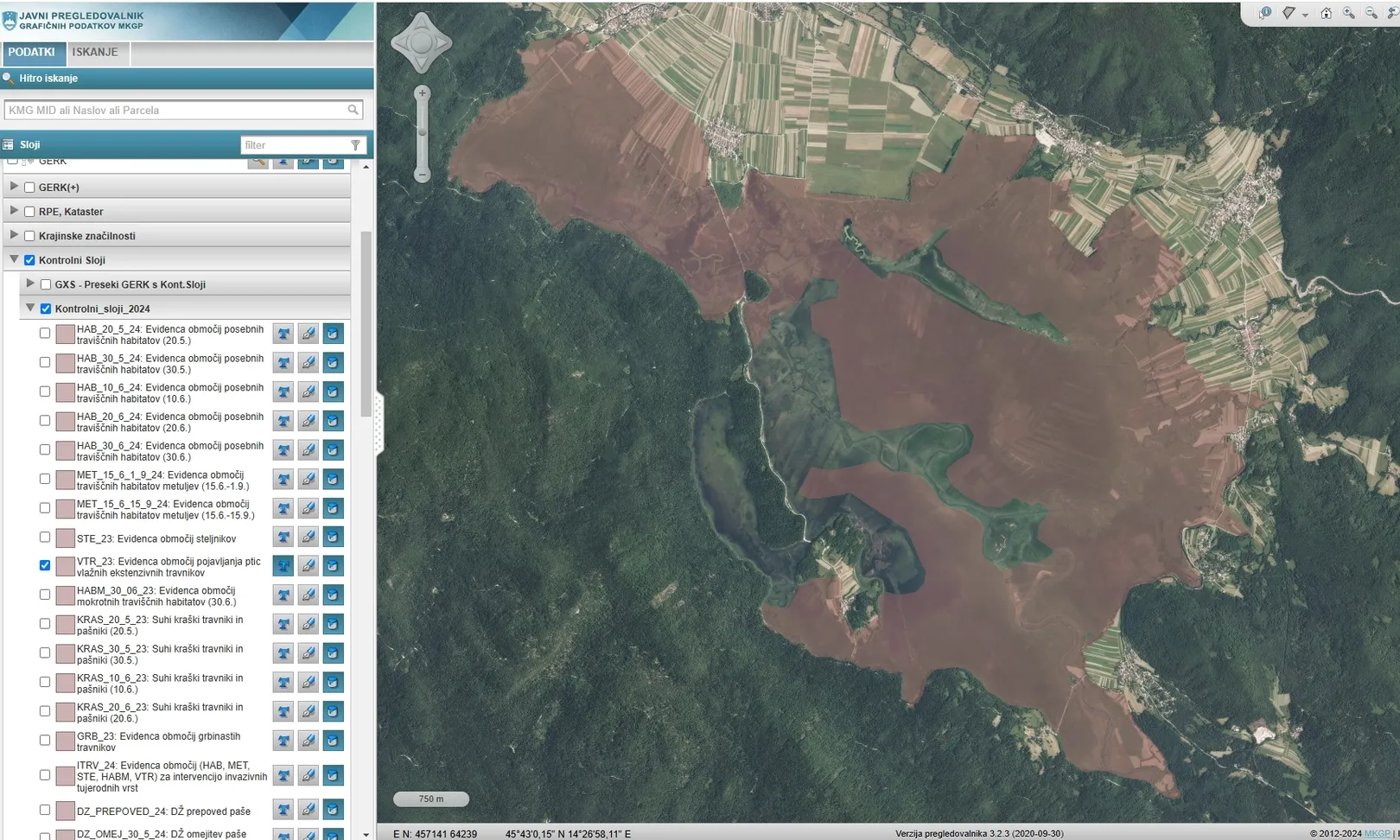
Management-performance scheme: BK.14 Habitats of birds in wet extensive grasslands (VTR).
More information on the rules of conditionality and SOPO and KOPOP interventions is available on the websites of the Ministry of Agriculture, Forestry and Food and the Slovenian Agency for Agricultural Markets and Rural Development, in particular at https://www.gov.si/zbirke/storitve/oddaja-zbirne-vloge-za-leto-2024/ .
Example of a control layer for bird habitats in wet extensive grasslands (VTR_23: Register of areas where birds of wet extensive grasslands occur) from the MKGP Public Viewer of Graphic Data.
Photo: Rudi Kraševec
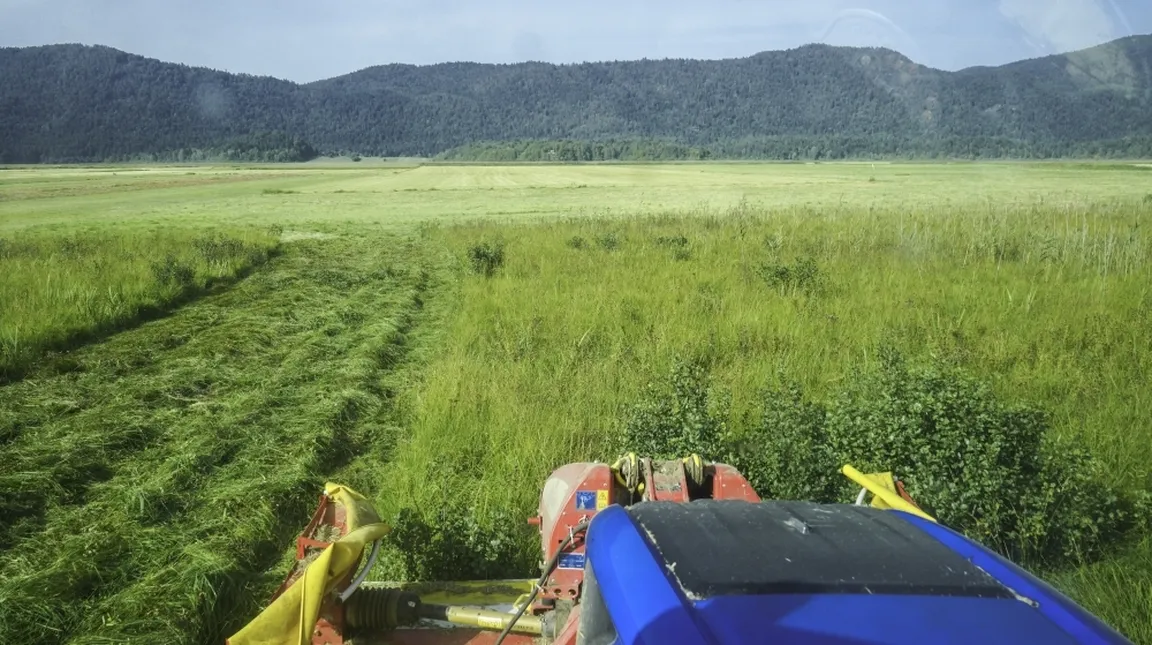
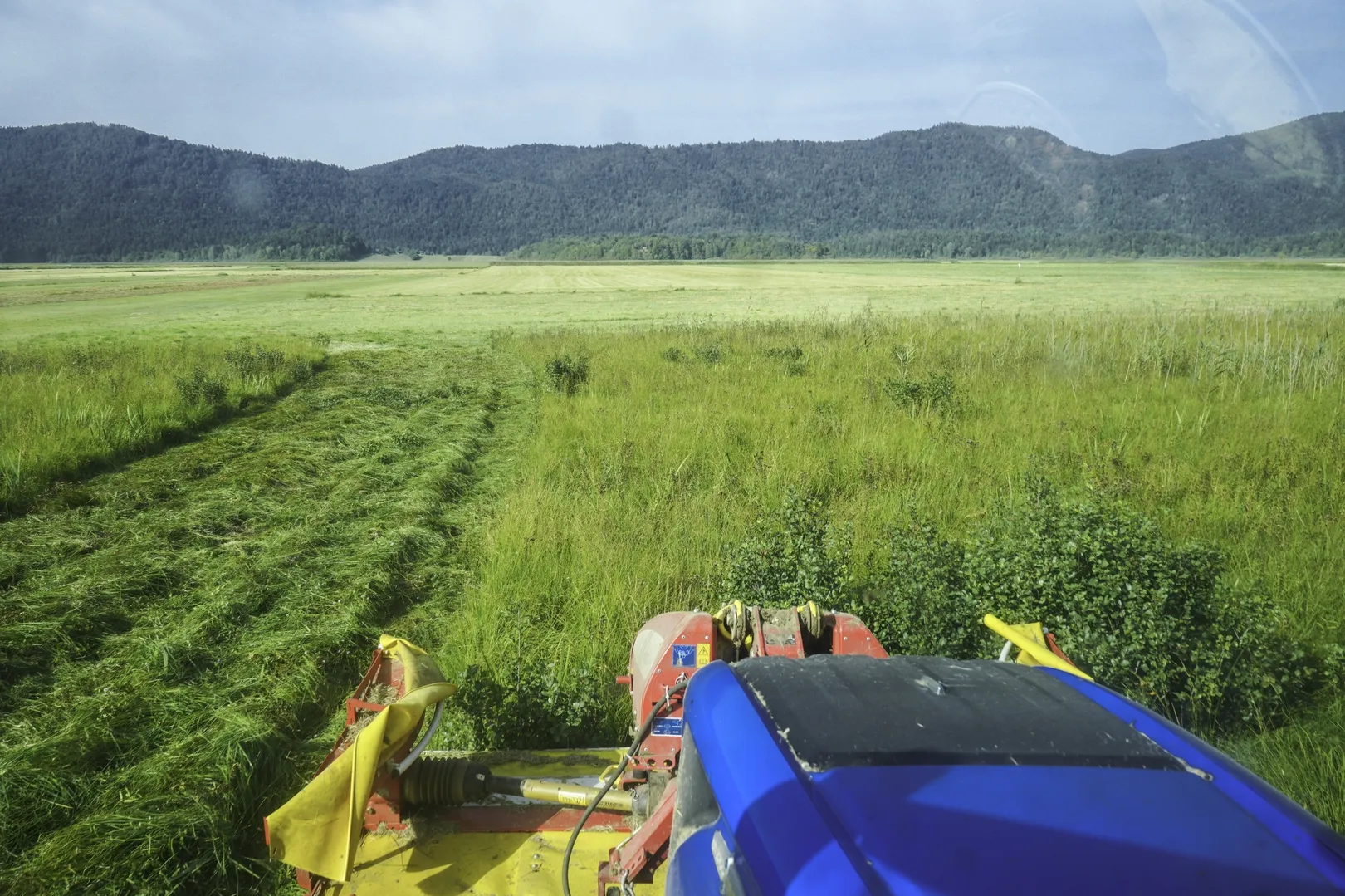
Mowing of wet grasslands in the Notranjska Park.
Photo: Rudi Kraševec
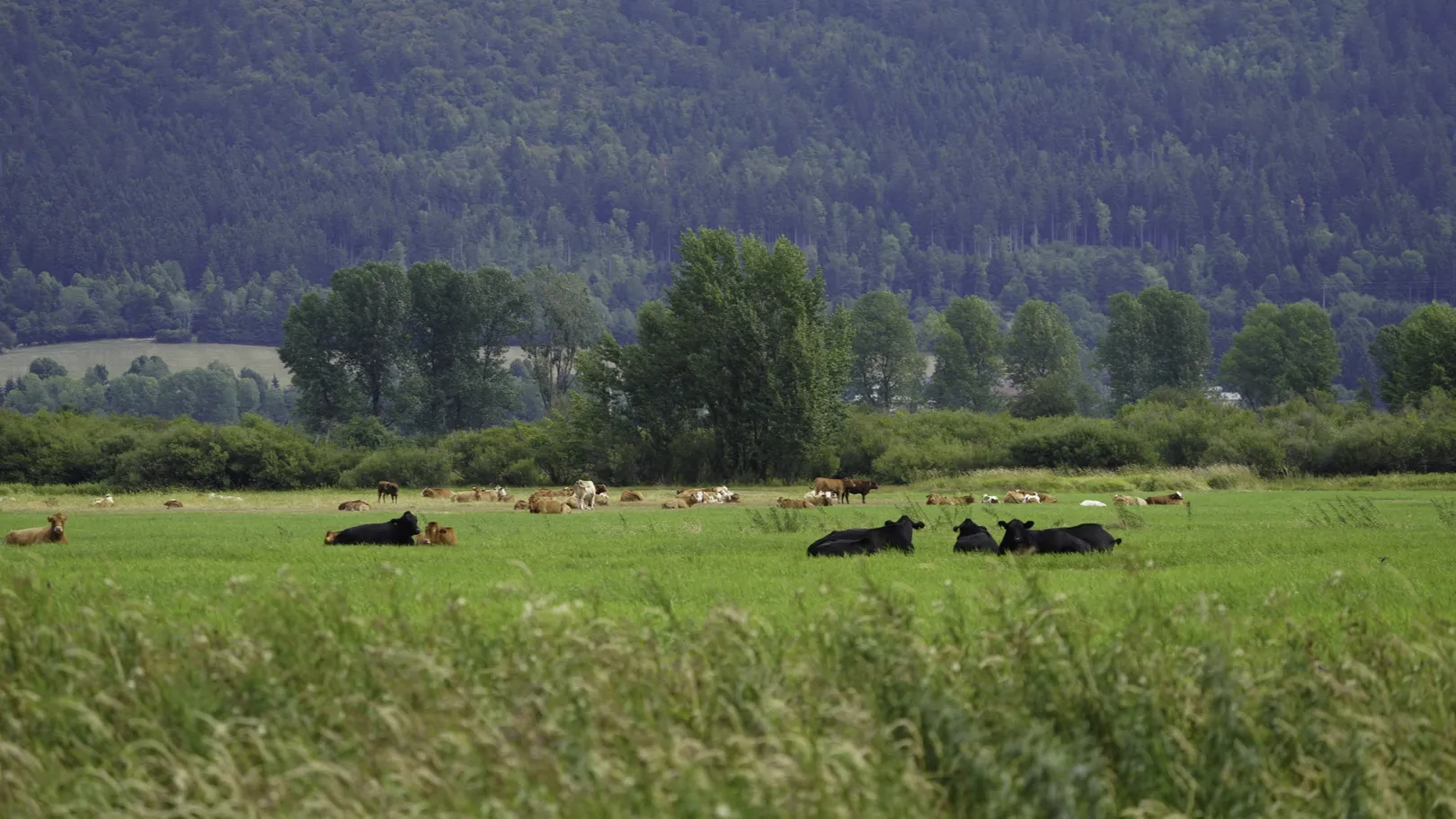
Cattle grazing
The contribution was prepared by the Ministry of Agriculture, Economy and Food.
LIFE TRŠCA
With LIFE TRŠCA we will improve the conservation status of the intermittent Lake Cerknica.
The implementation of extensive nature conservation projects exceeds the financial capacity of the local community, therefore Notranjska Park regularly applies for projects with the possibility of co-financing by the European Union.
The implementation of large-scale conservation projects exceeds the financial capabilities of the local community, therefore Notranjska Park regularly applies for projects with the possibility of co-financing from the European Union.