
LIFE TRŠCA: Determining the past distribution of reedbeds based on land use data from the early 19th century

Published: 18. 12. 2025 Author: NRP Categories: Projects

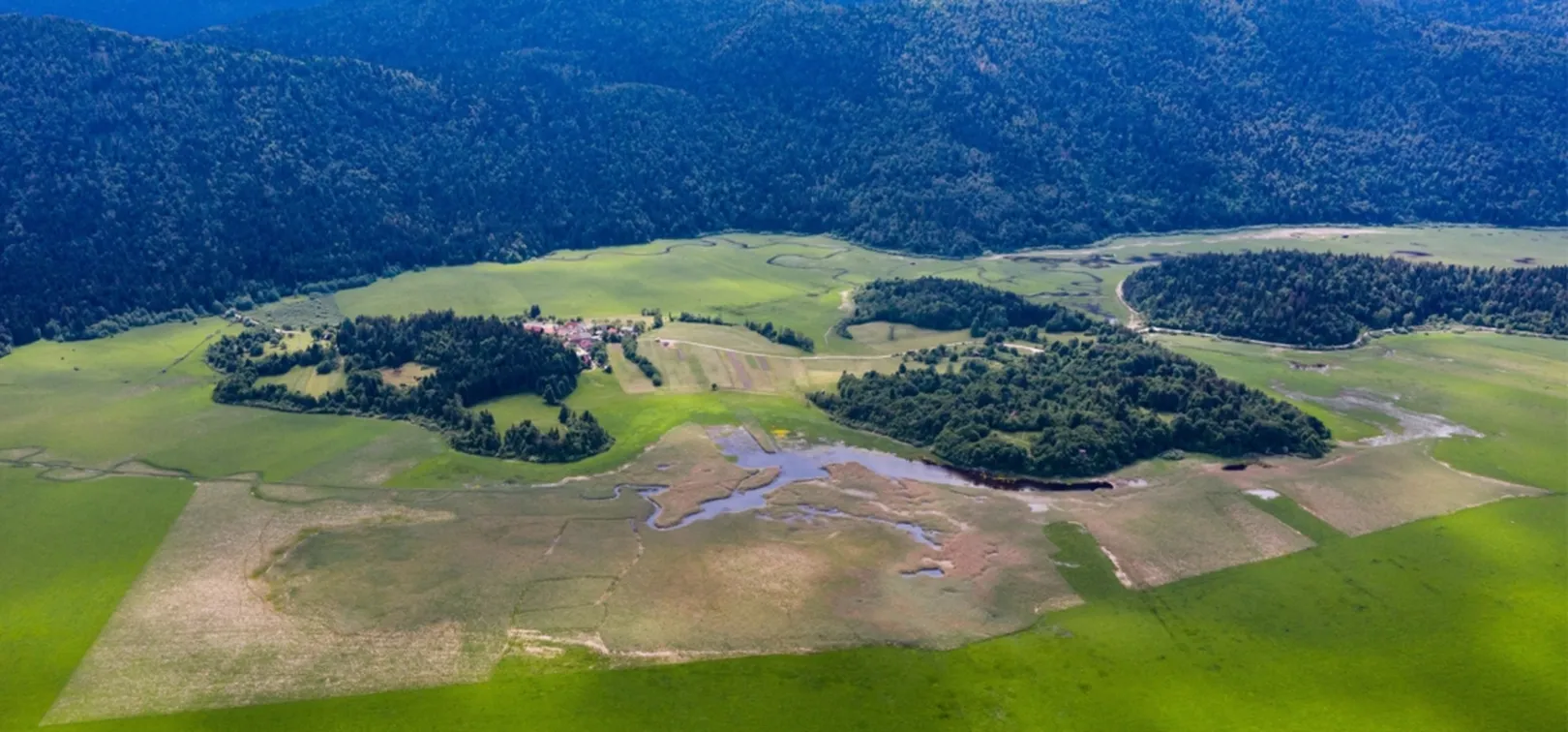
Panoramic view of the dry Lake Cerknica with the winding Stržen watercourse, the central forested island of Goričica, and the surrounding hills in the background.
Cerkniško Polje in the area of Gorica hill and the Dolenje Jezero water gauging station. (Photo: archive ZRC SAZU IZRK)

An interdisciplinary study by the Department of History, Faculty of Arts, University of Ljubljana and the ZRC SAZU, Karst Research Institute, determines the distribution of reedbeds on the Cerkniško Polje before hydrotechnical interventions in the 19th century. The data is based not only on cartographic material, but also on documentary material from the Franciscan cadastre from the 1820s and 1830s, which is written in German and Gothic. The data is understood in the broader context of written sources, ethnological, geographical, historical and popular literature.

A black-and-white page from a cadastral record with handwritten data in a table. The table contains numbers and words in German and Gothic script, such as “Sume” and “mit Zettel,” as well as several columns with different values. Some entries are highlighted in blue.
An excerpt from the land parcel record of the Franciscan cadastre for the cadastral municipality of Otok, indicating a "reed bed" near Stržen east of the Veliki Oltar. Reed beds on that area is not present on the habitat type map from 2009, and only a few vital reed beds are shown there on recent research by the Department of Biology of the Biotechnical Faculty. (Archive Republic of Slovenia - SI AS 176, Franciscan cadastre for Carniola, A117, c.m. Otok, land parcel)

According to cadastral data, "reed beds" covered a good quarter of all “meadow areas” in the then cadastral municipality of Otok (it covered Cerkniško Polje and part of the surrounding area, except for the extreme northwest of the polje in the cadastral municipality of Dolenja vas). In addition, the extent of reeds (or some other marsh plants that, except for young ones, are useless for fodder) was significant even in parts of the extensive meadow areas where reeds did not predominate. Reed beds, which from the point of view of livestock farming provided high-quality fodder from young shoots, and then litter from old reeds, were then mowed approximately four times per decade.

A historical map of the area with marked parcels, fields, and forests, colored in green, brown, and gray. On the left side is the settlement labeled “Ottok,” next to a body of water. The map includes handwritten parcel numbers and German location names.
Excerpt from the land cadastre for the area of the settlement of Otok. (Archive Republic of Slovenia - SI AS 176, Franciscan cadastre for Carniola, A117, c. m. otok, map sheet XVII)

A comparison with the map of habitat types on the Cerkniško Polje from 2009 indicates significant similarities, but also significant differences in the distribution of "reed beds" in the last two centuries. Further research will clarify whether they reflect actual changes in plant communities or whether these alleged changes are also marked by methodological challenges (e.g., what is hidden behind the label "reedbed" in the early 19th century).

Consequently, a study of historical botanical publications is underway, which also focuses on other data on common plant species at the floor of the Cerkniško Polje in the 19th century. It finds, among other things, that the fen ragwort (Senecio paludosus), today a vulnerable species in Slovenia, whose development begins in the water and continues when the lake drains, was already common on parts of the floor of the Cerkniško Polje at that time. During the flowering period, it turns parts of the polje floor yellow nowadays.

Aerial view of a green landscape with extensive meadows, small forested islands, and a settlement on the left. In the foreground are wetlands with bodies of water, and in the background are densely forested slopes of hills or mountains.
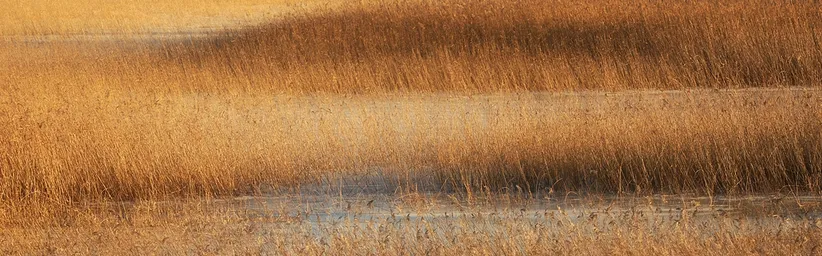
Sharp transitions between mowed and unmowed areas of reedbeds in Levišča. (Photo: archive ZRC SAZU IZRK)

In addition to the LIFE TRŠCA project, the research is primarily supported by the research programme “Slovene history” (ARIS).


Article was prepared by Matej Blatnik (the Karst Research Institute ZRC SAZU) and Žiga Zwitter (Department of History, Faculty of Arts, University of Ljubljana)

LIFE TRŠCA

With LIFE TRŠCA we will improve the conservation status of the intermittent Lake Cerknica.

Nalaganje...
Projects in the Notranjska Park
Logotip notranjskega parka z rastlino in metuljem.

Projects in the Notranjska Park

The implementation of extensive nature conservation projects exceeds the financial capacity of the local community, therefore Notranjska Park regularly applies for projects with the possibility of co-financing by the European Union.

The implementation of large-scale conservation projects exceeds the financial capabilities of the local community, therefore Notranjska Park regularly applies for projects with the possibility of co-financing from the European Union.


Read more
Read more