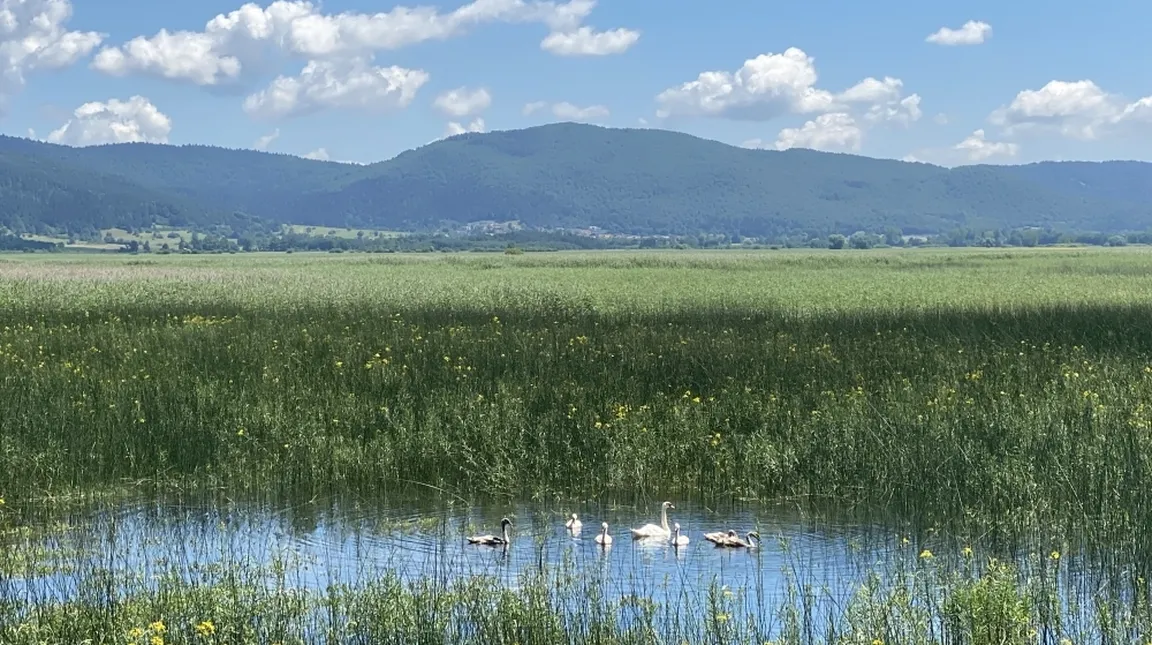
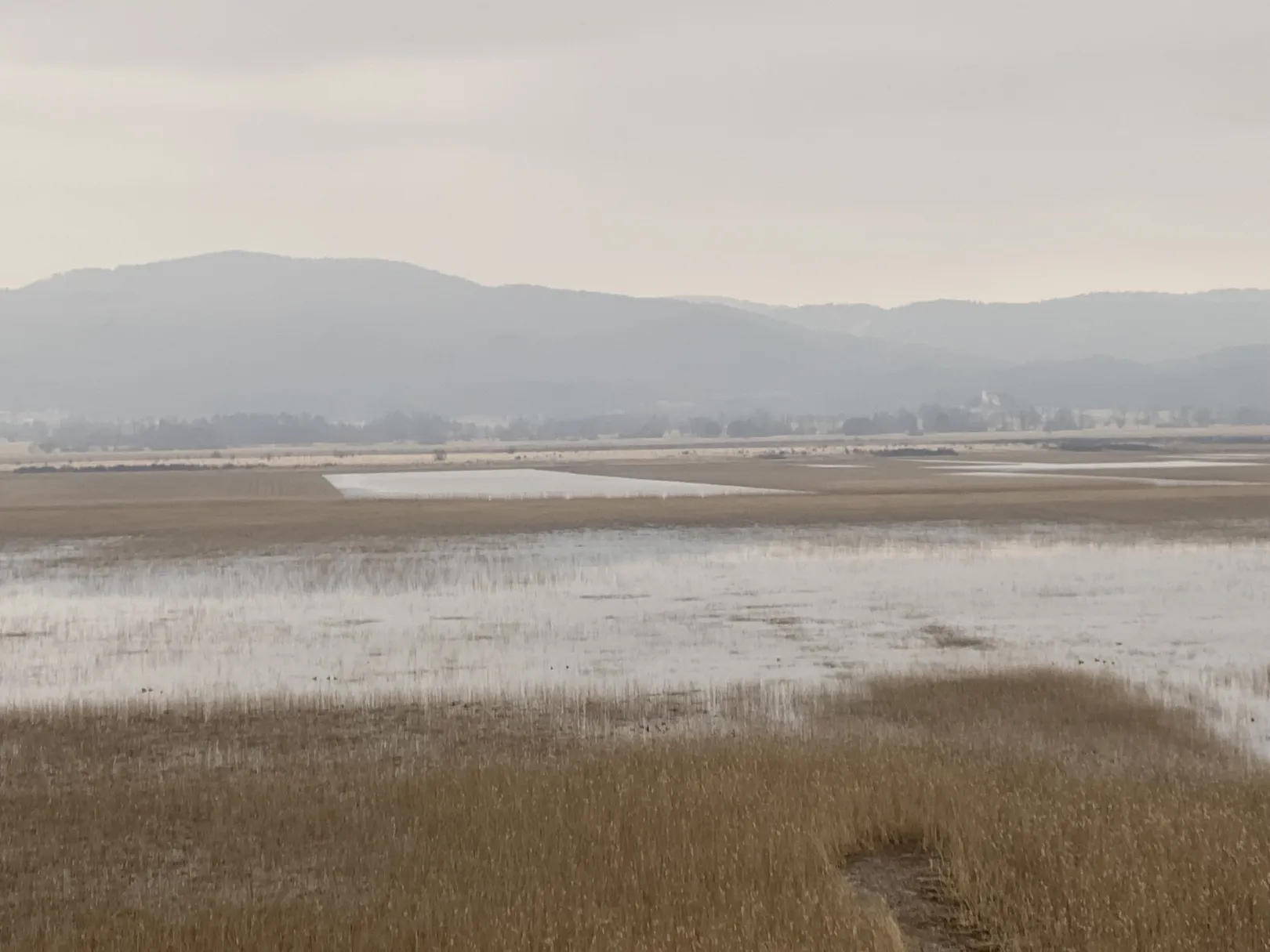
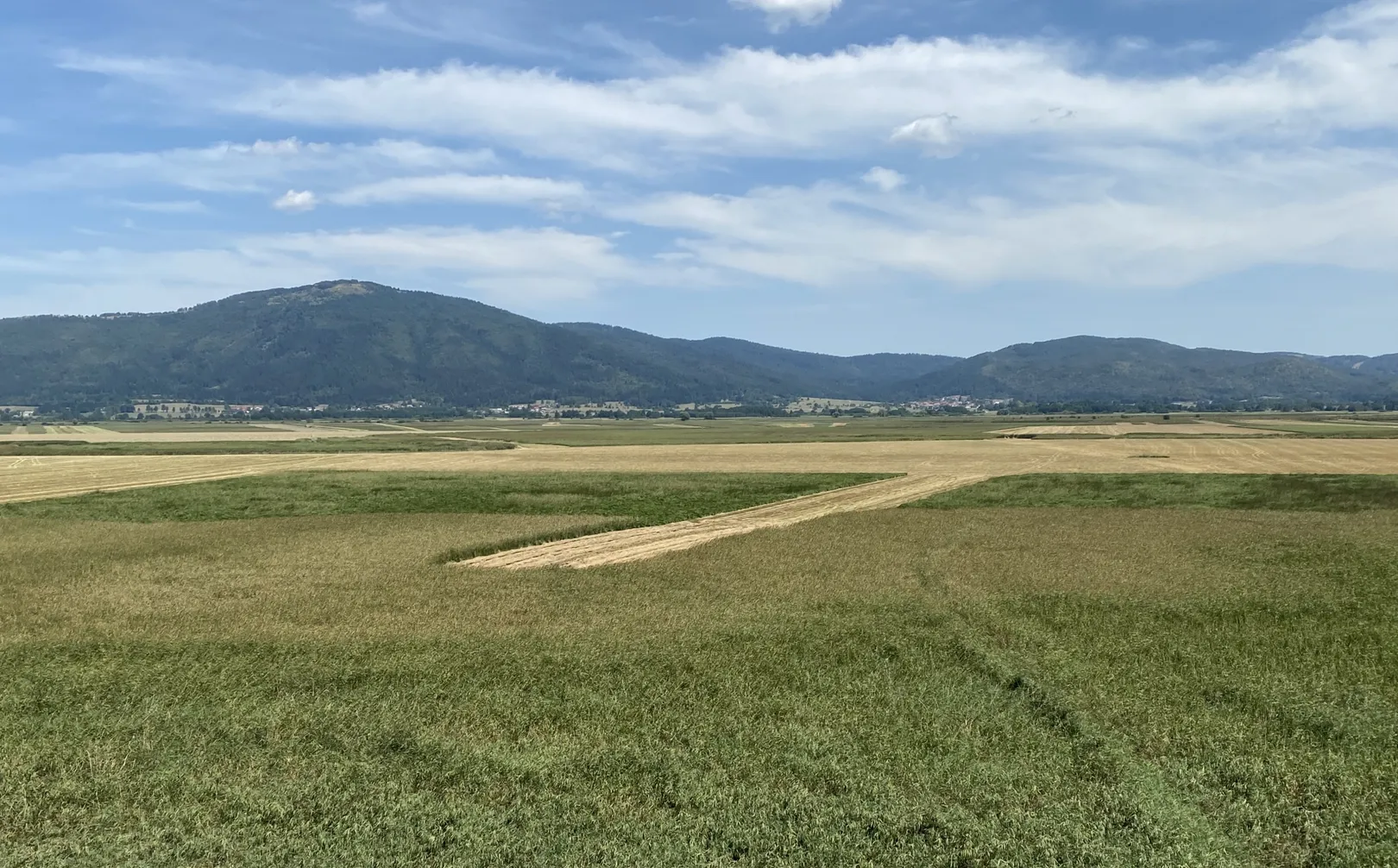
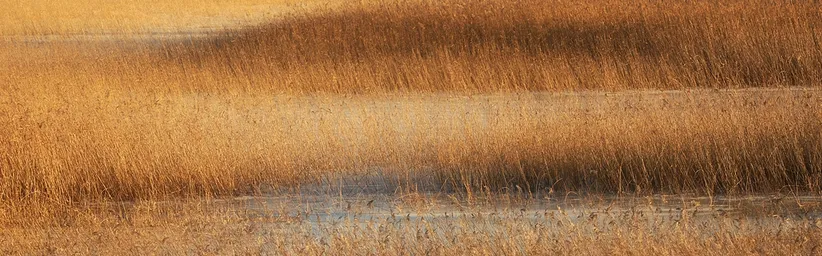
Due to the wetland characteristics of this area, fen and marsh vegetation prevail. Common reed (Phragmites australis) gives the lake’s vegetation its characteristic appearance. It thrives in flooded areas, where during high water the depth can reach up to two meters. Locals know the reed beds as “tršca.”
Reed beds perform numerous functions. They are able to break down and store excess nutrients in the water, especially nitrogen and phosphorus. They are also important for carbon storage, thereby contributing to the reduction of CO₂ in the atmosphere and helping to mitigate climate extremes such as floods, droughts, and high temperatures.
foto: arhiv ZRSVN
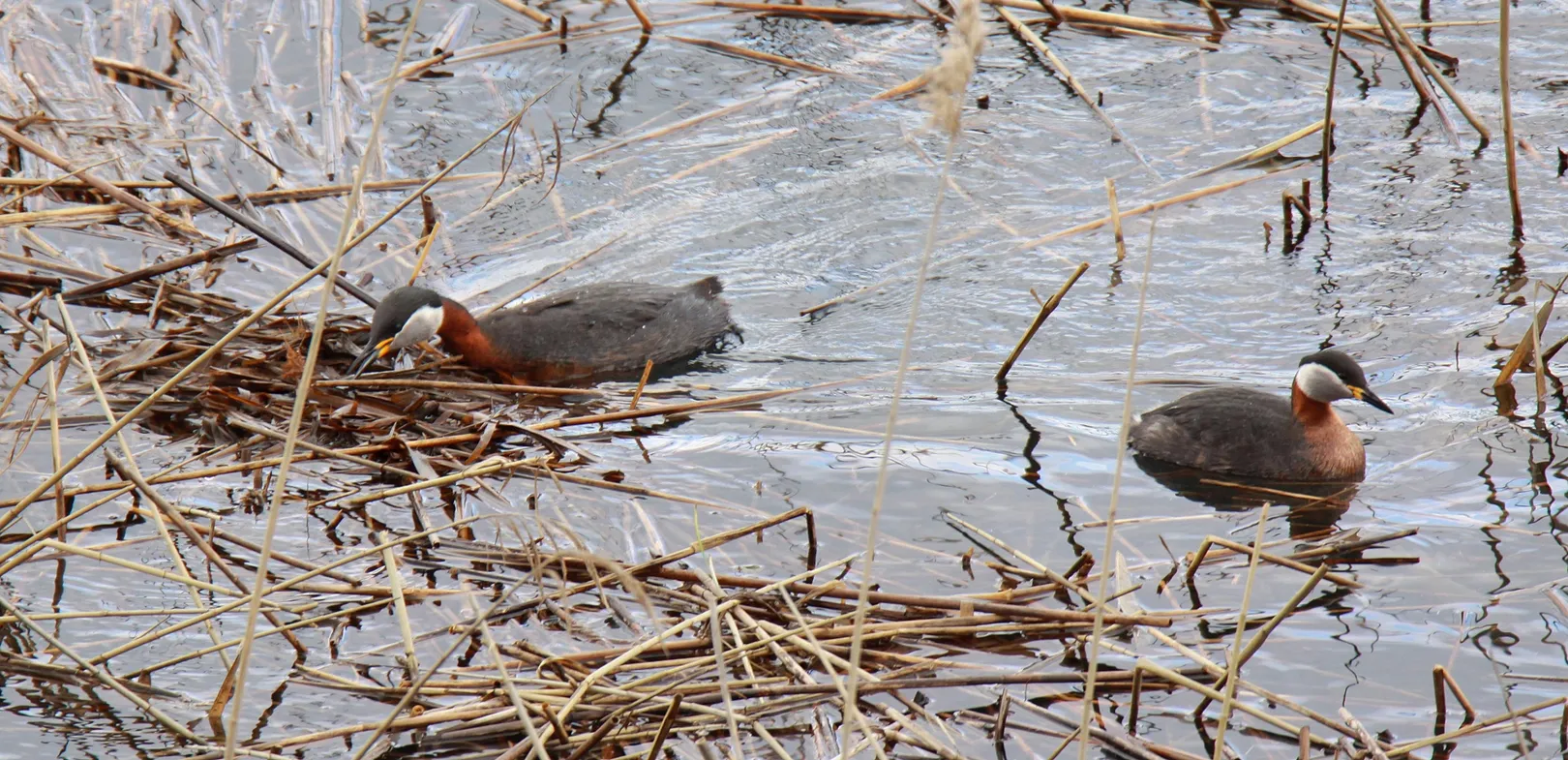
Some European threatened species are also tied to reed beds, such as the Ferruginous Duck (Aythya nyroca) and the Red-necked Grebe (Podiceps grisegena), which use them for nesting. The latter builds a floating nest from plant material and anchors it to submerged or floating vegetation. Dense reed growth is also of great importance for invertebrates, fish, and amphibians.
foto: Tine Schein
Red-necked grebe
Recently, practices have been observed at Lake Cerknica that contribute to the deterioration of reed bed conservation status. Populations of the Ferruginous Duck (Aythya nyroca) and the Red-necked Grebe (Podiceps grisegena) have also declined sharply in recent years. They are highly threatened by the general degradation of water bodies and the destruction of shallow lakes with dense shoreline vegetation formed by reeds. These observations present new challenges for the conservation and management of the Cerknica plain.
Within the project “Management of Marsh Habitats for the Conservation of Waterbirds of Intermittent Lakes” – LIFE TRSCA 101114184 — LIFE22-NAT-SI-LIFE TRSCA, co-financed by the European Union, we will therefore seek to identify the optimal way of managing marsh vegetation on the Cerknica plain, with special emphasis on the management of reed beds (“tršca”). As part of the project, proposals for measures to support adapted management of these habitats will also be prepared.
For this purpose, we examined how reed bed management is approached elsewhere in Europe. In neighboring Croatia and in Ireland, farmers have access to schemes that encourage them to preserve reed beds as non-productive areas (the goal being their conservation, while these areas are not used for agricultural production). In Poland and Germany, farmers are eligible for additional financial support if they maintain sufficient water saturation in such areas (i.e., they do not drain the land or otherwise interfere with water dynamics). In Italy, the reed bed conservation measure prescribes mowing every two years, as well as the cessation of draining and fertilizing on these areas.
We can conclude that existing approaches to preserving “tršca” vary across countries. Nevertheless, they provide a good starting point for our continued work in identifying appropriate reed bed management practices on the Cerknica plain.
Contribution prepared by the Institute of the Republic of Slovenia for Nature Conservation (ZRSVN).
LIFE TRŠCA
With LIFE TRŠCA we will improve the conservation status of the intermittent Lake Cerknica.
The implementation of extensive nature conservation projects exceeds the financial capacity of the local community, therefore Notranjska Park regularly applies for projects with the possibility of co-financing by the European Union.
The implementation of large-scale conservation projects exceeds the financial capabilities of the local community, therefore Notranjska Park regularly applies for projects with the possibility of co-financing from the European Union.