Between May 19th and 23rd, the LIFE TRŠCA project team traveled to Ruse, Bulgaria, for a networking visit. The purpose of our field trip was to observe various habitats where our target species – the ferruginous duck (Aythya nyroca) and the red-necked grebe (Podiceps grisegena) – successfully breed or reside. We were professionally guided by the Bulgarian Society for the Protection of Birds (BSPB), represented by their expert Nikolai Petkov.
BSPB is a nature conservation organization that brings together members from various fields related to nature, birds, and environmental protection. Their mission is to protect birds and the areas and habitats that are vital to them.
Day 1: Srebarna Nature Reserve
Our first stop was the Srebarna Nature Reserve, located in northeastern Bulgaria. The reserve includes Lake Srebarna and its surroundings and lies along the Via Pontica bird migration route, which connects Europe and Africa. This lake is the last remaining natural lake of the Danube – all others have been destroyed in some way. The protected area covers 6 km², with an additional buffer zone of 5.4 km². It was declared a nature reserve in 1948, listed as a Ramsar wetland in 1975, and added to the UNESCO World Heritage List in 1983.
Srebarna is best known for its rich birdlife – a total of 179 bird species have been recorded. Among them: Dalmatian pelican, mute swan, greylag goose, marsh harrier, various species of thrushes, herons, and cormorants. The ferruginous duck also nests here regularly, as it prefers shallow areas with reed beds. We found that ferruginous ducks thrive in habitats where the reed edge is irregular – interspersed with inlets and open water areas. With each successful brood, around 8–10 ducklings hatch, of which only up to 4 survive due to high predation.
The reserve is dealing with issues such as decreasing water levels and sediment accumulation. There are no longer high floods to flush out sediments. Furthermore, planned deepening of the Danube may lower the water level in the lake even more.
Day 2: Belene Island
On the second day, we visited Belene Island in north-central Bulgaria on the Danube River. The area is unique due to the Belene archipelago, consisting of 19 islands. Local attractions also include Persina Nature Park (the only park of its kind on the Danube), remains of the Roman military fortress Dimum, and the partially preserved Belene labor camp from the communist era.
The Belene island complex forms a mosaic of important habitats that support the nesting, feeding, and resting of waterbirds throughout the year. A total of 141 bird species have been recorded in the area, 40 of which are listed in Bulgaria's Red Data Book (1985). The islands host internationally significant populations of birds, including the ferruginous duck (Aythya nyroca), purple heron (Ardea purpurea), whiskered tern (Chlidonias hybridus), and white-tailed eagle (Haliaeetus albicilla). The marshy parts of the area are among the few breeding sites for the red-necked grebe (Podiceps grisegena) in Bulgaria. We discovered that red-necked grebes do not need as much cover as ferruginous ducks, as we observed many of them on open water. Nikolai explained that they build floating nests and only need a few stems to start construction. The lake on Belene Island that we visited can dry up completely, and unfortunately, high water levels are becoming increasingly rare here as well.
Day 3: Nikolovo and Nisovo Lakes
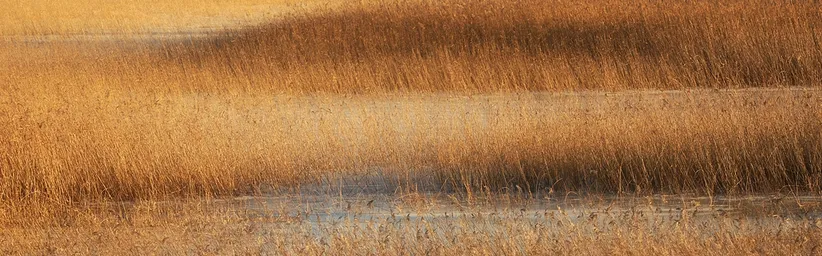
On the final day, we visited the Nikolovo and Nisovo lakes, where the common reed (Phragmites australis) – a key plant for our project – thrives. This habitat is vital for many bird species and other organisms, and it helps us better understand and compare habitat conditions between Slovenia and Bulgaria. Interestingly, we also observed an Egyptian vulture nesting in this area. After visiting the sites, we sat down with our guide Nikolai to ask him all the questions we had gathered during these three days of intensive fieldwork.
Unfortunately, wherever we gather information about waterbirds, we often reach a similar conclusion – climate change is reducing rainfall and water levels, which are crucial for these species.
Despite this, our excursion provided us with valuable insights that will help us in the LIFE TRSCA project. We learned what kind of habitats the ferruginous duck and red-necked grebe require, how they build their nests, what they eat, and where they feed. We also discovered that ferruginous ducks are quite aggressive – only one pair nests per 4 hectares – and their nests are very well hidden, often partially covered from above as well.
LIFE TRŠCA
With LIFE TRŠCA we will improve the conservation status of the intermittent Lake Cerknica.
The implementation of extensive nature conservation projects exceeds the financial capacity of the local community, therefore Notranjska Park regularly applies for projects with the possibility of co-financing by the European Union.
The implementation of large-scale conservation projects exceeds the financial capabilities of the local community, therefore Notranjska Park regularly applies for projects with the possibility of co-financing from the European Union.