The most well-known agri-environmental measure at Lake Cerknica is VTR (grassland bird protection), which protects the harrier and also preserves the habitats of wet meadows. However, as the nature of Lake Cerknica is very diverse, uniform measures are often insufficient or can even be harmful. Therefore, diverse agricultural measures are needed to promote habitat diversity.
Such measures are being developed in cooperation with various stakeholders within the LIFE TRŠČA project. For these measures to be effective, a professional basis is essential, which the Notranjska Park is preparing together with its project partners on the basis of various analyses. It is also crucial to be familiar with the development guidelines and innovations of European agricultural policy, which is adapted to the latest findings and conditions in nature and agriculture through individual financial perspectives.
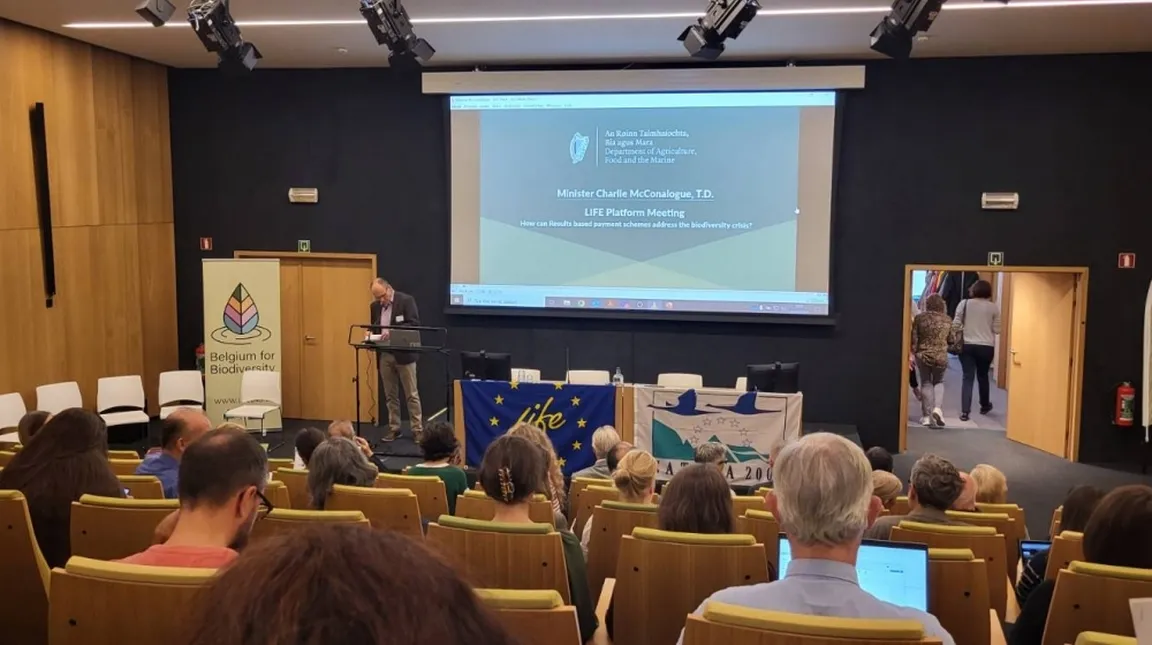
Representatives of Notranjska Park and the Slovenian Institute for Nature Conservation therefore attended the international LIFE Platform Meeting conference in Leuven, Belgium, in early October. The conference was held as part of the Belgium for Biodiversity project and brought together renowned researchers and conservationists from across the European Union, as well as representatives of European Commission sectors. At the conference, we learned about the practices of other EU member states and found that many countries face similar challenges to Slovenia, as biodiversity in agricultural landscapes is declining inexorably. Agricultural policy often remains insufficiently ambitious and ineffective in this regard.
One possible solution is to transform traditional agri-environmental measures into results-based schemes. Such measures encourage landowners to achieve specific results, such as creating a suitable habitat for the harrier, rather than simply prescribing actions such as mandatory mowing after a certain date. The evaluation system encourages positive practices and reduces the impact of negative ones, but it requires a good understanding of the ecological needs of the target species. The advantage of outcome-based measures is that they give landowners greater freedom to take traditional farming knowledge into account in their management practices.
In Ireland, where this approach has been developed over decades, result-based measures have contributed to the recovery of the harrier population, which was in sharp decline at the end of the last century. At the same time, these measures help to preserve life in remote rural communities.
As we want to ensure the well-being of both nature and people in the Notranjska Park, we want to adapt these good practices to local conditions in the Lake Cerknica area and implement them as effectively as possible in dialogue with the local community.