These include orchids, butterflies, moths, and birds, whose existence is increasingly threatened by the rapid decline of their habitats. To prevent further losses, it is essential to implement adapted agricultural practices that enable the long-term preservation of these sensitive habitats.
Why is time-adjusted use necessary?
Wetlands are areas that are occasionally or regularly flooded with water, including swamps, marshes, peat bogs, intermittent lakes, and floodplains and wet meadows. Such periodically or permanently wet environments provide a habitat for numerous plant and animal species. These include certain species of sedges, rushes, lake club-rush (Schoenoplectus lacustris), common reed (Phragmites australis), purple moor grass (Molinia caerulea), yellow iris (Iris pseudacorus), and several bird species, such as the reed warbler (Acrocephalus arundinaceus), purple heron (Ardea purpurea), bittern (Botaurus stellaris), little crake (Zapornia parva), and spotted crake (Porzana porzana).
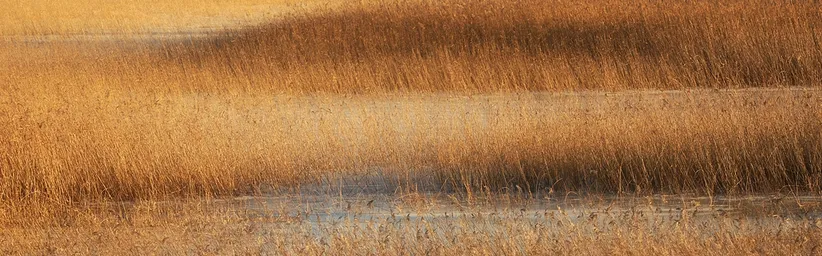
Wetland habitats often occur in small areas among other agricultural areas and are therefore exposed to inappropriate use. The greatest threats to them are changes in the water regime (hydromelioration) and abandonment of use, which leads to overgrowth. Proper management of these habitats is challenging, as excessive use and mowing can threaten local species, while abandonment leads to habitat loss due to overgrowth by woody species
Photo: Eva Vukelič
The use of wetland habitats is a challenge – abandonment leads to overgrowth, while too-frequent mowing threatens tied species.
The implementation of adapted agricultural practices contributes primarily to the preservation of marsh habitat types and species that are dependent on very wet habitats, which are not usually mowed every year. Plants characteristic of wet meadows also often grow in low marshes. The common orchid (Epipactis palustris) can also be found in such areas.
Photo: Jana Laganis
Orchid – common marsh orchid (Epipactis palustris).
Cerknica plain - a key wetland ecosystem
Cerknica plain, with its characteristic drying (seasonal) dynamics, represents one of the most important wetland ecosystems in Slovenia. Its ecological value is exceptional, as it enables the survival of numerous rare and endangered species, among others ferruginous duck (Aythya nyroca) and gray-necked grebe (Podiceps grisegena). Their populations are in decline due to degradation of water bodies and destruction of shallow lakes. Moreover, in recent times practices have been observed in the Lake Cerknica area that contribute to the deterioration of the state of wetland vegetation, especially the decline in the preservation of reed beds. This presents a significant challenge for the protection of Cerknica plain and highlights the need for holistic and sustainable management of this unique ecosystem.
Within the framework of the project "Managing Wetland Habitats to Preserve Waterfowl of Seasonally Drying Lakes" - LIFE TRSCA 101114184 — LIFE22-NAT-SI-LIFE TRSCA, co-financed by the European Union, we will therefore strive to find optimal ways of managing wetland vegetation on Cerknica plain. Special emphasis will be on protecting reed beds, which will also positively influence the conservation of targeted protected species.
Within the project, measures will be prepared for the tailored management of these habitats, with the aim of improving their condition and ensuring the long-term conservation of the biodiversity of this unique wetland.
Photo: Bojana Fajdiga
Patches of wetland areas are often found among other meadow areas.
This articlewas prepared by the Slovenian Institute for Nature Protection (ZRSVN).
LIFE TRŠCA
With LIFE TRŠCA we will improve the conservation status of the intermittent Lake Cerknica.
The implementation of extensive nature conservation projects exceeds the financial capacity of the local community, therefore Notranjska Park regularly applies for projects with the possibility of co-financing by the European Union.
The implementation of large-scale conservation projects exceeds the financial capabilities of the local community, therefore Notranjska Park regularly applies for projects with the possibility of co-financing from the European Union.