LIFE TRŠCA: Studying the vitality of reedbeds in the field in 2026

Published: 03. 09. 2026 Author: NRP Categories: Projects

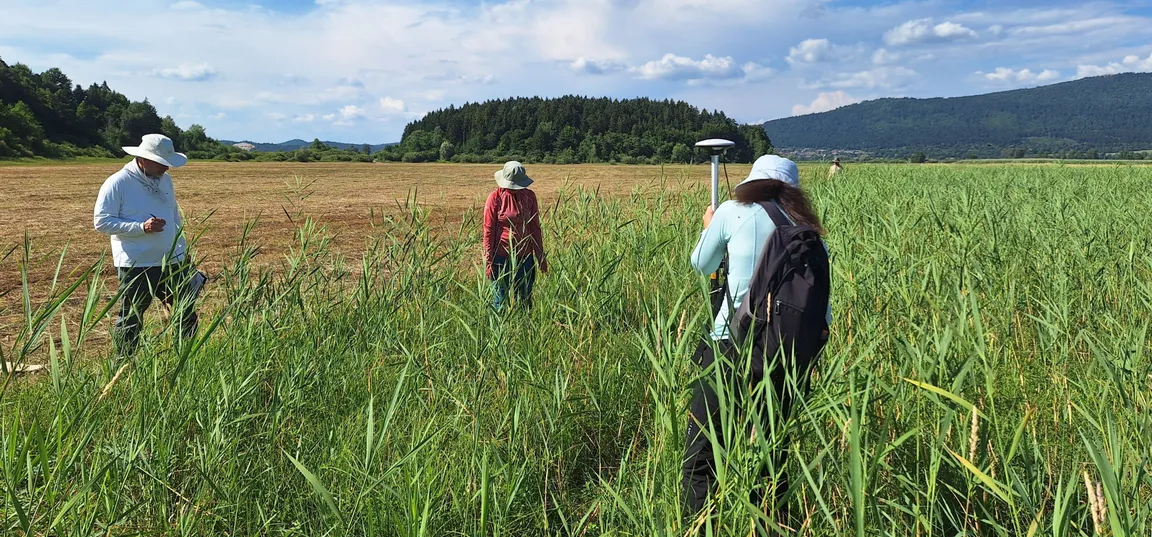
Three people are walking through tall grass and observing the vegetation in an open field. In the foreground and on the right, tall green vegetation dominates, whilst in the background there are mown meadows, a forest and a hilly landscape beneath a blue sky dotted with white clouds. The people are wearing sun hats and are scattered across the meadow as they catalogue or examine the flora.
Censusing vegetation composition and determining the location of the biomass sampling plot (Photo: Anja Mavrič Čermelj)

In July and August, researchers from the Chair of Ecology and Environmental Protection of the Biotechnical Faculty (Department of Biology) again conducted field research in the area of ​​Lake Cerknica and the LIFE TRŠCA project, respectively. For the third year in a row, we surveyed vegetation along transects for the census of birds that nest in reedbeds and at experimental polygons and collected samples to measure above-ground plant biomass.

When enumerating vegetation using the standard Central European method on selected 3 x 3-meter sample plots, we record all plant species present and determine their frequency, i.e., the proportion of the plot each plant species covers. After fieldwork, all data are arranged in tables, allowing us to compare changes in vegetation composition between years. To this data, we add data on mowing on these plots in each year, thus obtaining information on the impact of mowing on the relationships between species.

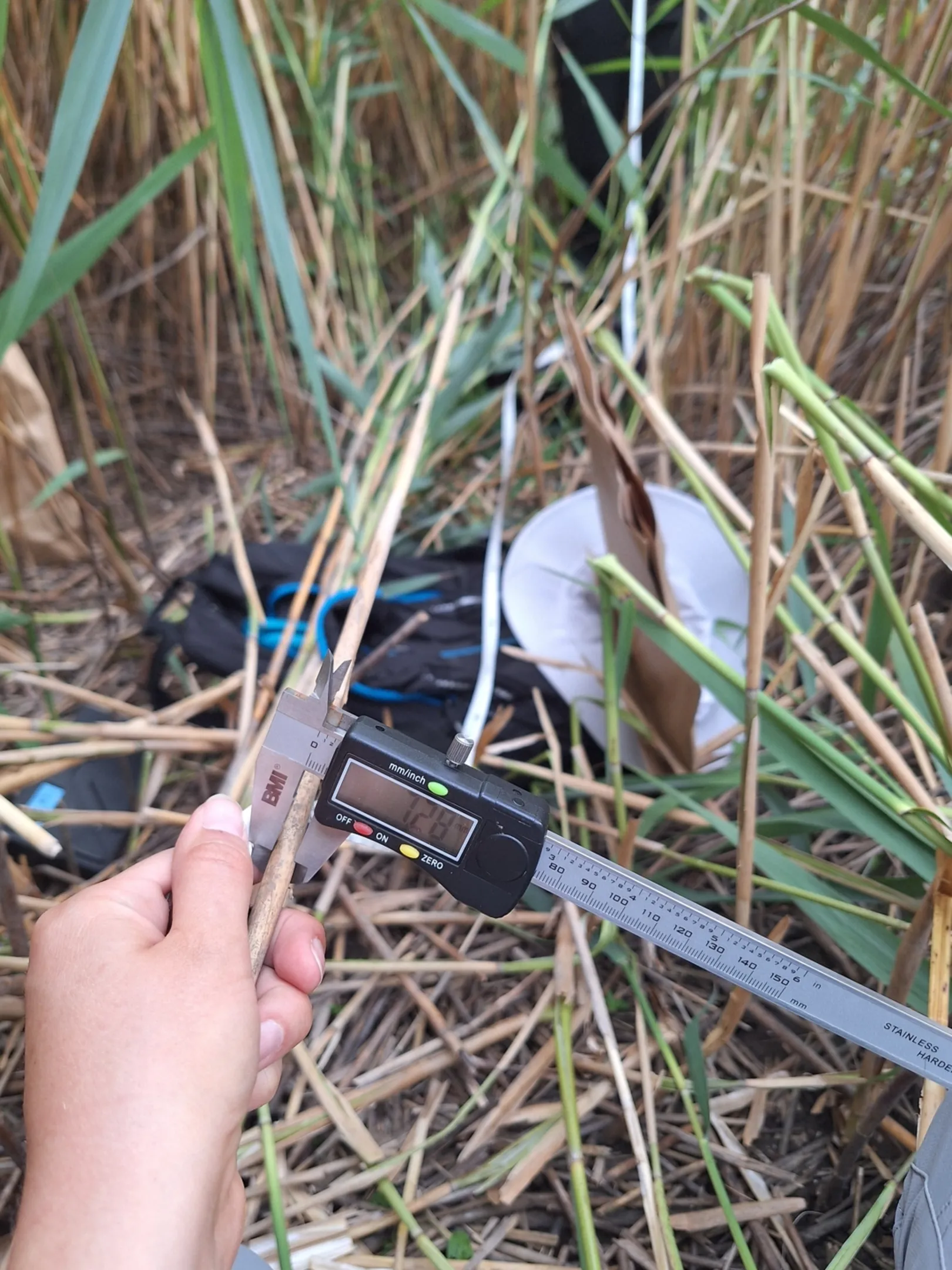
The second part of the fieldwork focuses on sampling the above-ground biomass of plants and measuring the morphological characteristics of common reed, which takes place on a smaller square plot with a half-meter edge. In this so-called harvesting method, all plants must be cut just above the ground, and the reed plants must be separated from the others. Since the sedges, which are present in almost every plot, have sharp leaf edges, the collection must be carried out wearing gloves. In order to best determine the vitality of the reed, we measure the height, the diameter of the stem just above the ground, and record the number of leaves on each plant. After the measurements, all the harvested plant material is stored in labelled paper bags. At the end of the day, all samples are taken to the laboratory at the Department of Biology, where the collected material is dried and weighed, as this is the only way to obtain reliable results.

A hand is holding a measuring tape amongst dense reeds and blades of grass. An object of light and dark colours is partially visible amongst the vegetation, surrounded by dry and green marsh vegetation.
Measuring basal diameter and height of reed (Photo: Anja Mavrič Čermelj)

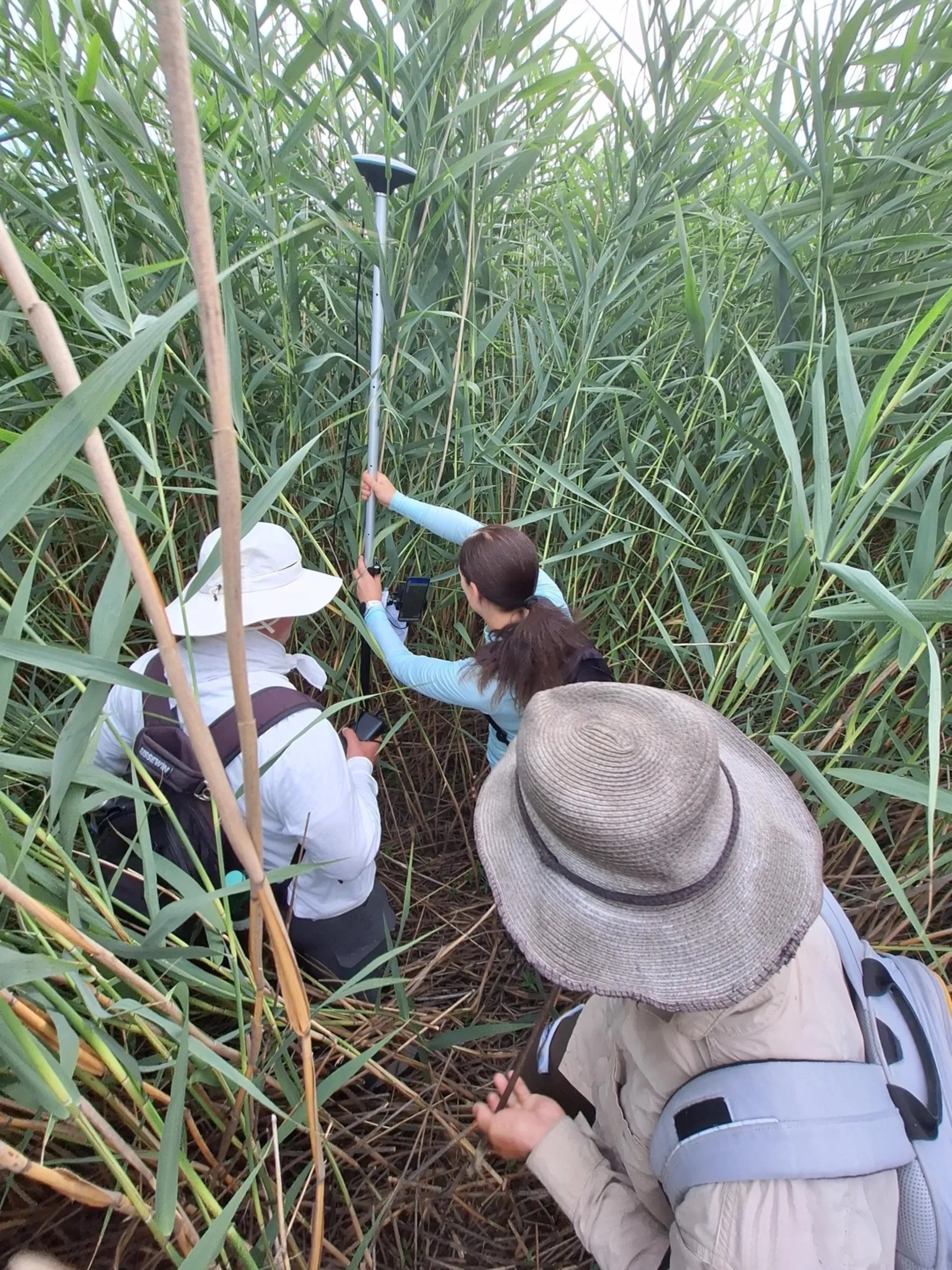
In the field work, we encounter tall reed beds that have not been mowed for several years, as well as freshly mowed sample plots. We survey the same plots every year to monitor the situation over time. However, in order to find exactly the same sampling plots every year in thick reeds over three meters high, we use a GNSS antenna and an RTK receiver that receives signals from many satellites and can thus accurately determine the location to within a few centimeters. At the same time, we also get information about the elevation. Without this tool, you would not be able to find the exact plot. 

Three people are in the dense reed bed, carrying out fieldwork. One person is kneeling on the ground, whilst the other two are bent over the survey site amongst the reed stalks. They are all wearing hats to protect themselves from the sun. Tall marsh vegetation grows around them, almost completely enclosing the narrow path through the reed bed.
Finding the corners of a survey plot in tall reeds using a GNSS antenna with RTK receiver.

The collected data will be used to monitor the vitality of reed beds, which are subject to large fluctuations in water levels and varying mowing regimes each year. This year's dry summer was not the best for reed beds, as very large areas of reed beds were already mowed in mid-July. This disrupts the natural cycle of reeds storing substances in their underground parts, thereby weakening their growth and vitality the following year.

Article was prepared by the Biotechnical Faculty of the University of Ljubljana.

LIFE TRŠCA

With LIFE TRŠCA we will improve the conservation status of the intermittent Lake Cerknica.

Nalaganje...
Projects in the Notranjska Park
Logotip notranjskega parka z rastlino in metuljem.

Projects in the Notranjska Park

The implementation of extensive nature conservation projects exceeds the financial capacity of the local community, therefore Notranjska Park regularly applies for projects with the possibility of co-financing by the European Union.

The implementation of large-scale conservation projects exceeds the financial capabilities of the local community, therefore Notranjska Park regularly applies for projects with the possibility of co-financing from the European Union.


Read more
Read more