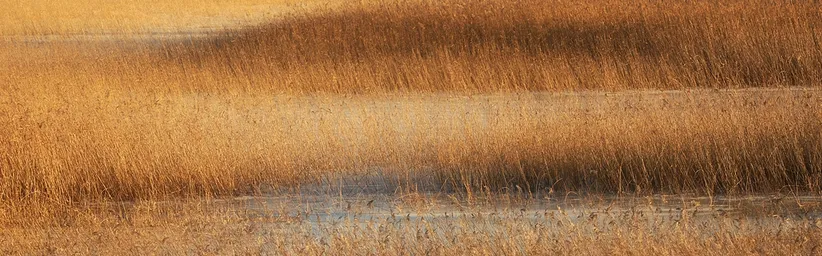
The Ham Wall Reserve was established in the mid-1990s and was entrusted to the ownership and management of The Royal Society for the Protection of Birds (The Royal Society for the Protection of Birds – RSPB). The main habitat in the reserve is a large, 250-hectare reed bed, which is the result of the diligent work of volunteers and staff at the RSPB. They began literally from nothing, from land devastated by intensive peat extraction. Even 6,000 years ago there was shallow sea with a reed bed here, later a floodplain forest and then a raised bog. The reed bed was then created by growing from seeds and transplanting seedlings of common reed, while also regulating the water regime.
photo: Tomaž Janča
Reed mowing with a special harvester
The climate and substrate are very favorable for reed growth, and therefore the reserve staff carry out ongoing thinning, which creates surfaces at different growth stages and open water surfaces. Without thinning the reed bed would become overgrown too quickly. The reserve supports the survival of many species associated with reed beds, especially bearded reedlings, moorhen, silkworm moth, brown long-eared bat and others. We were interested in what technology they use to maintain the reed bed, as this is also one of the LIFE Tršca activities – at Lake Cerknica this is connected with deposits of dead reed that form during annual floods. We saw a special crawler-harvester used to harvest the reed, special pontoon bridges for crossing between the channels, a solar-powered pump and many other interesting solutions. Among other things, the harvested reed is composted and sold on site, and buyers are encouraged to bring their own packaging.
photo: Tomaž Janča
The reserve manager Steve Hughes during the briefing to the project team
The reserve staff, Steve, Ali and Stephen, greeted us very kindly and hospitably, and patiently answered our numerous questions. Next, we looked at the application they use to manage the lands, which provides a precise overview of the entire history of interventions. What pleasantly surprised us about the reserve were the ubiquitous volunteers who perform a huge amount of essential work in maintaining and keeping the reserve running on a day-to-day basis.
Again, many thanks to all RSPB colleagues for the truly warm welcome. Unfortunately we did not have time to explore the surroundings of the reserve, except along the way there and back. But it was enough to experience the friendly English countryside.
The article was prepared by the Slovenian Society for the Observation and Study of Birds (DOPPS).
LIFE TRŠCA
With LIFE TRŠCA we will improve the conservation status of the intermittent Lake Cerknica.
The implementation of extensive nature conservation projects exceeds the financial capacity of the local community, therefore Notranjska Park regularly applies for projects with the possibility of co-financing by the European Union.
The implementation of large-scale conservation projects exceeds the financial capabilities of the local community, therefore Notranjska Park regularly applies for projects with the possibility of co-financing from the European Union.