LIFE TRŠCA: Which is a more favourable environment for amphibious plants - water or land?

Published: 20. 11. 2026 Author: NRP Categories: Projects

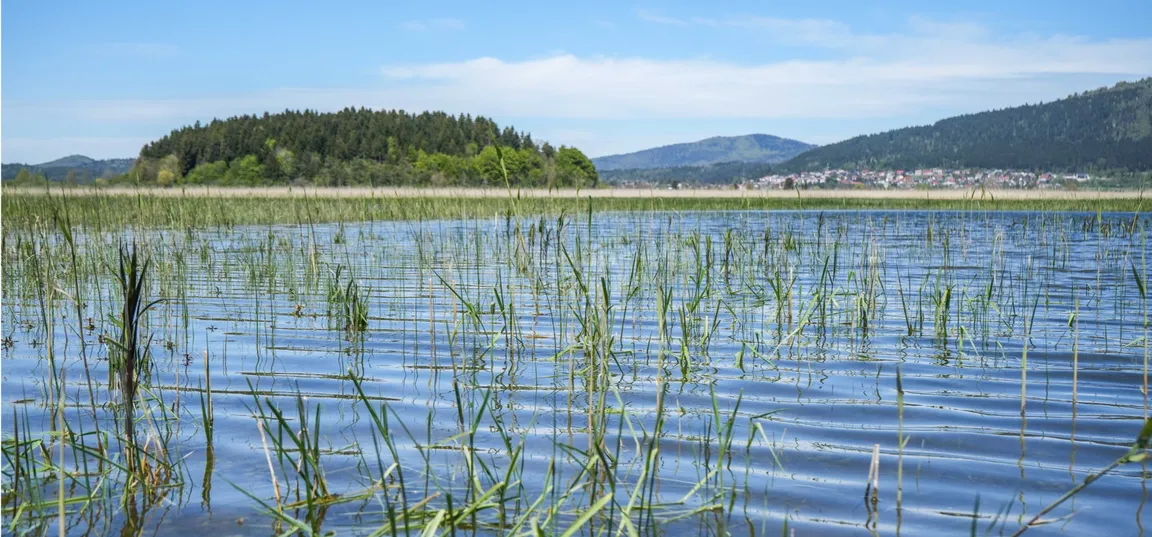
A view of the water’s surface of Lake Cerknica, with sparse stalks of cattail and grass protruding from the water. In the background is a forested island, beyond which stretch wooded slopes and a village on the lakeshore. The calm surface reflects the blue sky dotted with scattered clouds.
Photo: Rudi Kraševec

Now that the lake has refilled with water after a months-long drought, many people are wondering how the plants at Lake Cerknica manage to survive such drastic changes. In this environment, "amphibious" plants—those capable of living both in water and on land—have found their ecological niche. Here, we highlight two such species: the marsh forget-me-not (Myosotis scorpioides) and the thread-leaved water-crowfoot (Ranunculus trichophyllus). Both species, which are amphibious, are common at Lake Cerknica. They are able to survive whether submerged or on dry land, thriving in an environment, characterized by frequent and unpredictable fluctuations in water levels—a hallmark of Lake Cerknica. All flowering plants that live in water are considered "secondarily" aquatic, meaning they evolved from land-dwelling ancestors and subsequently adapted to an aquatic environment, accompanied by a simplification of their physical structure.

The marsh forget-me-not and the thread-leaved water-crowfoot are well-suited to an environment where conditions shift rapidly, thereby influencing plant characteristics. By many criteria, the marsh forget-me-not is more of a terrestrial plant than an aquatic one, whereas the aquatic form of the water-crowfoot is fully adapted to life in water.

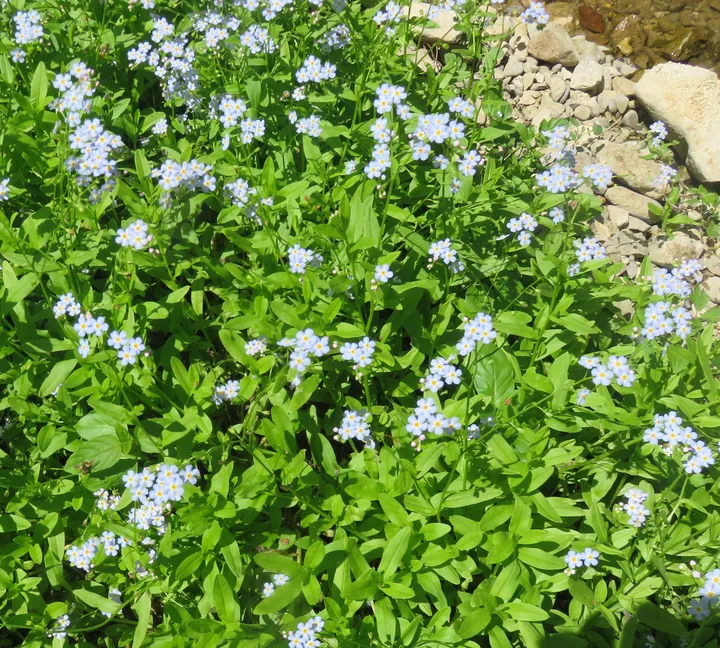
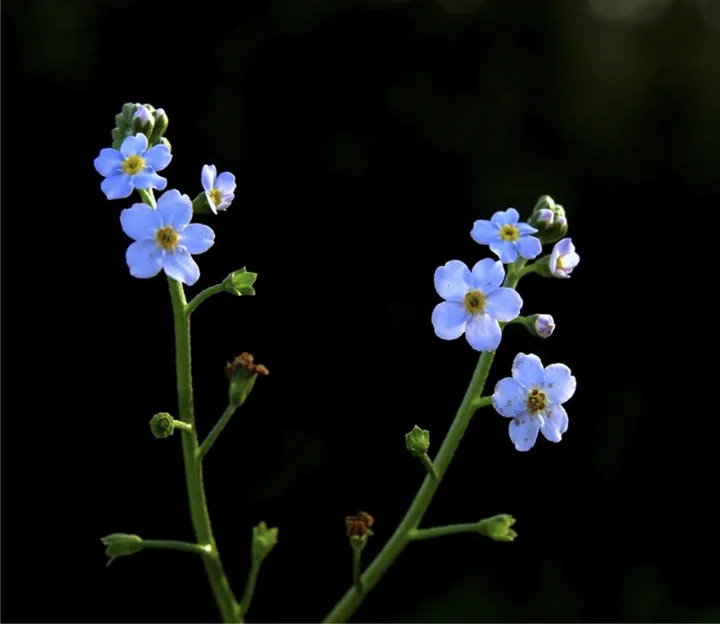
Morphological characters indicate that the marsh forget-me-not is not a typical submerged plant, as it has less specialized leaves for an aquatic environment. Nevertheless, the leaves that develop underwater are thinner and shorter than those that grow on land. In water, it is found only in a rosette form, whereas on land it grows up to 20 cm tall (Figure 1). It blooms only on land or in shallow water (Figure 2), which suggests that it is more closely related to land plants.

A dense carpet of green leaves and white flowers at the edge of a rocky slope. Among the leaves, a multitude of tiny four-petaled white flowers, illuminated by the sun, spread out. Light-colored rocks are visible in the upper right corner, while the rest of the photograph is filled with lush green vegetation.
Figure 1: Terrestrial form of aquatic forget-me-not: leaves are morphologically similar to aquatic forms and are visually indistinguishable from each other. (Photo: Mateja Germ)
Two slender stems with light blue flowers stand against a dark, hazy background. At the tops of the stems are several small five-petaled flowers with yellow centers and a few buds that have not yet opened. The flowers are illuminated by sunlight, which makes them stand out distinctly against the dark background.
Figure 2: The distinctive, sky-blue flowers of the aquatic forget-me-not, which bloom on land. (Photo: Mateja Germ)

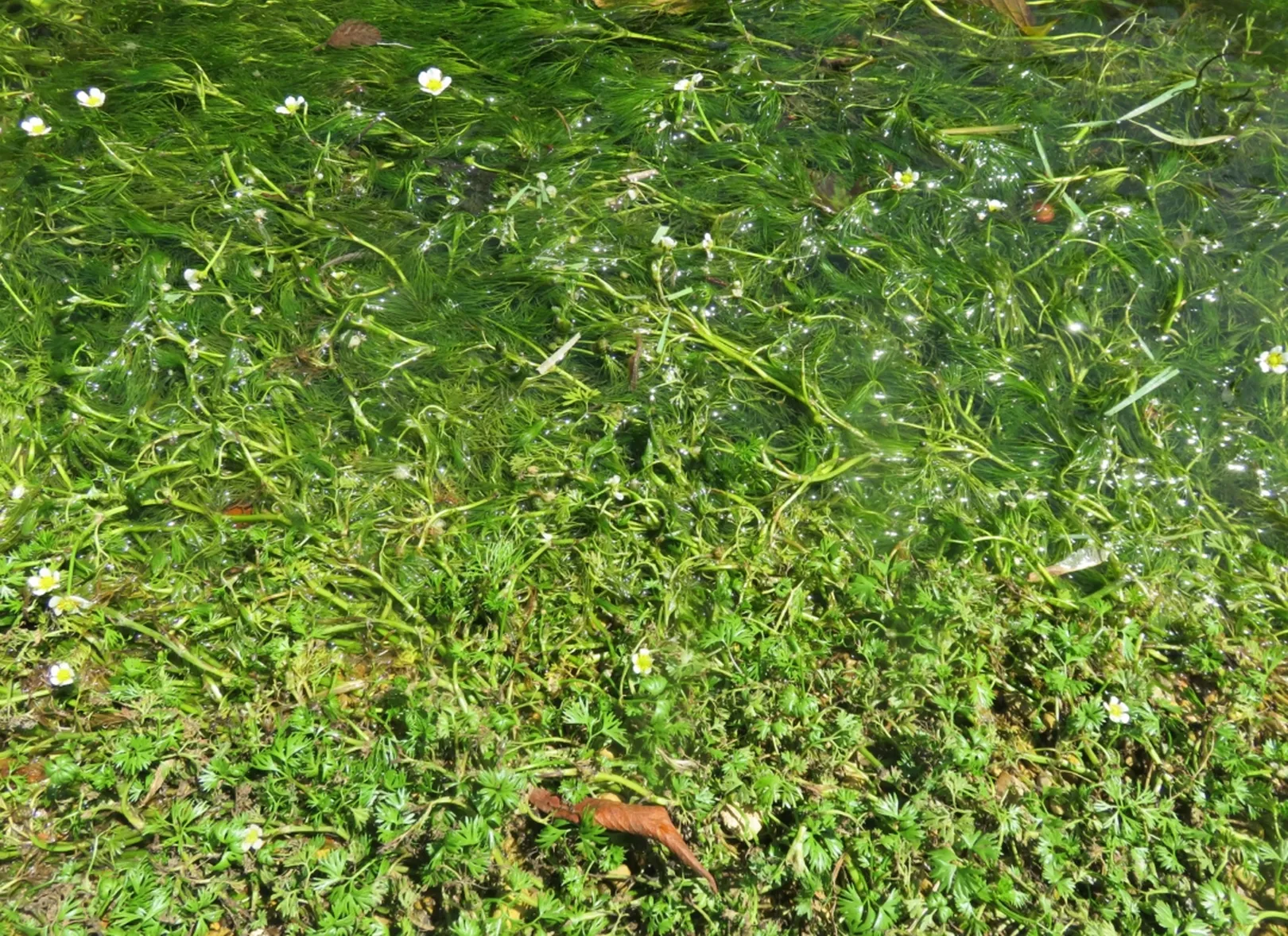
The submerged leaves of the thread-leaved water-crowfoot are longer, softer, and more flexible than its terrestrial leaves, allowing them to adapt more easily to water currents (Figure 3). Interestingly, the terrestrial leaves can easily withstand waterlogging and are gradually replaced by aquatic leaves. When exposed to air, these submerged leaves dry out; however, new leaves—adapted to a terrestrial environment—emerge from the shoots. These appear in the summer, when the water level drops. Such leaves enable the plant to continue growing on land, as they are less susceptible to desiccation.

A view through shallow, clear water toward dense aquatic vegetation. Long green leaves of aquatic plants are visible below the surface, and a carpet of tiny green leaves lines the edge. Sunlight reflects off the water’s surface, creating bright reflections.
Figure 3: Aquatic form (above) and terrestrial form (below) of the thread-leaved water-crowfoot in bloom. The aquatic leaves droop when pulled from the water because they have poorly developed supporting tissues. The terrestrial leaves are shorter and more rigid than the aquatic ones. (Photo: Mateja Germ)

Media such as air and water differ significantly in their properties: water has a much higher density, and due to the force of buoyancy, plants have less need for supporting tissues; furthermore, water supply does not cause problems, and plants can thrive year-round because temperature fluctuations in water are less pronounced. On the other hand, aquatic plants are often exposed to low light levels, and the CO2 diffusion in water is much slower. Amphibious plants successfully overcome these challenges, taking advantage of the benefits offered by both aquatic and terrestrial environments. With the help of various strategies, they survive in their environment and are winners among species in habitats where water levels fluctuate frequently and unpredictably, such as on Lake Cerknica.

Article was prepared by the Biotechnical Faculty of the University of Ljubljana.

LIFE TRŠCA

With LIFE TRŠCA we will improve the conservation status of the intermittent Lake Cerknica.

Nalaganje...
Projects in the Notranjska Park
Logotip notranjskega parka z rastlino in metuljem.

Projects in the Notranjska Park

The implementation of extensive nature conservation projects exceeds the financial capacity of the local community, therefore Notranjska Park regularly applies for projects with the possibility of co-financing by the European Union.

The implementation of large-scale conservation projects exceeds the financial capabilities of the local community, therefore Notranjska Park regularly applies for projects with the possibility of co-financing from the European Union.

Read more
Read more