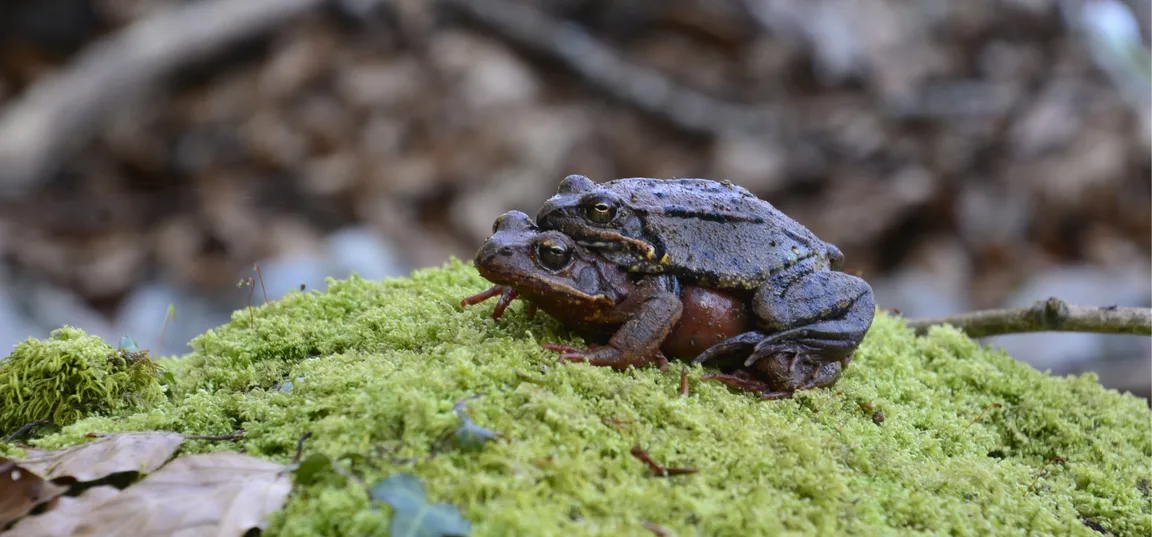
Vranja Jama Cave is a karst spring located next to intermittent Lake Cerknica in the Zadnji Kraj area. It was first mentioned in written sources as early as 1689, when it was described by Janez Vajkard Valvasor in his work The Glory of the Duchy of Carniola. Today, the cave is also known for an exceptional natural phenomenon – a large number of common frogs (Rana temporaria) overwinter in its water-filled section and in an area known as the “Frog Beach”. Previous studies recorded several tens of thousands of overwintering individuals in the cave, making Vranja Jama Cave one of the largest known overwintering sites for this species in the world.
In spring, the frogs leave their overwintering site and migrate towards Lake Cerknica, where they reproduce. In 2026, we therefore carried out monitoring of the spring migration to determine how many frogs leave Vranja Jama Cave, how their migration proceeds, and whether their numbers have changed compared to previous studies conducted in 1996 and 1997. We also assessed the condition of the surrounding habitat, particularly reedbeds and wetland areas in the Zadnji Kraj area.
Spring Migration Results
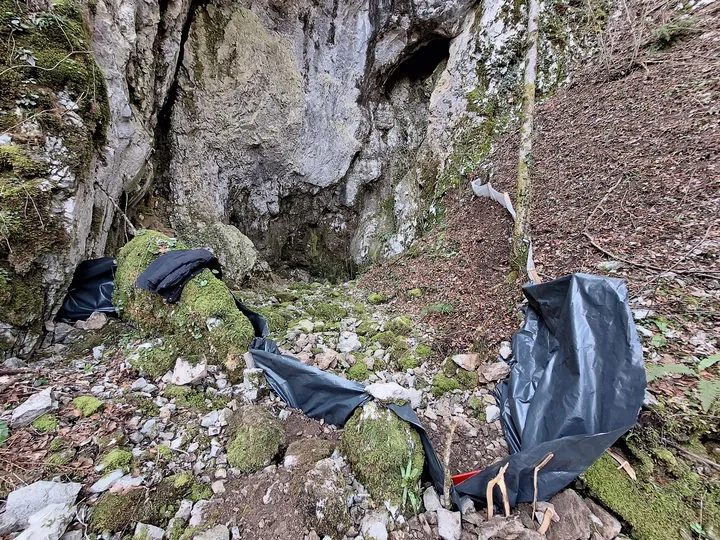
The monitoring was carried out from 4 March to 24 April 2026. In front of the cave entrance, we installed a guiding fence and two traps, which directed the frogs to a location where they could be counted. Individuals were classified according to their developmental and reproductive status, while temperature and weather conditions were also recorded.
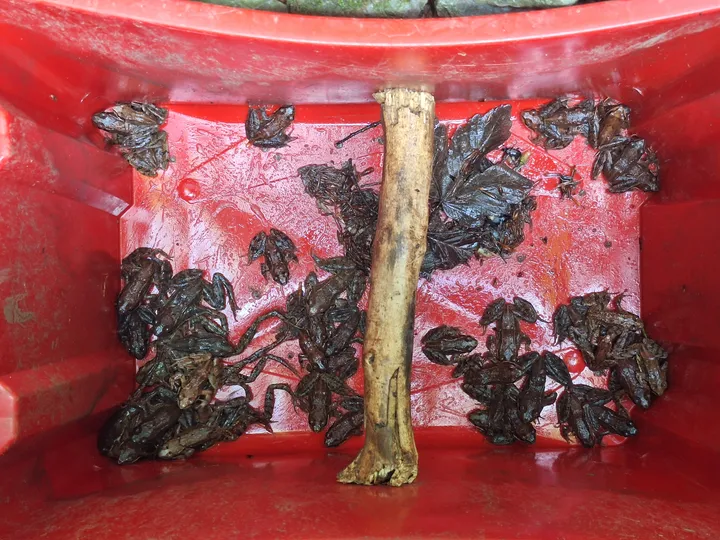
During the monitoring period, we recorded 3,525 common frogs. These included 2,146 adults in amplexus, representing 1,073 pairs, 1,036 individual adults, and 343 juvenile and subadult individuals. Adult frogs migrated most intensively in early March. The main migration peak was recorded on 11 March, when approximately 1,000 individuals were recorded. Juvenile and subadult frogs began appearing only after 14 April, with their numbers peaking on 21 April, when 231 individuals were recorded.
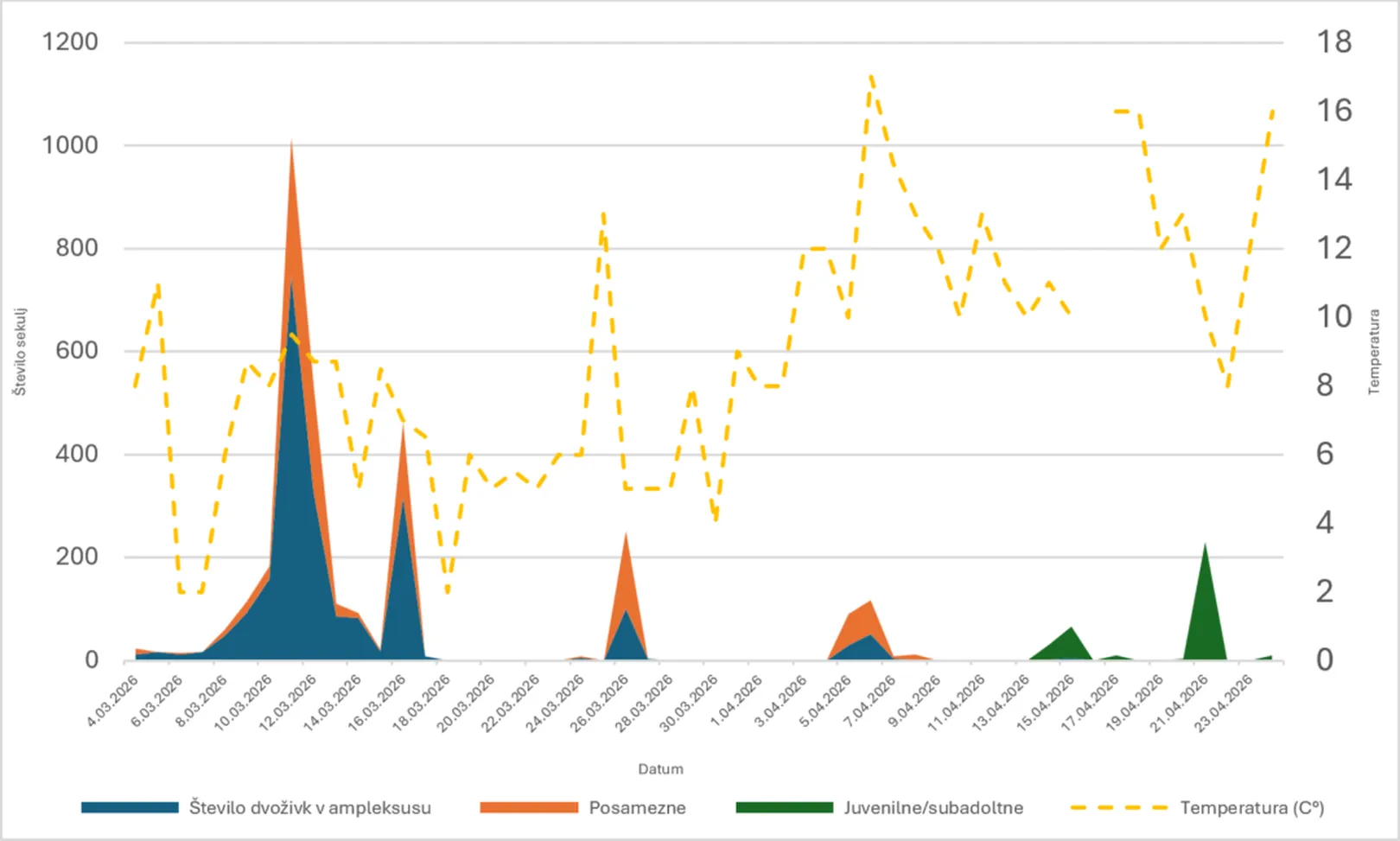
Migration activity was primarily associated with weather conditions. The highest number of frogs migrated during rain or drizzle, with 44.2% of all recorded individuals observed under such conditions. The majority of frogs (68.8%) migrated at temperatures between 5 and 10 °C.
Sexually mature frogs generally migrate as soon as suitable conditions occur due to their reproductive drive. This often happens at temperatures above 5–6 °C, as they need to reach their breeding sites in time to reproduce. Juvenile and subadult individuals are not under the same time pressure and can therefore migrate later, when temperatures and weather conditions are more favourable. In our monitoring, juvenile and subadult individuals were predominantly recorded at temperatures between 15 and 20 °C.
Comparison with Previous Studies
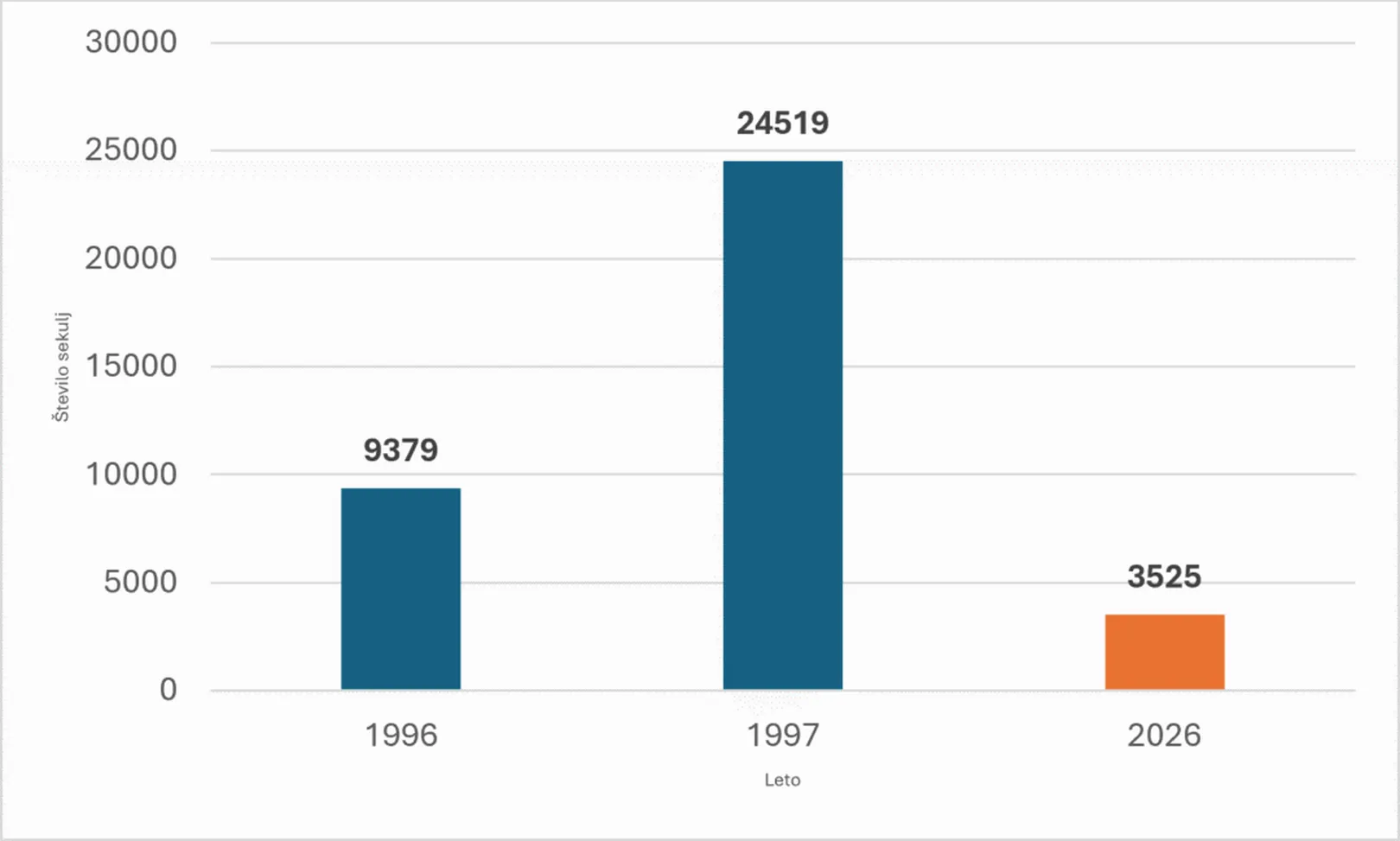
A comparison with the studies conducted in 1996 and 1997 shows a substantial difference in the number of recorded frogs. In 1996, 9,379 individuals were recorded at Vranja Jama Cave, while in 1997 the number reached as many as 24,519 individuals. In 2026, we recorded 3,525 individuals.
The number recorded in 2026 was therefore 62.4% lower than in 1996 and 85.6% lower than in 1997. Compared with the average of the two historical years, which was 16,949 individuals, approximately 79.2% fewer frogs were recorded in 2026.
This result is important, but it cannot be directly interpreted as evidence of a decline in the overall common frog population. Numbers can vary considerably between years due to weather conditions, the success of autumn migration, and other factors. Some frogs may also overwinter outside Vranja Jama Cave. For a more reliable assessment of long-term changes, monitoring would therefore need to be repeated over several consecutive seasons.
Influence of Mowing Extent and Frequency on Reedbeds in the Amphibian Breeding Habitat
In addition to the number of common frogs, which was considerably lower than in 1996 and 1997, we also analysed the condition of the breeding habitat in the Zadnji Kraj area, as changes in habitat condition could potentially affect population size.
We focused primarily on changes in habitat management. Before 2018, the Zadnji Kraj area had not been mown for an extended period, allowing tall, dense and vigorous reedbeds and other wetland vegetation to develop. This structure provided important shelter for adult amphibians, as well as suitable sites for spawning and the development of eggs and tadpoles.
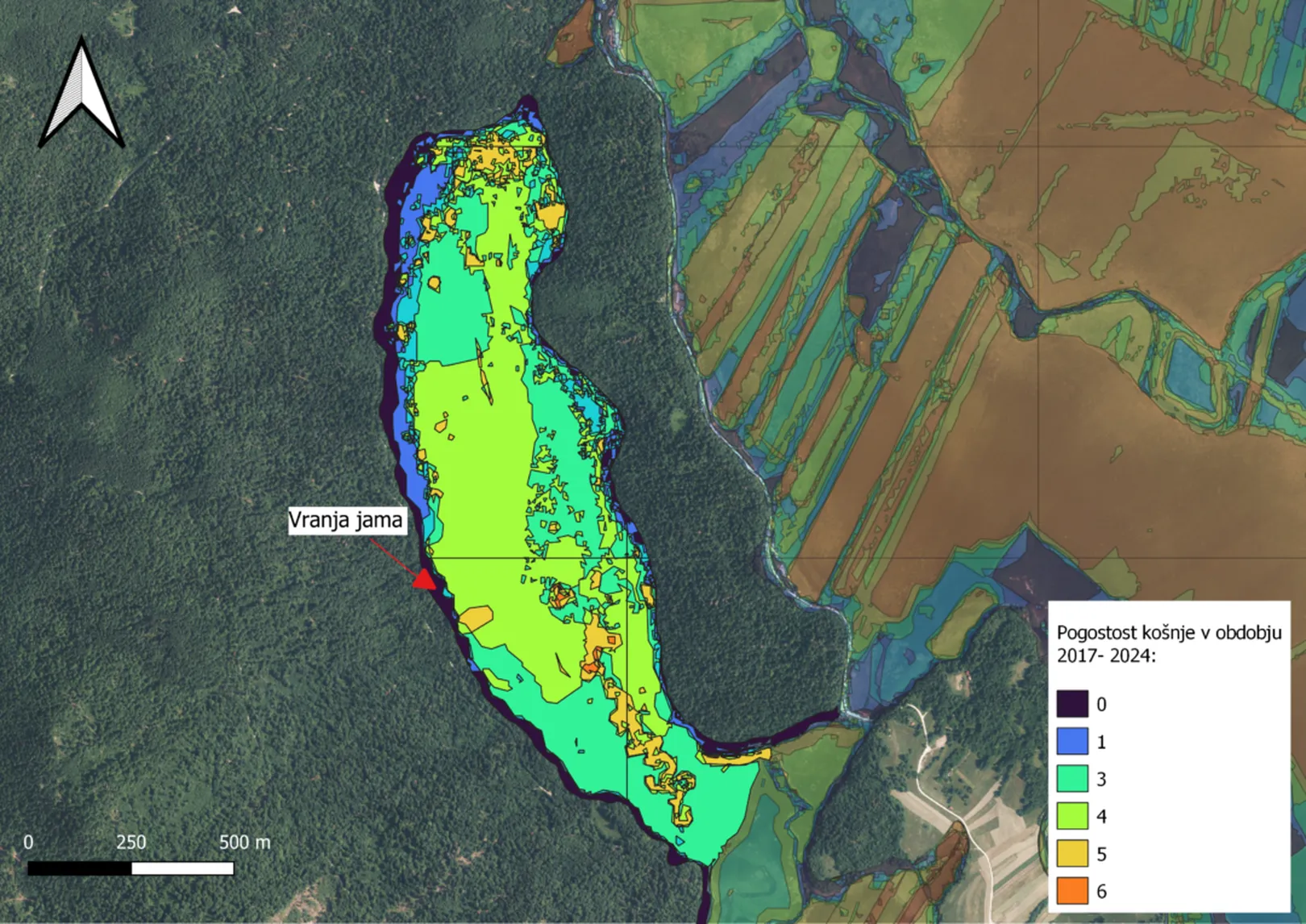
Since 2018, larger areas have been mown. The largest proportion of the area was mown in 2018, 2019, 2021 and 2022, when between 56.3% and 83.8% of the 82.6-hectare study area was mown. Almost 74% of the area was mown three to four times over the eight-year period.
For amphibians, neither completely dense reedbeds nor completely open habitats are necessarily optimal. Rather, they benefit from heterogeneous environments with a variety of habitat structures. In the Zadnji Kraj area, such heterogeneity is already naturally created by open-water areas and deeper sections known as estavelles, where reedbeds do not develop and Schoenoplectus lacustris occurs.
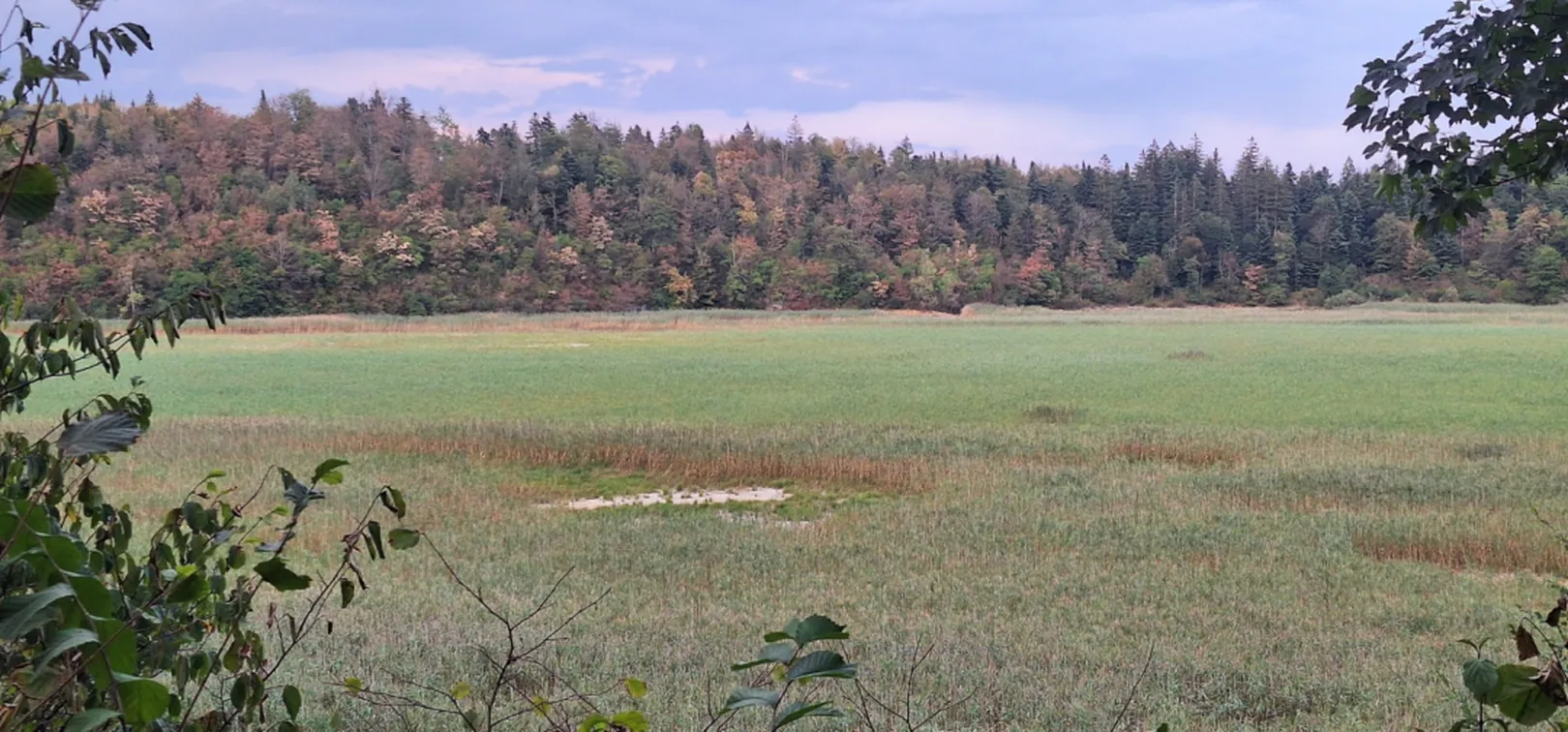
Field observations and previous studies indicate that frequent mowing has reduced the density and vitality of the reedbeds. Dense reedbeds can provide shelter for adult amphibians, eggs and tadpoles and influence their exposure to predators. They are particularly important in limiting the access of larger fish to shallow areas and open-water pools. Where reedbeds are less dense, fish can move more easily between open-water areas and sites where eggs and tadpoles develop, potentially increasing predation pressure.
Dead reed stems from the previous year are particularly important because, in early spring, when new vegetation has not yet developed, they are one of the few available forms of vegetation structure. At this time, they can provide shelter and sites for spawning, as well as help retain egg masses in shallow areas. In shallow water, plant stems can reduce the movement of egg masses caused by wind and water currents, thereby limiting their displacement into deeper or otherwise less suitable parts of the lake.
A reduction in reed density can therefore alter the balance between different habitat structures and reduce the proportion of suitable shelter and breeding areas. At the same time, increased habitat openness may facilitate predator access and increase the influence of wind and water currents. Other factors, including climate change, may also affect reproductive success. Shorter and less extensive flooding periods can lead to water bodies drying out more rapidly, thereby reducing the time available for tadpoles to complete their development.
Changes in vegetation and their temporal coincidence with the lower number of recorded common frogs suggest that changes in habitat management may be one of the factors influencing the condition of the population. However, the available data do not allow us to reliably confirm a direct causal relationship between mowing and the decline in the number of common frogs. Population size is influenced by multiple interacting factors, and a better understanding of their relative importance will require several years of monitoring of common frog numbers, breeding habitat condition and habitat management practices.
Conclusion
The 2026 monitoring confirmed that Vranja Jama Cave remains an important overwintering site for common frogs. However, the number of recorded individuals was substantially lower than in the studies conducted in 1996 and 1997. The results cannot yet be interpreted as definitive evidence of a decline in the overall population, as annual fluctuations in the number of overwintering individuals are possible and part of the population may overwinter outside the cave.
For the long-term conservation of common frogs and other amphibians, it is important to maintain a mosaic structure of wetland habitats – a combination of open-water areas, shallow breeding habitats, and sufficiently large patches of unmown, vigorous reedbeds and other wetland vegetation that limit the movement of larger fish. Such habitats are important not only for amphibians, but also for numerous invertebrates, waterbirds, fish and other species.
Continued systematic monitoring of common frog numbers, reproductive success and changes in vegetation will be essential for improving our understanding of the processes taking place at Vranja Jama Cave and for developing appropriate measures to conserve this exceptional natural phenomenon.