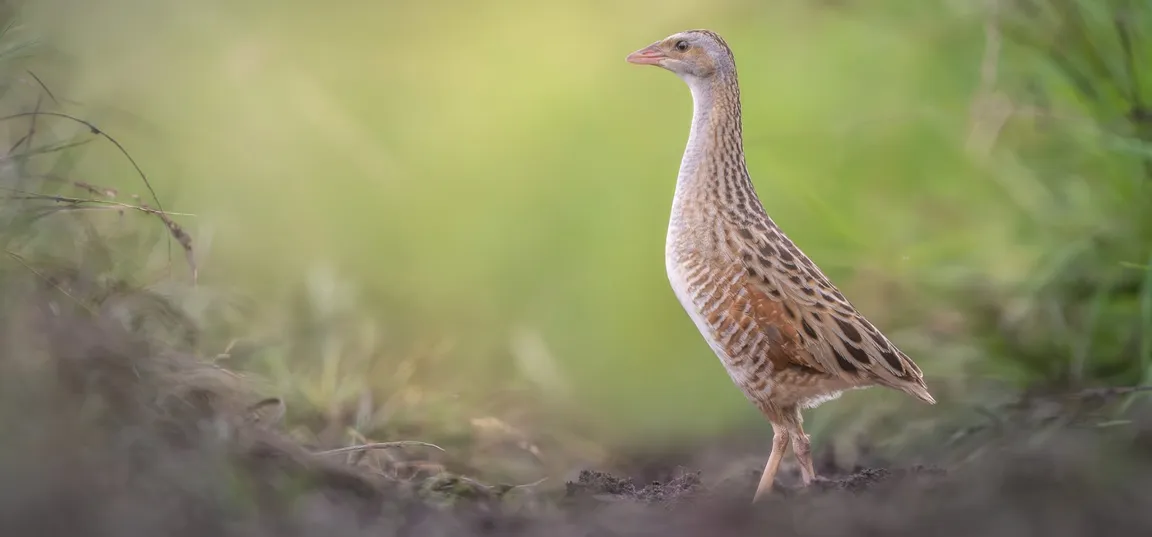
The Corn Crake (Crex crex) is a common inhabitant of wet meadows. During the day, it hides in thick grass, so it is rarely seen, but much easier to hear. Its characteristic sharp call echoes mainly on late spring nights, shortly after it returns from its wintering grounds in Africa.
It is precisely during its singing season that, in collaboration with the DOPPS - Birdlife Slovenia, we conduct a census of singing males, which we use to estimate the population size. We survey each area at least twice.
The Corn Crake census at Lake Cerknica has the longest tradition in Slovenia. Monitoring has been conducted continuously since 1992, meaning this year marks its 34th year. It is the longest-running monitoring program for any bird species in Slovenia.
Just over a decade ago, between 300 and 400 Corn Crakes nested in Slovenia. The largest numbers were found in the Ljubljana Marshes, followed by Lake Cerknica, Breginjski Stol, the Nanoščica River basin, Planinsko Polje, and Jovsi. Today, the picture is quite different. The population has declined significantly—this year, only 219 singing males were recorded in Slovenia, 53 of them at Lake Cerknica, which is below the long-term average of 71 males.
This year’s results varied greatly across Slovenia. In some places, the year was even a record success—as many as 53 Corn Crakes were counted in Planinsko Polje, the highest number to date. In the Pivka area, however, not a single Corn Crake was recorded this year, which has happened only twice in the history of the censuses.
The smaller number of Corn Crake at Lake Cerknica is not a result of flooding. The bird is, in fact, a species of floodplain grasslands and is well adapted to flooding. During high water, it temporarily retreats to higher-lying edges, and once the water recedes, it returns to the grasslands and continues nesting.
The Corn Crake is among the most endangered meadow birds in Slovenia and Europe. The greatest threat to it comes from the intensification of agriculture. In the past, wet meadows were mowed in late summer, but today many meadows are being drained, fertilized, or converted into croplands. Fertilized meadows with dense vegetation are unsuitable for the Corn Crake, and early mowing can destroy its nests and chicks.
At Lake Cerknica, the situation is somewhat different, as there is relatively little mowing before August, so the immediate risk of nest destruction is not high. In recent years, we have observed that the extent of mowing around Lake Cerknica has been increasing. Even the wettest, marshy areas with low vegetation are being mowed more and more frequently. As a result, the Corn Crake's habitat is becoming too open, making it harder for the bird to hide from predators.
Long-term monitoring of the Corn Crake population is therefore extremely important to us, as it allows us to better understand changes in the area and helps us find effective solutions. We are also developing these solutions as part of the LIFE TRŠCA project, in which we are developing new agri-environmental measures.
Among the proposed measures is the option for farmers to mow certain meadows only every other year and receive appropriate compensation for doing so. Unmowed vegetation provides Corn Crakes with better cover and more favorable nesting conditions the following year.
The Corn Crake is a so-called umbrella species, meaning that by protecting its habitat, we simultaneously preserve the living conditions for numerous other plant and animal species. Our research at Lake Cerknica shows that annual early mowing is not optimal for many other organisms either. Among plants, these include, for example, Allium ericetorum, Iris sibirica, and other characteristic species of wet meadows, whose populations decline when mowing is too frequent or too early.
Protecting the Corn-crake thus means protecting the entire grassland ecosystem. In the Notranjska Park, we have high hopes for the new agricultural payment systems and believe that, together with farmers, we will find solutions that will benefit both nature and local residents in the long term.
Corn Crakes that successfully overwinter in sub-equatorial Africa and survive a migratory journey of several thousand kilometers generally return to the very area where they have successfully nested in previous years. That is precisely why preserving high-quality grasslands around Lake Cerknica is crucial for the future of this exceptional species.