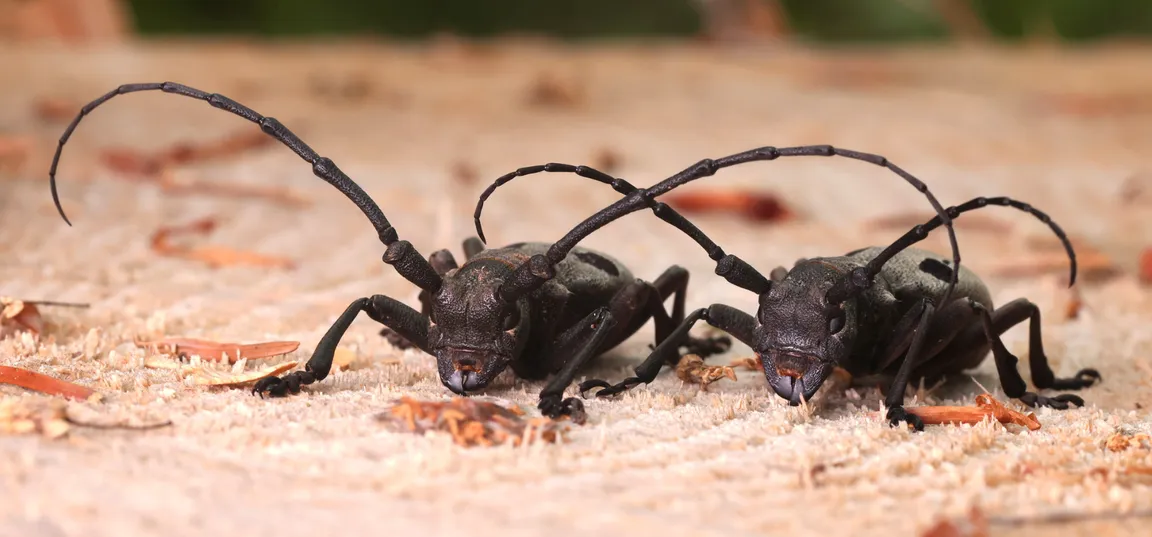
The Longhorn Beetle (Morimus funereus) is a large beetle belonging to the longhorn beetle family (Cerambycidae), distributed throughout the forests of Central and Southeastern Europe. In Slovenia, it is relatively common in mixed fir-beech forests, while it is not particularly common in pure beech forest stands. It is absent from the forests of the Koroška and Prekmurje regions.
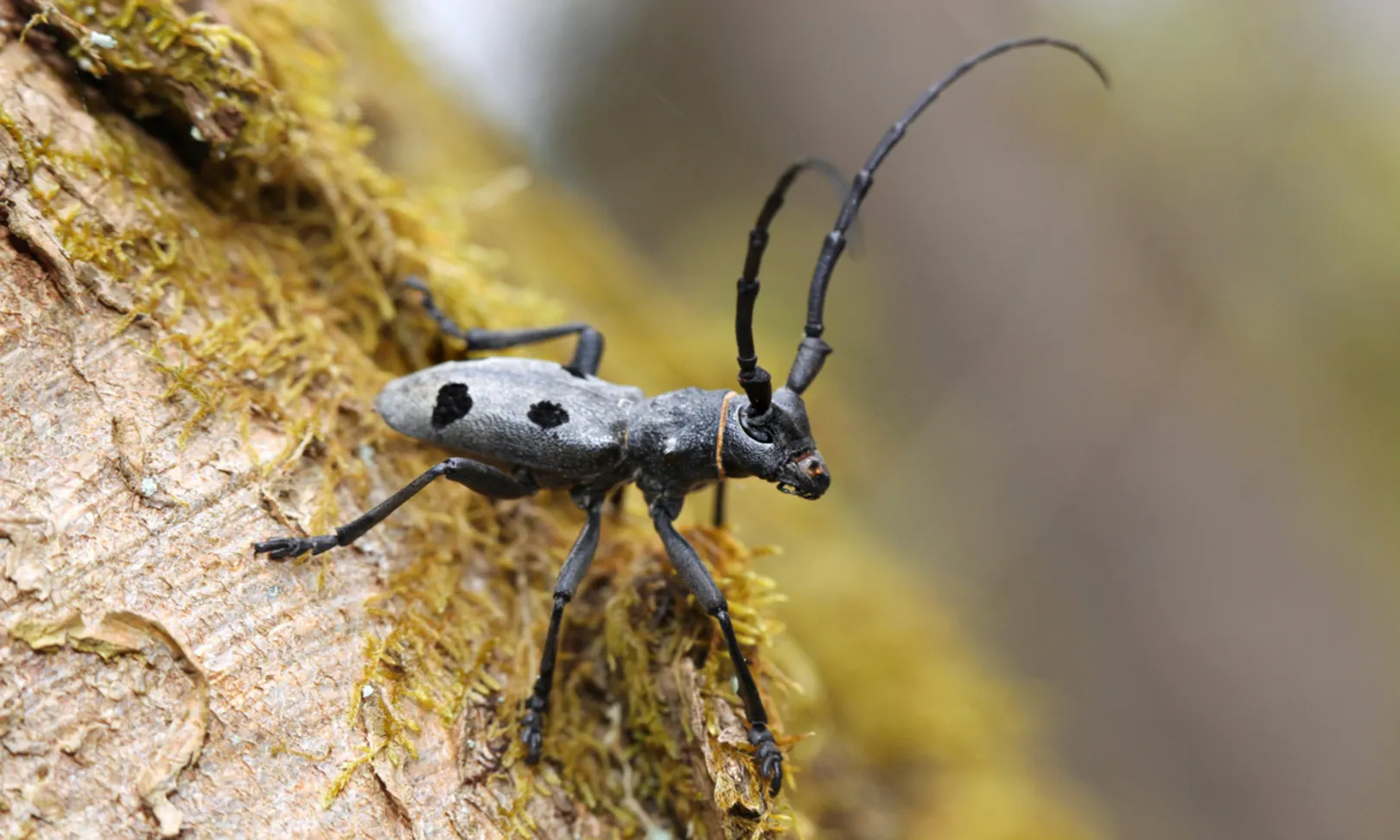
It can be recognized by its dark grey body with a velvety appearance and two pairs of darker black spots on its wing covers (elytra).
The body of the Longhorn Beetle measures between 15 and 37 mm in length. Its head is adorned with long antennae which, in males, exceed the body length when bent backwards, whereas in females they are slightly shorter than the body. Antenna length is the easiest way to determine the sex of the beetle.
Its wings are not functional for flight, making it a common misconception that Longhorn Beetles can fly like most other beetle species. Their annual migrations take place across the forest floor, tree trunks, and fallen branches. Occasionally, they undertake longer journeys by travelling on felled logs loaded onto forestry trucks.
According to scientific literature, the beetle lays fertilized eggs in decaying wood, primarily that of broadleaf trees. However, this does not entirely apply to the fir-beech forests of Notranjska. For several years, we searched for Longhorn Beetles in the areas of Javorniki, Snežnik and Menišija, examining beech stumps, felled beech trees on the forest floor, and beech logs stacked along forest roads, but our success was almost negligible. Nevertheless, each year we did find a few specimens on beech logs prepared for transport out of the forest.
After several years of intensive searching and documenting previously rare observations and locations of the Longhorn Beetle, we examined a freshly felled fir tree and a large fir stump. What followed was a great surprise and revelation. On the first fir stump above Zadnji kraj near the intermittent Lake Cerknica, we observed seven Longhorn Beetles; four more were found on the neighbouring stump, while the remaining stumps hosted two or three individuals each. Within an area of only a few hundred square metres, we found more than 25 beetles—more than we had previously recorded during an entire year of monitoring.
The female lays her eggs in the wood of freshly felled fir trees, as well as beech and spruce. The eggs develop into larvae that live in dead wood for several years. Development from egg to adult takes three to four years, and according to some sources, up to five years. Adult beetles appear from early May until the end of June in higher and cooler mixed-forest habitats, both during the day and at night.
A female typically lays between 50 and 100 eggs, either individually or in small groups, in cracks within the bark or wood.
The Longhorn Beetle is listed as a Natura 2000 species (Annexes II and IV of the Habitats Directive). In Slovenia, it is protected under the Decree on Protected Wild Animal Species and is also included on the IUCN Red List of Threatened Species in the Vulnerable (VU) category. Furthermore, it is considered an indicator species of well-preserved old-growth forests.
Locations where the Longhorn Beetle is observed can be reported through the NarcIS project, Slovenia’s Nature Information System, via the online portal sporocivrsto.si.
For many years, the ministry responsible for nature conservation has been working to establish new forest conservation areas, particularly within state-owned forests. Through reduced and adapted use of forest biomass, these areas aim to create favourable conditions for the preservation of rare species and endangered forest habitat types.