Work package 2: Improving the reedbeds and other marsh vegetation of HT 3180* management by introducing new and revising existing Agri-environment schemes and other CAP measures to promote limited mowing
Work package 2: Improving the reedbeds and other marsh vegetation of HT 3180* management by introducing new and revising existing Agri-environment schemes and other CAP measures to promote limited mowing
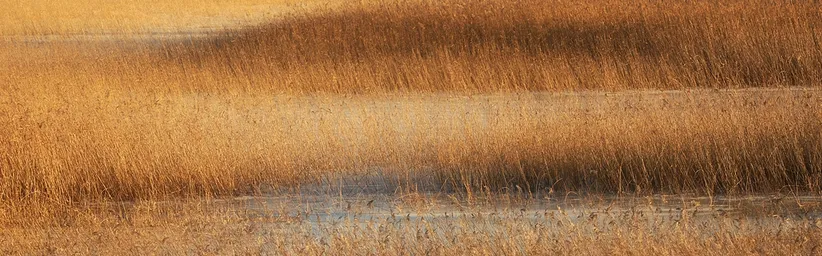
Photo: Rudi Kraševec
T.2.1 - Determination of the optimum marsh vegetation management regime
As part of task T.2.1 NRP and project partners will determine the optimal management of all types and subtypes of marsh vegetation of the HT 3180* with a precise definition of habitat type distribution. All the findings will be the basis for the economically efficient formulation of new Agri-environment schemes for managing marsh vegetation and adaptation of existing measures and the preparation of a detailed land management plan in the project area. Task T.2.1 is divided into four subtasks:
Purpose: ZRSVN and MKGP will analyse data on land use in the project area in the last five years and data on farmers' enrolment in agri-environment measures and other measures of the agricultural policy. We will identify the measures with a negative impact on the management of marsh vegetation and should therefore be changed. We will also include the experiences of 30 local farmers in the analysis of the state of existing management practices of marsh vegetation. We will perform interviews with these farmers.
Status: Task is in progress
We prepared the baseline documents that will serve as a basis for the development of agricultural measures for Lake Cerknica: Report on enrolment in agricultural measures since 2006 (NRP), Analysis of the extent and frequency of mowing in the project area in 2017–2023 (NRP), and Review of existing measures and rules applicable to Lake Cerknica that may have a positive impact on wetland vegetation (ZRSVN). The latter document also identifies measures and rules targeting wetland vegetation, as well as their shortcomings, which could potentially be addressed within the LIFE TRŠCA project.
Within the LIFE TRŠCA project, NRP has established a close and productive cooperation with the Faculty of Civil and Geodetic Engineering (FGG). Together, we developed a methodology and prepared the data required for the analysis of actual land use over the last five years. This represents an important achievement for NRP. NRP also prepared two scientific papers on the methodology: “Analysis of Sentinel-2 and PlanetScope time series for mowing detection at intermittent Lake Cerknica (2017–2023)”, published in the collection of papers Digital Connections, issued by GIS Day Slovenia, and “Simple land-use inventory – a case study of Lake Cerknica”, published in the journal Varstvo narave. NRP also co-developed a research poster on the history of mowing in habitats of key conservation bird species, which was presented by FGG at the Biospace Conference in Rome (10–14 February 2025). NRP conducted all 30 interviews with landowners and prepared a joint analysis.
Purpose: In this subtask, we will use a professional GPS device to determine the exact distribution of the different types of marsh vegetation on Lake Cerknica, assess each of them from an ecosystem perspective, and determine the optimal management method. We will also prepare an analysis of the ecological needs of the Red-necked Grebe (Podiceps grisegena) and the Ferruginous duck (Aythya nyroca). Experts from Poland will also be involved in the analysis and will visit Lake Cerknica to advise the project team in the field.
Based on all the collected data and analyses, a report on the optimal use of the marsh habitats will be prepared, which will be the basis for the preparation of the Management Plan (T.2.1.iv) and the design of agri-environmental measures.
Status: Task is in progress
NRP organised a workshop on the assessment of wetland vegetation types, attended by project partners DOPPS, UL BF, IZRK, ZRSVN and NRP. During the workshop, the different wetland vegetation types were defined and the project area was surveyed in the field. In autumn 2023, UL BF carried out field surveys of the wetland vegetation types and validated the data obtained through remote sensing using drone imagery. NRP prepared maps of the identified vegetation types.
On 6 February 2024, NRP and DOPPS organised a workshop at which Polish experts Janusz Kloskowski (University of Poznań) and Marcin Polak (University of Lublin) presented the ecological requirements of the target species, the Ferruginous Duck (Aythya nyroca) and Red-necked Grebe (Podiceps grisegena). The workshop was attended by representatives of DOPPS, NRP and ZRSVN. During two field visits, with the support of NRP and DOPPS, the Polish experts conducted sampling of benthic invertebrates at several locations, as these organisms represent an important food resource for the target species. This study was not originally foreseen in the project; however, it provides essential insight into the habitat conditions of the target species and will therefore constitute an additional project result and has been incorporated into the study of the ecological requirements of the target species. Preliminary results were presented at the international LIFE Amphicon conference (WP8). DOPPS conducted a literature review on the habitat requirements of the target species and prepared the final Study of the ecological requirements of Red-necked Grebe and Ferruginous Duck during the breeding period at Lake Cerknica, with contributions from Polak and Kloskowski. The study was updated in 2026.
NRP purchased a professional GPS device (RTK GNSS), which was used to determine the precise locations of individual wetland vegetation types and the exact locations of the experimental plots where different mowing regimes are being tested, based on the plan prepared by NRP (T.2.1.iii).
NRP prepared the Map of wetland vegetation types at Lake Cerknica. The first version of the document was prepared in March 2025; however, in 2026 it was substantially expanded and updated with new findings obtained through research conducted within the LIFE TRŠCA project.
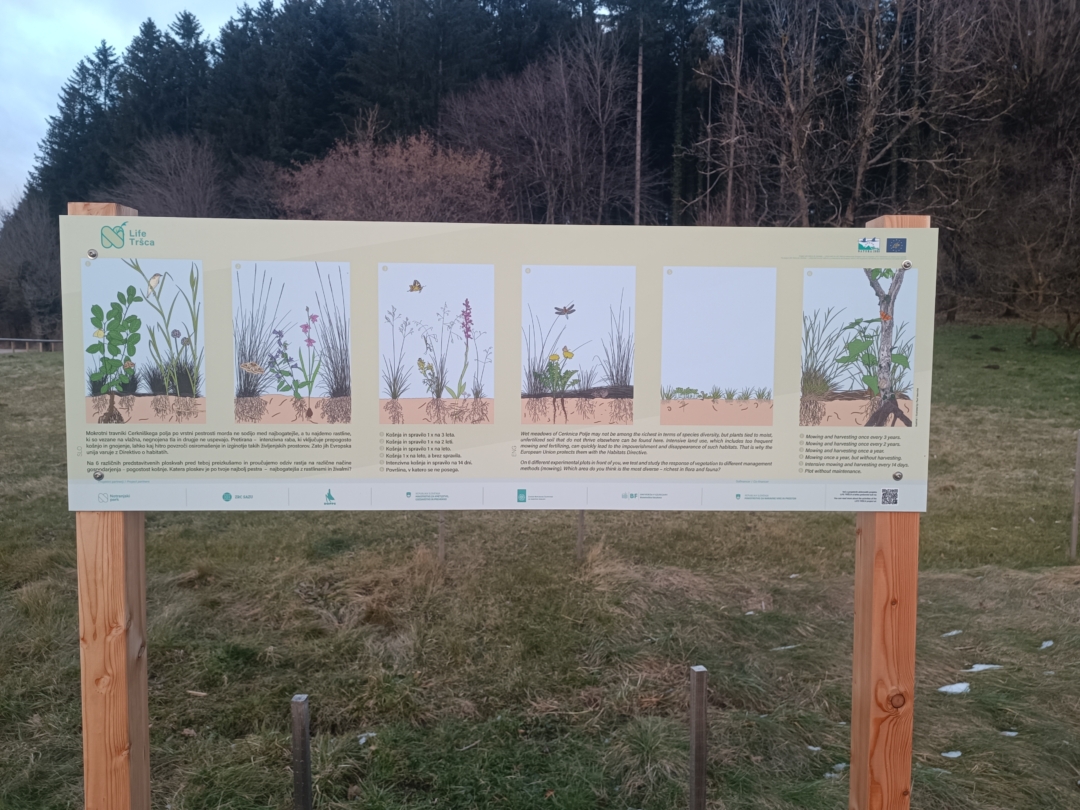
Purpose: NRP will set up a set of experimental plots in two locations to test different mowing regimes (no mowing, mowing once a year, mowing every two years, mowing every three years). Regular vegetation inventories will be carried out on these plots to monitor the response of the habitat and vegetation to the different management regimes. These test plots will also be useful as a teaching tool for different groups.
NRP will first prepare a detailed plan for the establishment and management of the test plots, then they will be marked on the ground and an information board with information on this sub-action will be set up.
Status: Task is in progress
NRP designed two different types of experimental plots: plots in Pretržje, intended for educational activities and demonstrating the effects of different mowing regimes on vegetation species richness; and research plots, intended to study changes in vegetation quality resulting from different mowing regimes. Vegetation surveys on the larger research plots were conducted by UL BF, while NRP conducted surveys on the smaller educational plots. The first year of testing was successfully completed and a report was prepared by NRP and UL BF. We printed 1,000 leaflets on the experimental plots and prepared an information board, which has been installed at the educational site.
The experimental plots consist of rectangular areas with uniform land use, with the actual dimensions adapted to the width and length of individual parcels, as well as square plots intended for educational purposes, with predefined dimensions of 3 × 3 m. A mown strip of at least 1 m in width is maintained around each plot. The strip provides access for visitors between the individual plots and enables discrete assessment of the condition of each square plot.
The land-use regimes follow a gradient of management intensity. The proposed management regimes are:
Mowing and removal of biomass once every 3 years.
Mowing and removal of biomass once every 2 years.
Mowing and removal of biomass once a year.
Mowing once at the beginning of the project, followed by no further mowing.
Intensive mowing and biomass removal every 14 days (only on the educational plot in Pretržje).
No management intervention.
Activities on the experimental plots will continue throughout the entire duration of the LIFE TRŠCA project, allowing the effects of different land-use regimes on habitat condition to be demonstrated more clearly over time. Each research plot is appropriately marked every year using coloured snow poles at least 250 cm in length.
Vegetation surveys are carried out on all plots before mowing, followed by the preparation of an annual report on the survey results and mowing activities.
We also prepared an information leaflet in Slovenian and English language explaining the purpose of testing different mowing regimes. The educational plot in Pretržje has also been marked on site with an information board.
Purpose: Based on data gathered in all the above-mentioned activities, we will prepare a detailed management plan for each land plot in the project area. The implementation of that plan will ensure optimal conditions for different marsh vegetation types as well as populations of target bird species.
Status: Task is in progress
Results:
MILESTONE: First draft of the management plan for the project area prepared.
T.2.2 - Formulation of new and revision of existing agricultural policy measures for the Lake Cerknica area
Main objective of T.2.2. is to formulate new and revise existing Agri-environmental and other measures of Agricultural policy for the preservation of marshland habitats of the intermittent lake (HT 3180*). The measures for marsh vegetation will be placed in the next Strategic Plan for the period 2028-2034 and implemented into the new financial perspective of the Common agricultural policy after 2027.
Purpose: An expert group, established in the scope of this subtask, will formulate new and revise existing Agricultural policy measures proposals for the preservation of marshland habitats of the intermittent Lake Cerknica. The expert group will be composed of representatives of all project partners, representatives of the Agricultural Advisory Service, the Agency for Agricultural Markets, local agrarian communities, and hunting societies.
The expert group will take part in two trips abroad to visit organizations with experience in designing agricultural measures. The aim of the trips will be an exchange of information. The group will also prepare an adjustment of the currently valid VTR measure for the corncrake.
Status: Task is in progress
Since November 2023, 15 informal meetings have been held with potential members of the Expert group for land management (SSRZ). At the initiative of three common land communities and the Fishing Association Cerknica, the LIFE TRŠCA project was presented at three meetings of the Management Boards of common land communities and at one General Assembly of fishermen.
In March 2024, 14 representatives were confirmed as members of the Expert Group: six representatives of common land communities, three representatives of hunting associations, one representative of the fishing association, three representatives of the Agricultural Advisory Service and one representative of the Agency for Agricultural Markets and Rural Development (ARSKTRP).
Already in 2024, preparations of materials for consultations with the Expert Group began. These included the Review of good practices for the conservation of wetland vegetation in EU Member States (prepared by ZRSVN and reviewed by NRP). ZRSVN also prepared a presentation on the Common Agricultural Policy (SKP) and the formal framework for the preparation of new agri-environment measures for the project partners.
In parallel, regular meetings of the Working Group on Farming in Protected Areas, organised by the Ministry of Agriculture, Forestry and Food (MKGP), were held on agricultural measures. NRP participated in these meetings, which focused on the preparation of measures for the next programming period. NRP also participated in the LIFE Platform meeting in Brussels focusing on results-based SKP measures, where valuable information and experience relevant to the development of agricultural measures were obtained (WP8).
Results:
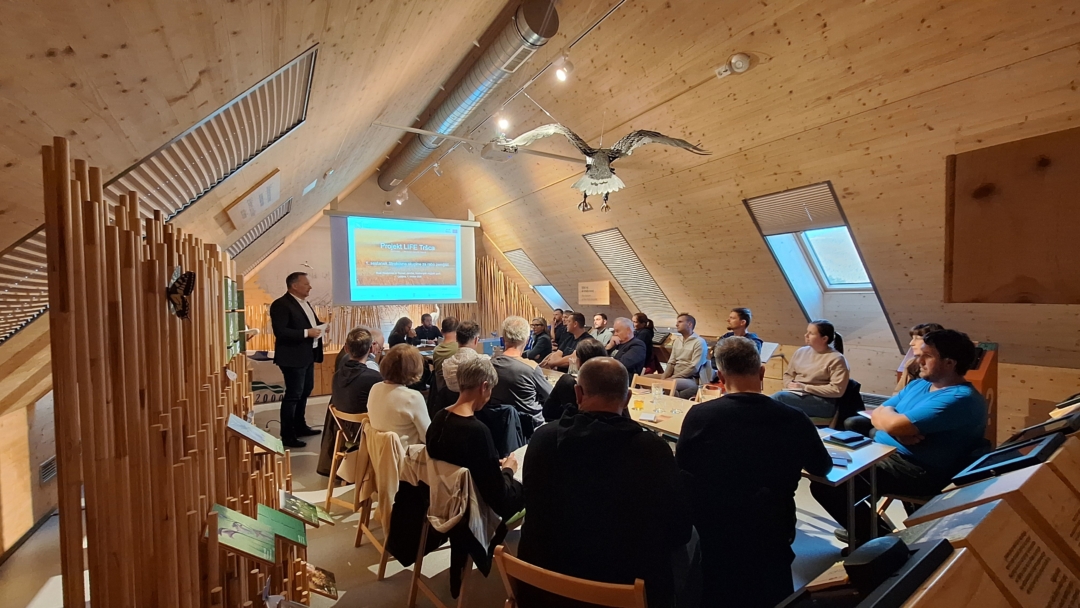
The first meeting of the Expert group for land management was held on 1 October 2025. The agenda was as follows:
Welcome address by Leon Kebe, Director of NRP
Welcome address by Ana Gabrejna Fajdiga, LIFE TRŠCA Project Manager
Introduction of the members of the Expert group
Presentation of the challenges related to agricultural policy measures and nature conservation at Lake Cerknica (Tomaž Jančar)
Any other business: discussion of dates for the following meetings
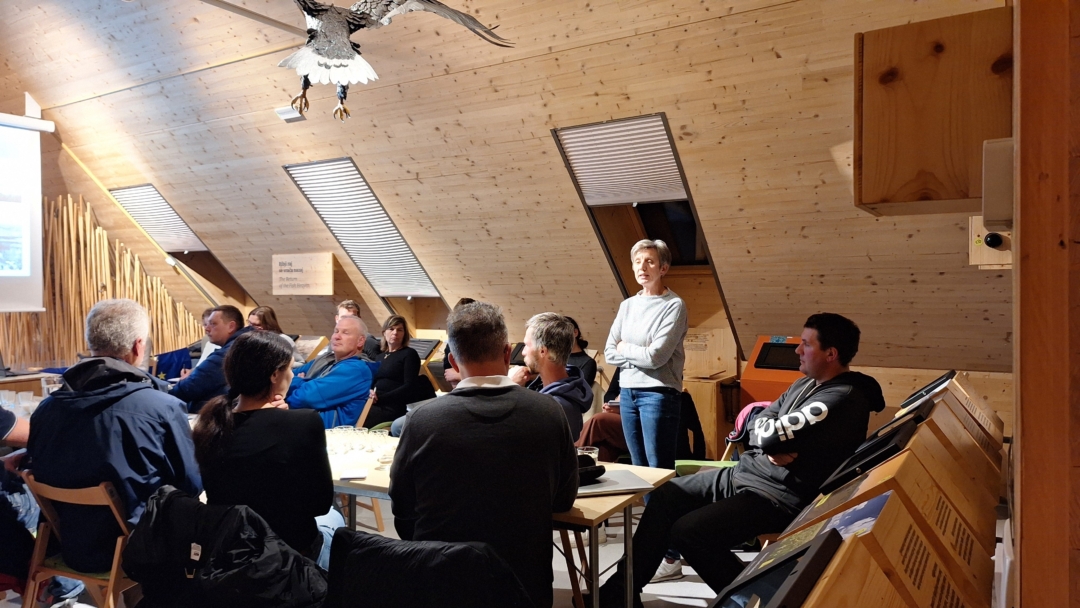
At the first meeting, the members of the SSRZ introduced themselves and discussed the issues surrounding agricultural policy measures and nature conservation at Lake Cerknica.
The second meeting of the Expert group for land management was held on 12 November 2025. The agenda was as follows:
Objectives of the work of the Expert group for land management – 10 min (Tomaž Jančar, NRP)
Review of the existing CAP rules applicable to Lake Cerknica – 20 min (Mateja Žvikart, ZRSVN)
Agriculture in the Municipality of Cerknica – 10 min (Magda Doles, Agricultural Advisory Service, Ljubljana)
Analysis of enrolment in agri-environment measures at Lake Cerknica, 2006–2025 – 20 min (Rudi Kraševec, NRP)
Results of the survey on the management of wetland vegetation – 10 min (Damjan Intihar, NRP)
Satellite analysis of mowing at Lake Cerknica, 2017–2025 – 20 min (Rudi Kraševec, NRP)
At the second meeting, a representative of the local Agricultural Advisory Service (KGZ Ljubljana) also spoke about agriculture in the Municipality of Cerknica.
The third meeting of the Land Use Expert Group was held on 17 December 2025. The agenda was as follows:
Summary of the second Expert Group meeting (Tomaž Jančar, NRP, 5–10 min)
Effects of mowing on wetland vegetation (Igor Zelnik, Faculty of Biotechnology, University of Ljubljana, 15–20 min)
Effects of water levels and water-level fluctuations on wetland vegetation (Aleksandra Golob, Faculty of Biotechnology, University of Ljubljana, 10–15 min)
Map of vital reedbeds based on satellite imagery analysis (Nik Ojdanič, Faculty of Biotechnology, University of Ljubljana, 10 min)
Effects of mowing on Allium angulosum and draft agri-environment measure for its conservation (Jošt Stergaršek, NRP, 10–15 min)
Changes in Lake Cerknica water levels over the decades and the influence of climate and human interventions (Matej Blatnik, Karst Research Institute, 15–20 min)
At the third meeting, representatives from the Faculty of Biotechnology and the Institute for Karst Research discussed wetland vegetation and water levels.
The fourth meeting of the Land Use Expert Group was held on 5 February 2026. The agenda was as follows:
Summary of the third Expert Group meeting (Tomaž Jančar, NRP, 5–10 min)
Effects of mowing at Lake Cerknica on birds (Dejan Bordjan, DOPPS, 20 min)
Corn Crake and its habitat at Lake Cerknica and the VTR measure (Tomaž Jančar, NRP, 15 min)
Effects of mowing on waterbird breeding (Rudi Kraševec, NRP, 10 min)
Ecological requirements of the Ferruginous Duck and Red-necked Grebe (Matej Gamser, DOPPS, 15 min)
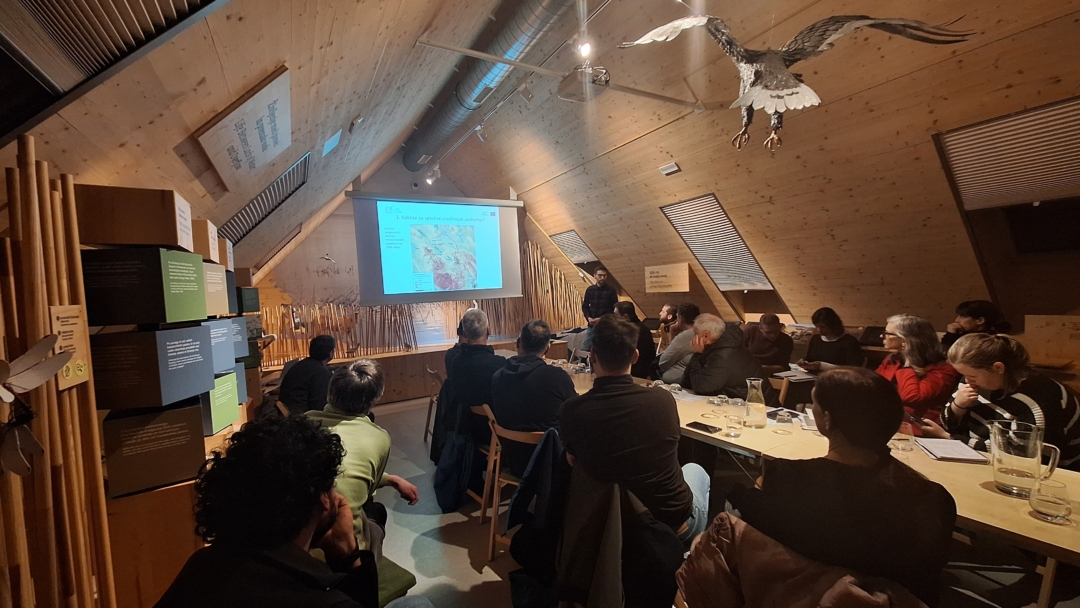
Results of the waterbird survey (Rudi Kraševec, NRP, 15 min)
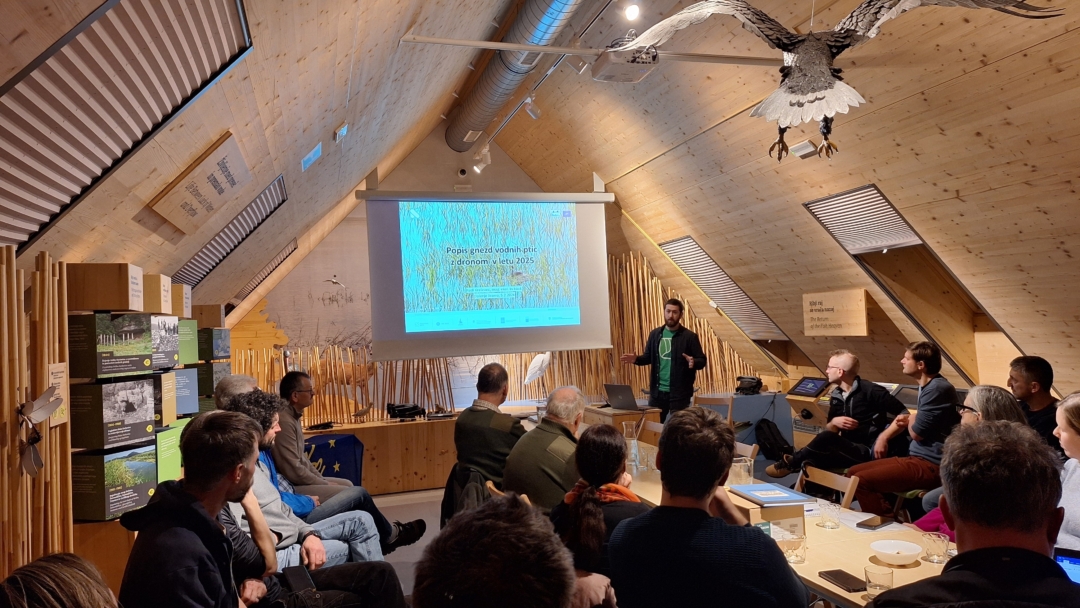
The fourth meeting focused on birds. In the photograph, NRP colleague Rudi Kraševec is presenting the results of the waterbird nest surveys carried out using a drone.
Purpose: Several different materials are needed for the appropriate formulation of new/revised Agricultural policy measures. These materials will serve as starting points and will be prepared by the project partners as part of this task, namely:
material on the impact of mowing on reed beds, tall sedges, and other marsh vegetation,
material about the impact of mowing of reedbeds and other marsh vegetation on birds,
overview and analysis of related Agricultural policy measures from other EU countries,
material on the impact of water regime/fluctuations on marsh vegetation,
material on the economic aspects of mowing the marsh vegetation.
Status: Task is in progress
Reports have been received from the external contractors, the Bulgarian Society for the Protection of Birds (BSPB) and the Chamber of Agriculture and Forestry of Slovenia (KGZ Murska Sobota).
The partners prepared reports assessing the impact of mowing on wetland vegetation and birds, as well as the impact of water-level fluctuations on wetland vegetation. The reports on the impact of mowing on reedbeds, tall sedge communities and other wetland vegetation, and the report on the influence of hydrological conditions on wetland vegetation, were consolidated into a single body of material. This integrated approach provides a more comprehensive assessment of the factors affecting wetland vegetation at Lake Cerknica.
Purpose: Agricultural policy measures proposals will be formally adopted in national legislation of Common Agricultural policy.
Status: Task is in progress
Results:
In cooperation with the Institute of the Republic of Slovenia for Nature Conservation (ZRSVN), NRP contributed to making the new agri-environment measure “Wetlands and bogs” (MOKR_BAR) available for enrolment from 2024 onwards also in selected areas within the LIFE TRŠCA project area. The measure allows mowing of wetlands only every second year.
As a result, already in the first year, farmers enrolled 88 ha of land in the measure. This represents an important achievement, as these areas are predominantly located in reedbeds that had previously been mown regularly. In 2024, these areas therefore remained unmown, which is expected to significantly improve the habitat conditions for the target waterbird species and contribute to improved reedbed vitality in these areas.
Purpose: We will carry out a series of activities to inform local farmers and landowners about future changes and to encourage them to apply for the newly created measures.
Status: Not due yet
Results:
LIFE TRŠCA
With LIFE TRŠCA we will improve the conservation status of the intermittent Lake Cerknica.
The implementation of extensive nature conservation projects exceeds the financial capacity of the local community, therefore Notranjska Park regularly applies for projects with the possibility of co-financing by the European Union.
The implementation of large-scale conservation projects exceeds the financial capabilities of the local community, therefore Notranjska Park regularly applies for projects with the possibility of co-financing from the European Union.