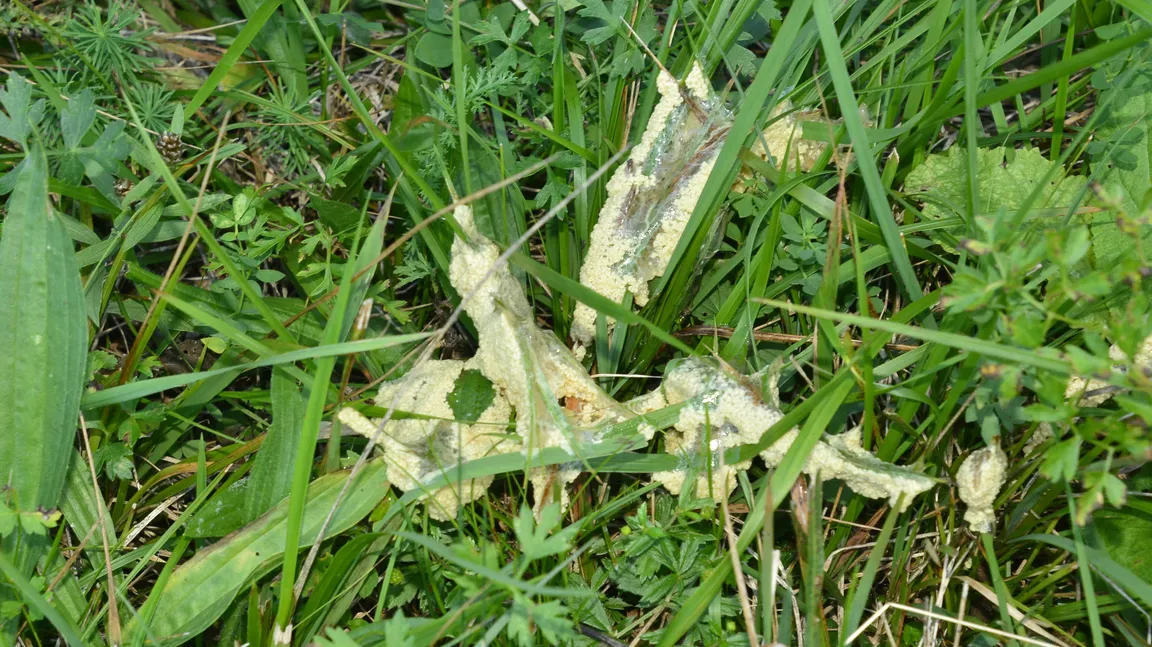
When the autumn air becomes humid and the ground still radiates the warmth of late summer, something unusual begins to appear from tiny cracks in the earth—a slimy, yellowish mass that slowly spreads across the grass. It is neither a fungus, nor a plant, nor a bacterium. It is a slime mold, an organism from the class Myxogastria, scientifically named Mucilago crustacea – the Dog Sick Slime Mold.
It is a plasmodium – a single, enormous cell with a multitude of nuclei that can move across surfaces in search of bacteria and organic particles to feed on. When it is warm and humid enough, the plasmodium leaves the soil and spreads across grassland plants. At that point, we see it as a pale yellowish to creamy mass, similar to someone spilling a thick liquid.
After a few hours or days, this mass begins to change—it turns white and dry, and a thin crust forms on the surface. Meanwhile, spores, tiny black grains that are scattered by the wind, mature inside. When this happens, the slime disappears – only a dark patch of dust remains, a silent reminder that something unusual was "breathing" there not long ago.
Although its appearance may seem eerie, the slime mold is completely harmless. It does not infect plants or cause damage – it is simply part of the natural cycle of decomposition, in which it plays an important role in breaking down organic matter in the soil.
And yet ... when you see it in the middle of a meadow after a warm night, in the pale light of dawn, it seems as if you are witnessing something ancient – a formless creature that moves, feeds, and disappears without leaving anything behind except traces that it was really there. At first glance, one might think that someone had vomited in the middle of the meadow during the night.