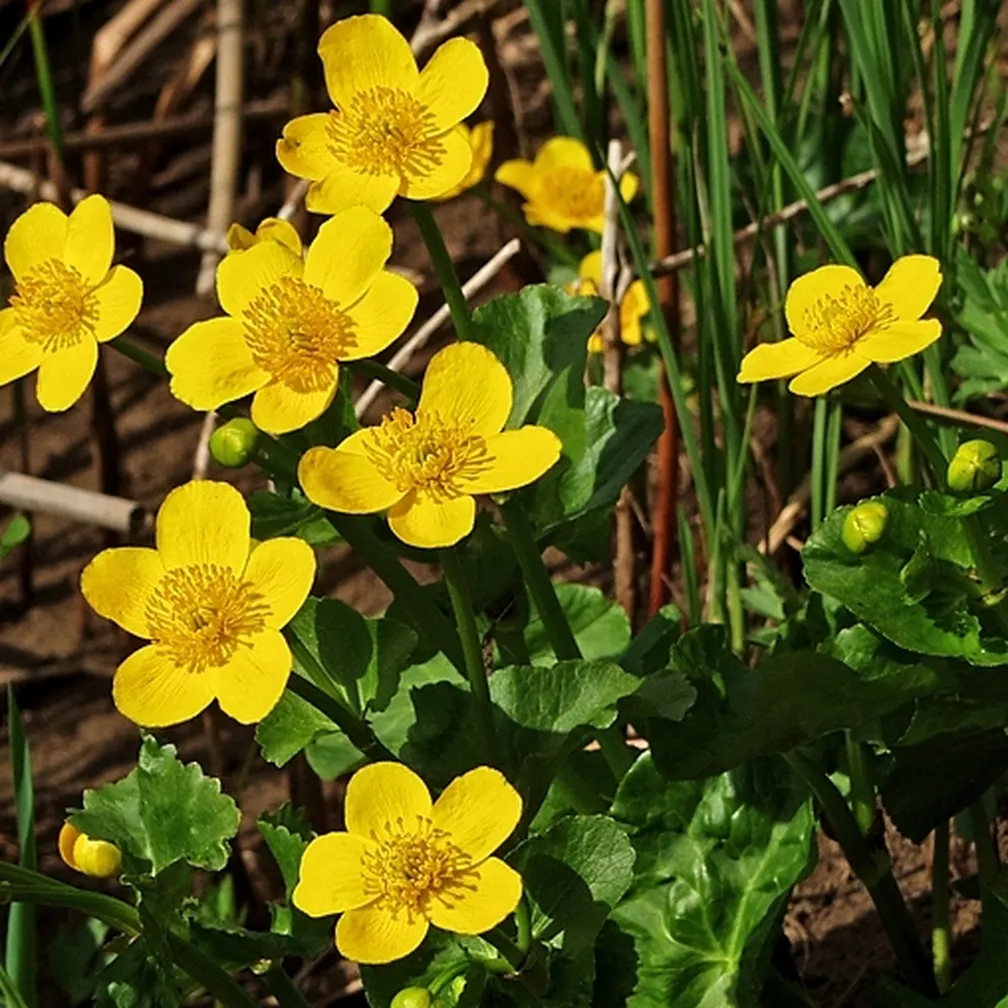

Buttercups (Ranunculaceae) are mainly herbs, perennials or annuals. Rare among them are woody climbers. Around 2000 species mainly inhabit the temperate zone of the northern hemisphere, in our region about 100 occur. They have alternate (spiral) arranged stem leaves, which are often divided. An exception are sroboti, which stand out with their oppositely arranged leaves. Hermaphroditic flowers (in one flower the female – pistil and male reproductive structures – stamens) of bright colours bear numerous stamens and one to many pistils.
Flowers are formed differently. Originally they are star-shaped (teloh, zlatica and vetrnica), in some genera (orlica, preobjeda) two-sexed flowers have developed. The floral mantle of buttercups can be single or double. They are characterized by a variety of fruits.
Predominantly they are capsules (dry fruits that arise from a unilocular ovary; at maturity they open along the ventral seam and seeds are expelled from them; characteristic for the genus teloh and ostrožnik) and nuts (dry fruits whose seed does not open, hence the seed is dispersed together with it; as with zlatice and kosmatincih), less commonly they occur as berries and heads. Many genera of buttercups are poisonous due to their alkaloid content.